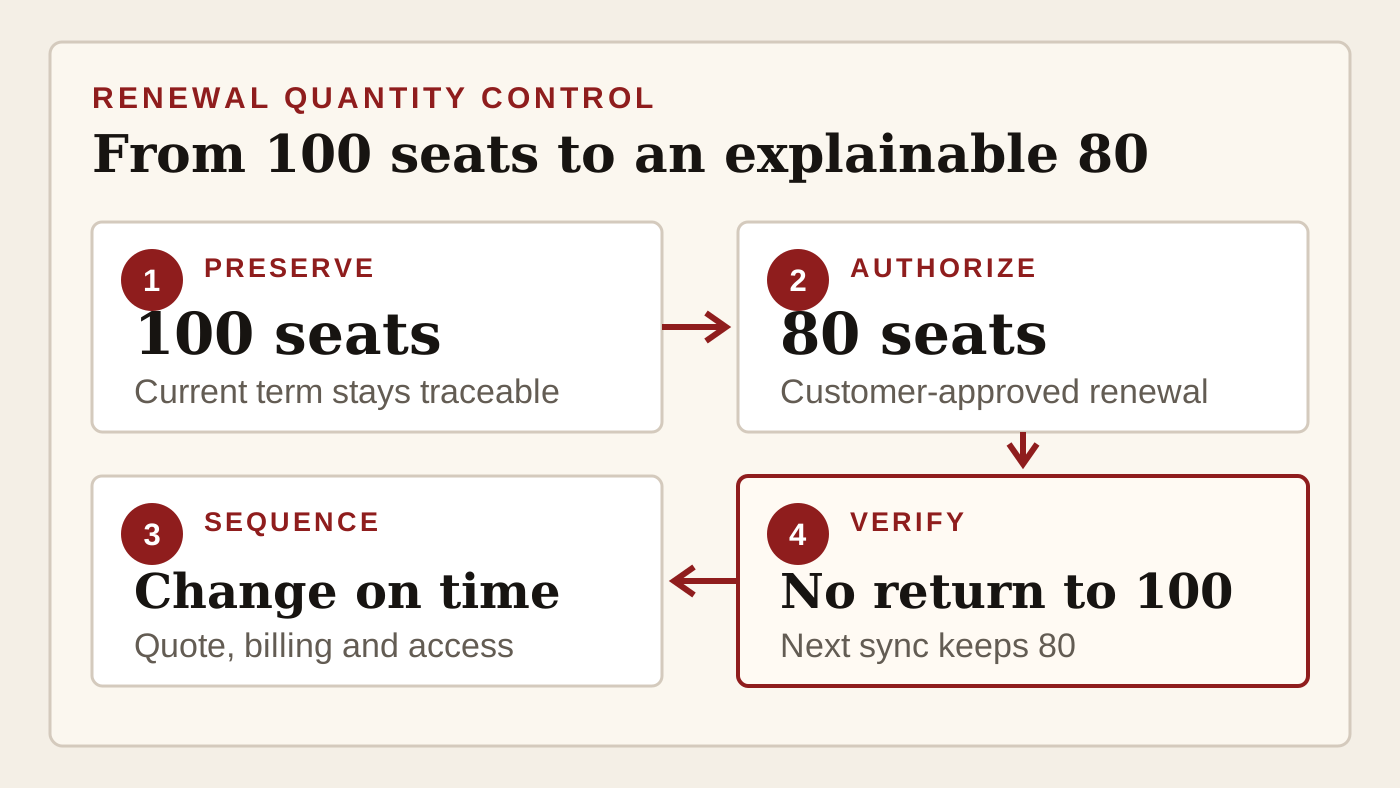
A customer agrees to renew 80 seats. The renewal opportunity shows 80 and the new quote prices 80. The billing subscription still carries 100. The product-entitlement table still grants 100. The Customer Success workspace reports 96 active users, while a CRM product line copied from the prior term remains at 100. Each number can be technically valid for a different moment. If the team chooses one without classifying it, a real contraction can become a billing error, an access incident, a forecast mismatch, or a misleading retention report.
RevOps should treat a quantity reduction as a cross-system commercial cutover. Preserve the prior term, capture the customer-approved future scope, name the effective date, separate purchased quantity from provisioned and used quantity, update each authorized record in order, and reconcile the first normal billing, service, forecast, and reporting cycle. The goal is not to force every system to display the same number immediately. It is to make every number explainable by meaning and time until the new term is active.
What to watch today
Watch for renewals described as seat reduction, license true-down, partial cancellation, product removal, lower tier, smaller volume, contracted capacity change, reduced workspace count, or scope adjustment. Prioritize changes close to a quote deadline, renewal date, billing run, forecast call, provisioning update, or Customer Success handoff. Also inspect accounts where the renewal amount fell but no line-level quantity changed, or where quantity fell while the total amount stayed flat because price, term, discount, or product mix changed.
The first warning is one quantity field with no type. A CRM property called seats can mean prior contracted seats, current billed seats, provisioned users, active users, minimum commitment, proposed renewal seats, accepted renewal seats, or forecast planning quantity. A value of 80 cannot drive a safe workflow until the field definition says which meaning, source, unit, product, and effective period it represents.
The second warning is an accepted quote that disagrees with the live subscription. That disagreement may be expected before the renewal effective date. It becomes a defect when the workflow cannot show whether the subscription should change now, at period end, after an amendment, or only after another approved event. The operator needs the old and new records plus the timing rule, not a bulk overwrite that makes the screens agree early.
The third warning is an amount-only correction. A seller can lower the opportunity amount without changing product lines. A discount can reduce value while quantity stays the same. A price increase can hide a seat contraction because total recurring value remains stable. Forecast and retention reporting need separate quantity, unit-price, discount, product-mix, and timing deltas before they can explain what changed.
Why RevOps should care
Quantity sits between the customer decision and several operating systems. It can affect the renewal opportunity, quote, approval, recurring amount, subscription, invoice, service access, entitlement, customer-health context, support expectations, commission input, forecast category, contraction reporting, and future expansion baseline. Those surfaces do not always update on the same clock or from the same writer.
HubSpot documents subscription records separately from line items and quotes. Its Line Items API exposes line-item properties and associations to deals and quotes. Its quote workflow connects buyer-facing commercial terms with deals and line items. Salesforce's official opportunity-products exercise shows quantity and sales price on products attached to an opportunity. Stripe separately documents subscription-item quantities and changes to subscription prices or quantities. These sources confirm that quantity can live in several record types with different lifecycle behavior.
The documentation does not decide which record is contractually binding, when service access should change, whether unused seats can be removed, how a credit or proration should be handled, how revenue should be recognized, or whether the customer accepted a smaller scope. Legal, Finance, Billing, Deal Desk, Customer Success, Support, Product Operations, and the commercial owner still need the approved business rule. RevOps should connect those rules to traceable fields, owners, and reconciliation checks.
CRM and workflow signals to inspect
- Account or company ID, legal entity, billing customer ID, subscription ID, contract or order ID, renewal opportunity or deal ID, quote ID, product and price ID, line-item ID, entitlement ID, workspace or tenant ID, and stable cross-system association
- Prior term start and end, renewal effective date, customer notice date, quote issue and acceptance date, subscription period end, billing-cycle anchor, invoice date, access-change date, and the timezone used for each event
- Product, SKU, edition, tier, unit, quantity type, prior contracted quantity, proposed quantity, approved renewal quantity, billed quantity, provisioned quantity, entitled quantity, active or used quantity, minimum commitment, and overage rule
- Prior and new unit price, list price, discount, currency, billing frequency, term, recurring amount, one-time amount, tax context, proration treatment, credit treatment, and total commercial delta
- Opportunity stage, forecast category, close date, amount, contraction amount, renewal type, probability, manager judgment, and the exact line-level source used by the forecast or retention report
- Quote version, status, approval, signature or acceptance evidence, buyer-facing quantity, superseded version, amendment reference, and whether the quote is allowed to update the subscription automatically
- Subscription status, item quantity, current period, scheduled change, pending update, cancellation state, invoice status, last writer, sync status, and error or retry state
- Entitlement or service-access quantity, provisioned users, active users, pending removals, protected admins or service accounts, customer notification, access owner, and rollback path
- CSM, commercial owner, renewal owner, Finance or Billing owner, Deal Desk reviewer, Product or Provisioning owner, Support owner, data owner, forecast owner, and receiving owner acceptance
- Change request, customer evidence, decision source, prior values, approved values, effective time, changed-by identity, review state, post-change sample, reconciliation status, exception reason, and close condition
15-minute operator action
Choose the five most recent renewals where quantity decreased or where amount decreased and the product-line reason is unclear. For each renewal, capture the prior contracted quantity, accepted future quantity, product or SKU, effective date, active quote, opportunity product lines, live subscription quantity, entitlement or provisioned quantity, current usage context, owner, and next billing date. Do not change access, billing, forecast, or customer status during this first pass.
Classify every number as prior contracted, proposed, customer accepted, currently billed, currently entitled, currently provisioned, currently used, forecast planning, or unexplained. Then compare quantity, unit price, discount, product mix, term, and total amount. Mark whether the reduction is a confirmed contraction, a future-dated change, a pricing-only change, a product migration, an administrative correction, an incomplete amendment, or evidence unclear.
Choose one material mismatch. Name the record that proves the customer decision, the system that should change next, the effective time, the owner authorized to act, the downstream checks, and the rollback condition. The output is five classified renewal quantity changes and one controlled cutover decision. It is not an automatic account-wide seat reduction.
Build a quantity authority table
Create a small authority table by product and quantity type. For each field, record its meaning, unit, source system, source object, permitted writer, effective-time rule, downstream readers, and conflict route. Contracted quantity may come from a signed order or accepted quote. Billed quantity may come from a subscription item. Entitled quantity may come from a provisioning or license service. Used quantity may come from product telemetry. Proposed quantity may live on a renewal opportunity before the customer accepts it.
Do not select authority from whichever record updated most recently. A usage event can be newer than the signed agreement and still not define the purchased scope. A renewal quote can represent future terms while the current subscription remains correct for the active period. A CRM product line can be a planning record rather than an invoice instruction. Authority depends on the decision and time, not timestamp alone.
Keep the old and new quantities together during the transition. Store the source IDs, effective date, prior quantity, approved quantity, unit, product, reason, reviewer, and target records. Avoid a single seats field that changes early and makes the old term impossible to reconstruct. A dated before-and-after record lets forecast, billing, service, and Customer Success answer their own questions without inventing history.
Sequence the commercial and service cutover
Start with the customer-approved commercial record. Confirm the exact product, quantity, unit price, discount, term, currency, and effective date on the active quote, order, amendment, or other authorized source. Preserve superseded versions. If the accepted scope is ambiguous, hold the operational cutover and route the evidence gap rather than asking Billing or Product Operations to interpret a sales note.
Next, update the renewal opportunity and line-level forecast treatment. Separate the contraction caused by quantity from price, discount, product substitution, currency, and term. Record when the forecast reflects the expected future state and which report should continue showing the current term. A future contraction can be valid in the forecast before it is valid in current billing or service access, as long as the dates and definitions remain visible.
Then schedule the subscription or billing change through the supported and approved path. Stripe's documentation notes that changing subscription items or quantities can affect billing behavior and prorations. HubSpot and other CRM or commerce setups can use different subscription, quote, payment, and integration paths. Test the actual configuration, preserve the request and response, and confirm whether the change applies immediately, at period end, or on another scheduled date.
Finally, align entitlement and provisioning with the service rule. Do not remove access merely because the renewal opportunity shows a lower number. Confirm the effective date, protected users, admin accounts, active sessions, data retention, exports, support obligations, customer communication, and recovery process. When the customer must choose which users remain, make that a customer-owned implementation step with a deadline rather than an arbitrary automated deletion.
Reconcile the first normal cycle
After the effective date, compare the accepted commercial source, renewal opportunity lines, subscription items, invoice, entitlement, provisioned users, customer-success record, forecast snapshot, contraction report, and warehouse model. Explain every remaining difference by timing or purpose. Reopen the exception when an old integration restores 100, a quote update never reaches billing, an entitlement remains high without an approved grace period, or reporting counts both old and new lines.
Use one reconciliation row per product and term. Show prior quantity, approved quantity, billed quantity, entitled quantity, provisioned quantity, forecast quantity, effective date, source IDs, last writer, status, owner, and unresolved reason. Close only when the current numbers match the approved timeline, the customer-facing service is correct, the financial records are governed, and the next normal sync does not reverse the change.
Measure workflow quality with reviewed quantity changes, source coverage, records with clear quantity type and unit, on-time cutovers, unresolved cross-system mismatches, changes reversed by sync, access exceptions, billing corrections, duplicate lines, and forecast or retention restatements. These are operating measures, not universal benchmarks. A lower quantity can be a valid customer decision without proving poor health, bad service, or preventable churn.
Risks and limits
Do not use product usage as automatic permission to reduce contracted quantity or service. Low usage can support a customer conversation, but it does not establish the agreement, renewal intent, entitlement, billing instruction, or user-removal list. Likewise, unused licensed capacity can remain part of a valid minimum commitment. Keep usage evidence separate from the approved commercial source.
Do not let RevOps make legal, accounting, tax, revenue-recognition, pricing, credit, access, privacy, or contract decisions outside its authority. RevOps can expose the mismatch, preserve the trail, route the owner, control CRM and workflow evidence, and verify reconciliation. The responsible function must approve the business action under current company policy and platform behavior.
Do not build a heavy approval for every harmless seat correction. Focus the controlled review on customer-approved reductions, material value, active subscriptions, immediate billing or access consequences, forecast impact, multiple products, unclear effective dates, sensitive service accounts, or records that disagree. A simple pre-effective-date typo with one trusted source and no downstream use can follow a smaller correction path.
Platform editions, APIs, quote tools, billing configurations, entitlement services, product telemetry, and integrations change. Verify current documentation and test representative records in the target environment. The safe outcome is not one universal seat number on every screen. It is a renewal quantity whose commercial meaning, effective time, system authority, customer impact, forecast treatment, and post-change reconciliation remain inspectable from 100 to 80.
Related reading
How to track renewals across your CRM · Renewal management workflows · Trace every deal before retiring a CRM product · The quote trail behind a late-stage amount increase · The forecast review after a quote expires · Will your CRM correction survive the next sync? · Customer Success Operations · CRM data quality workflows · Sighub profile · HubSpot profile · Salesforce profile · Vitally profile
Source notes
These official sources support the workflow model and product concepts. They do not prove a specific retention outcome, benchmark, or vendor claim.
- HubSpot manage subscriptions: Official reference for subscription records, status, billing details, associated records, line items, and supported subscription-management actions in HubSpot.
- HubSpot Line Items API: Official developer reference for line-item properties, product references, quantities, deals and quote associations, updates, archival, and relationship handling.
- HubSpot create and send quotes: Official reference for quote records, associated deals and line items, buyer-facing commercial details, approvals, signatures, and payment-related quote workflows.
- Salesforce create an opportunity and add products: Official Salesforce exercise showing price-book selection and products added to an opportunity as opportunity product records with quantity and sales price.
- Stripe change subscriptions: Official reference for changing subscription items or prices and for the billing behavior, prorations, payment handling, and update choices that can follow a subscription change.
- Stripe set subscription quantities: Official reference for per-item subscription quantities and quantity updates in Stripe Billing. It supports the record model, not a decision about contracted or entitled scope.
Last updated: 2026-08-09