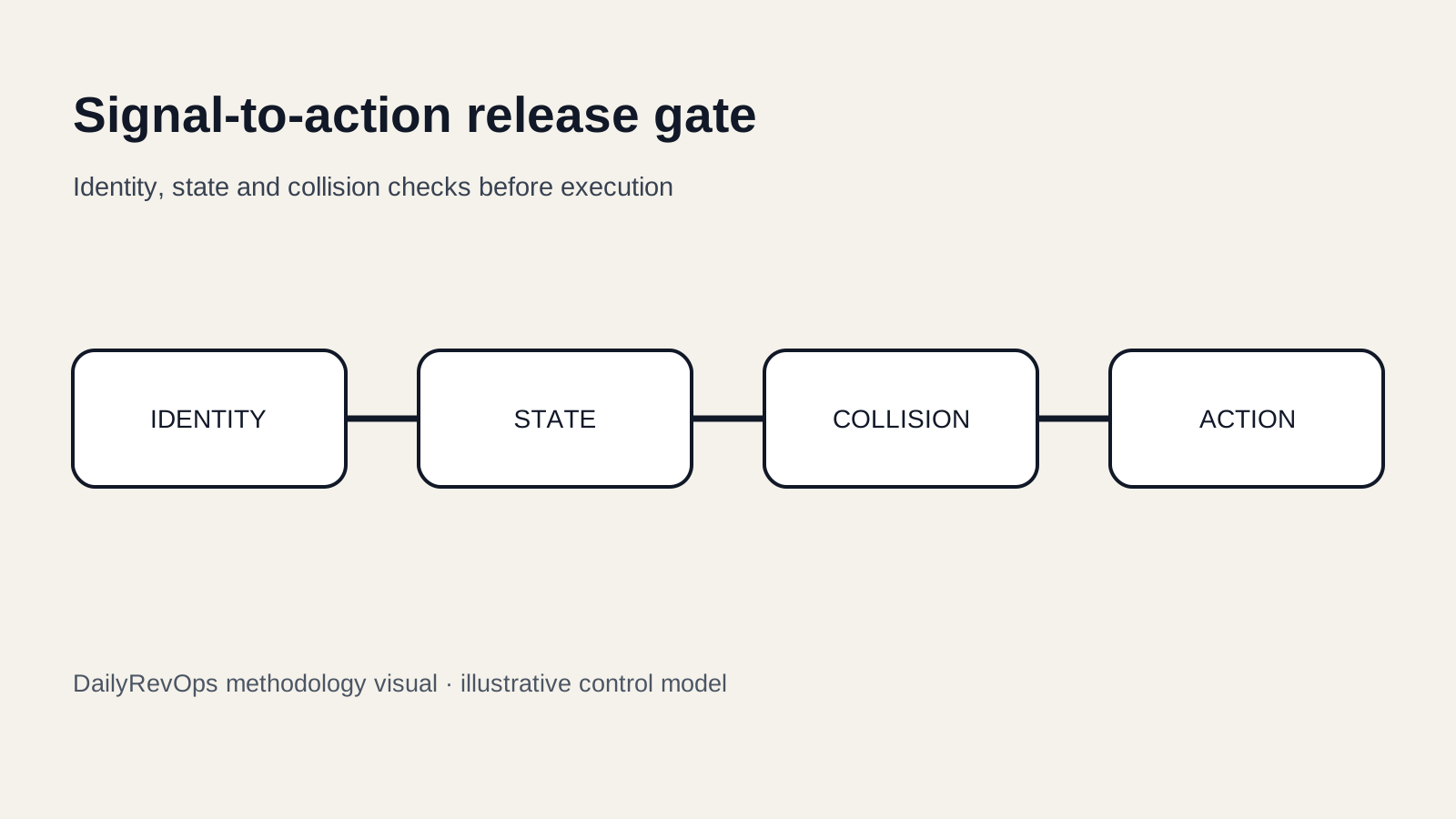
Problem
Signals and conversational interfaces can now trigger multi-system GTM work quickly. A correct signal can still produce the wrong business action when identity is ambiguous, state changed, another motion already owns the customer, a permission is too broad or a retry duplicates the action.
Why it matters
Recent UserGems, Demandbase and Close releases expand control surfaces for campaigns, orchestration and communications. RevOps needs a repeatable gate that keeps source evidence and action authority separate, tests difficult states and leaves an execution record outside the interface that initiated the work.
1. Name the action class
Choose one action class for the release: alert, task, CRM update, audience change, campaign enrollment, sequence enrollment, outbound call or another bounded effect. Do not approve a generic capability such as let the agent run outbound. The action class determines the consequence and therefore the evidence and permissions required.
Write the target grain and destination next to it. A company-level signal may not authorize a person-level email. An account play may create several provider actions. Keep the mapping explicit so one trigger cannot silently expand into a larger blast radius. Name whether the result is informational, internal-only, reversible or customer-facing.
2. Build the evidence contract
List every fact required to decide whether the action is allowed: source signal, stable account or person ID, owner, lifecycle state, open opportunity, customer status, consent or suppression, active campaign state and any commercial or support boundary. Name the authoritative system and maximum age for each blocking fact.
Keep optional context separate. An assistant can use public research or a transcript to improve a draft while the action gate depends only on governed identity and eligibility fields. Missing optional context can degrade gracefully; missing blocking evidence should stop or route to review. Preserve observed-at timestamps so a later operator can see which state was available when the decision ran.
3. Resolve identity before policy
Test clean and ambiguous identity cases before evaluating the signal. Include duplicate companies, parent-child accounts, contacts associated with several companies, merged records and records that exist in one system but not another. The workflow should produce an explicit exception when it cannot establish the target.
Store the chosen source IDs and association path with the decision. A later operator should be able to see why a signal from one system was attached to the CRM or campaign record that received the action. Do not let a confidence score hide unresolved identity when the next step is consequential.
4. Check collisions and current state
Immediately before execution, re-read the small set of fields that can invalidate the action. Then check whether an equivalent motion is already active: sequence, campaign, open task, customer communication, support escalation or another orchestration play. The check should happen close to execution rather than only when the signal first arrived.
Define precedence. A current customer-support escalation may suppress outbound prospecting; a human-owned opportunity may change who controls next contact; a recent owner change may invalidate a cached routing decision. Treat collision as a normal state with a documented owner, not an edge case that each automation resolves independently.
5. Limit execution authority
Use the smallest credential and action set that can perform the approved work. Separate read, draft, approve and execute where possible. A workflow that can read campaign state should not automatically be able to activate every campaign, and a phone number visible to an operator should not automatically be available to an automated voice agent.
Set rate, volume and population limits for the pilot. These limits are guardrails, not success metrics. Their job is to bound the blast radius while the team observes real behavior and exception patterns. Record the effective credential or integration identity with every executed action.
6. Force failure and retry cases
Test a source timeout, destination timeout, permission denial, stale signal, changed owner, newly suppressed person, duplicate action and partial multi-system success. Record which failures stop safely, which degrade to an informational result and which require operator reconciliation.
Retry the same execution key after a simulated timeout. Confirm the workflow recognizes an already completed business action or produces a safe idempotent result. A transport retry must not become a second customer touch or duplicate CRM mutation. Test the case where the destination committed the action but the response never returned.
7. Verify destination state
A successful request is not the same as a verified business result. Re-read the destination after execution and compare the actual state with the approved state. For a campaign action, confirm membership and status. For a CRM write, confirm the field or object history. For calling configuration, place a controlled test that exercises the intended routing or caller identity.
Keep partial results when several destinations are involved. If a CRM task was created but an advertising audience update failed, the workflow should expose both outcomes. Do not collapse a multi-system action into a single success flag that hides reconciliation work.
8. Approve with rollback and monitoring
Approve only the tested action class, population, integration identities and policy version. Store the release version, owner, monitoring query, exception queue and emergency stop procedure. If the workflow can be disabled, verify that disabling it does not leave already-created downstream work unmanaged.
After the first operating cycle, sample successful, blocked and corrected actions together. Promote scope only when the team can reconstruct source evidence, decision, authority, execution and outcome from durable records without relying on the initiating chat or visual builder. A high action rate is not evidence that the control boundary is working.
Step-by-step workflow
- Write one action class, target grain, destination and business owner.
- List authoritative evidence and maximum freshness for each blocking field.
- Create clean, ambiguous, stale, suppressed and collision test records.
- Resolve stable identity before any eligibility or scoring decision.
- Run read-only or draft-only and reconcile source evidence.
- Enable one reversible action with narrow credentials and volume limits.
- Re-read material state immediately before execution.
- Check active equivalent customer or CRM actions before writing.
- Force timeout, denial, duplicate, changed-state and partial-success cases.
- Retry one execution key and verify duplicate prevention.
- Read the destination after execution and compare actual with approved state.
- Record exception state and rollback outcome.
- Approve wider use only with a named monitor and emergency stop path.
CRM fields and signals needed
- Source signal ID, observed-at time, threshold and policy version
- CRM account/contact IDs and association confidence
- Owner, lifecycle/customer state, opportunity state, suppression and consent
- Active campaigns, sequences, tasks and customer communications
- Action class, execution key, credential identity and destination result
- Prior state, proposed state, approval or policy, rollback state and exception reason
Common mistakes
- Treating an intent or engagement signal as permission to contact a person.
- Letting the assistant choose a duplicate or ambiguous record silently.
- Checking eligibility only when the signal fires and not before execution.
- Giving one credential broad read and write access across unrelated workflows.
- Retrying after a timeout without checking whether the business action already happened.
- Keeping the only explanation of a production change inside a chat thread.
- Treating a partially completed multi-system action as either fully successful or fully failed.
Example operating rhythm
- Before launch: complete identity, stale-state, collision, retry and rollback tests.
- Daily in the first week: inspect successful actions, blocks, duplicates and partial failures.
- After any scoring, prompt, integration, permission or source-mapping change: rerun the representative cohort.
- Weekly: review collision reasons, stale evidence, blocked identities and manual corrections.
- Monthly: remove unused permissions, obsolete signals and duplicate workflows.
Tooling options
- Use the CRM or governed customer model for stable customer identity and durable action history.
- Use source platforms for the signals they originate and retain observed-at timestamps.
- Use agent or orchestration interfaces to propose and execute only inside the documented action contract.
- Use an exception queue for ambiguous identity, stale state, collisions and denied permissions.
- Keep a versioned release record and execution IDs outside transient conversation history.
Source notes
These sources support the workflow model and product concepts. They do not prove a specific business outcome, benchmark result, or vendor claim.
- UserGems MCP launch: Official September 18, 2026 launch.
- Demandbase Orchestration release: Official September 18, 2026 product announcement.
- Close phone management: Official September 17, 2026 product update.
Last updated: 2026-09-21
Decision frameworks to read next
FAQ
Does every signal-triggered action need human approval?
No. Low-impact, deterministic and reversible actions can be policy-approved after the release gate proves identity, current state, collision handling and duplicate protection. Higher-impact, customer-facing or ambiguous actions need stronger review.
What should stop execution?
Ambiguous identity, stale blocking state, missing required evidence, suppression or consent conflict, active higher-priority work, denied permission or an unavailable destination should stop any action that depends on that condition.
Why recheck state if the signal is fresh?
The signal can be fresh while ownership, customer status, opportunity stage, consent or campaign membership changed after the signal was observed. Action authority depends on current business state, not only signal age.
What is the minimum audit record?
Keep the source signal and time, target IDs, policy version, current-state check, action key, executing identity, destination result and exception or rollback state.