Audited operational data
CRM exports, pipeline snapshots, renewal reviews, field-completion reports, support/account data, and documented workflow audits.
Publishable: Yes, if sample, date range, fields, and limits are disclosed.DailyRevOps tracks RevOps operating signals only when the source, definition, and limitations are clear. This page explains what can be trusted, what stays unpublished, and how operators can check the same workflow inside their own stack.
A number is only useful when another operator can understand where it came from and what it actually measured. These tiers define how benchmark claims are handled.
CRM exports, pipeline snapshots, renewal reviews, field-completion reports, support/account data, and documented workflow audits.
Publishable: Yes, if sample, date range, fields, and limits are disclosed.Survey responses from RevOps, Sales Ops, CS Ops, and revenue leaders with clear respondent profile and definitions.
Publishable: Yes, if sample size, role mix, company size, collection window, and question wording are shown.Vendor documentation, public reports, official product pages, release notes, and cited third-party research.
Publishable: Only as attributed context, not as DailyRevOps benchmark truth.Uncited adoption numbers, scraped snippets without source, anonymous market-share claims, or AI-generated estimates.
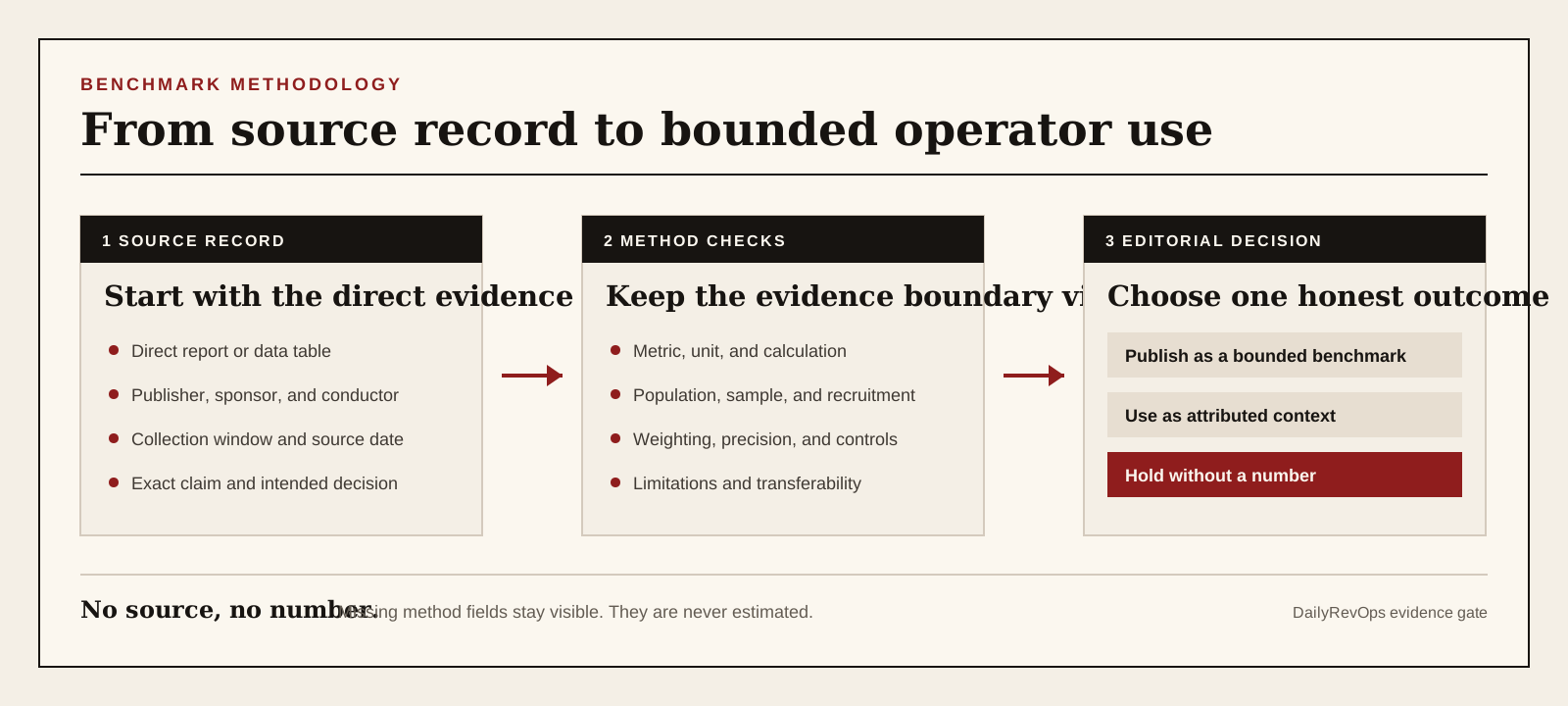
Publishable: No.A direct report can still be too weak for comparison. DailyRevOps completes this record before an external number can move from research notes into a public benchmark. The record separates what the publisher disclosed from what an operator might assume.
The survey fields follow the AAPOR disclosure standard. CRM extract fields add the lineage and workflow context needed for RevOps. An empty field is a visible limitation, not permission to estimate the missing method.
| Evidence field | Required record |
|---|---|
| Claim and direct source | Record the exact claim, direct report or data-table URL, publisher, research sponsor, research conductor, and funding source when different. A search snippet, recap, or vendor quotation is not the source record. |
| Metric and unit | Copy the metric definition, unit of observation, numerator, denominator, response options, and relevant question wording. State whether the result is record-weighted, account-weighted, revenue-weighted, or respondent-reported. |
| Population and eligibility | Name the target population, geography, company sizes, industries, roles, commercial motion, CRM or product cohort, and every visible inclusion or exclusion rule. |
| Sample and recruitment | Record completed sample size, sampling frame, probability or non-probability method, recruitment route, incentives, oversampling, quotas, response base, and uncovered population where disclosed. |
| Collection window and mode | Record the exact start and end dates, collection mode, language, extract timestamp where applicable, and whether the result is a snapshot, period measure, survey response, product-usage event, or mixed method. |
| Calculation, weighting, and precision | Preserve the calculation method, weighting variables, combined-source treatment, design effects, precision statement, and any model assumptions. If these are not disclosed, mark them missing rather than reconstructing them. |
| Quality controls and data processing | Record deduplication, validity checks, missing-data treatment, exclusions, imputation, bot or fabricated-response checks, coding method, and any human or automated quality review. |
| AI use and human validation | State whether AI helped recruit, interview, generate, clean, code, label, or estimate the data, which task it performed, and where a researcher validated the output. Unknown AI use remains a disclosure gap. |
| Limitations and transferability | Place the source's limitations beside the result. Add the DailyRevOps boundary: which RevOps teams, CRM workflows, segments, or operating models the evidence does not represent. |
| Operator decision | Name the decision the evidence can inform, the internal metric it should be compared with, the owner who should inspect the gap, and the action that could change. Do not turn descriptive evidence into a target without a matching population and method. |
Passing the source check does not automatically make a number a universal target. The publication outcome depends on whether another operator can see the evidence boundary and use the result for a defined decision.
Use only when the direct source, metric, population, sample, collection window, calculation, limitations, and operator use are visible. Keep the source boundary next to the number.
Use when the source is direct and useful but the cohort, commercial interest, weighting, precision, or transferability prevents an independent market comparison.
Use when a required evidence field is absent or only a secondary summary is available. Publish the measurement method or operator question instead of estimating the missing result.
DailyRevOps applied the full qualification record to Salesforce's direct 2026 report instead of copying a headline statistic. The report gives useful sample and collection context, but several fields needed for an independent benchmark remain undisclosed.
Decision: hold its numeric results as benchmark claims. Use the report only as vendor-attributed context for a clearly named cohort and operating question. Do not turn a reported result into a RevOps target or market average.
| Evidence field | What the report discloses | Gap or boundary |
|---|---|---|
| Direct source and commercial context | The official Salesforce Research PDF is the direct source. Salesforce publishes the report and has a commercial interest in sales technology and AI adoption. | A separate research conductor, funding statement, and independent sponsor are not named in the report. |
| Metric and response base | Charts name topics, response categories, and selected respondent groups. The report says comparisons use unrounded totals. | The complete questionnaire, exact wording for every claim, item-level response bases, skip logic, and treatment of non-response are not published together. |
| Population and sample | The report covers 4,050 sales professionals in 22 countries. It provides country, industry, company-size, and role distributions, including 1,022 Sales Ops respondents in a mixed sales sample. | The sampling frame, market coverage, screening rules, and populations excluded from the third-party panels are not disclosed. |
| Recruitment and collection | Salesforce describes an anonymous survey of third-party panelists conducted during August and September 2025. | Exact field dates, invitation and recruitment route, survey mode, languages, incentives, completion rate, and response rate are not stated. |
| Calculation, weighting, and precision | The report explains that displayed totals can differ because of rounding and that comparison calculations use unrounded totals. | Weighting variables, quotas, design effects, margins of sampling error, uncertainty intervals, and cross-country combination rules are not disclosed. |
| Quality controls and research-process AI | No survey quality-control or research-process AI disclosure was found in the report methodology pages. | Deduplication, respondent validation, attention checks, missing-data handling, bot or fabricated-response controls, coding review, and any AI-assisted research tasks remain unknown. |
| Limitations and transferability | The report identifies its mixed roles, countries, industries, and company sizes, and includes a general informational-use disclaimer. | A global mixed sales panel is not a direct proxy for one RevOps team, CRM environment, segment, or operating model. Vendor sponsorship also stays beside any attributed use. |
| Operator use and publication decision | The report can help operators form questions about sales AI workflows, data readiness, tool consolidation, and Sales Ops priorities before inspecting their own records. | DailyRevOps holds the report's numeric results as benchmark claims. They may be referenced only as vendor-attributed context with the disclosed cohort and method attached, not as a target or market average. |
No external product-usage number reviewed for this update exposed enough evidence to clear the publication gate. A vendor can have a large event store and still leave readers unable to identify the eligible population, exposure rule, instrumentation loss, tenant weighting, exclusions, or calculation. DailyRevOps therefore publishes the evidence contract, not an estimated statistic.
This contract separates product telemetry from survey answers and CRM extracts. It follows one event from its versioned schema through identity, exclusions, aggregation, quality review, and a reproducible release record. Snowplow's official documentation supports explicit schemas, validation, failed-event handling, and versioning. The W3C Data Quality Vocabulary supports keeping the metric, measurement, dataset, provenance, and fitness-for-purpose context distinct. Neither source supplies a RevOps outcome number.
| Evidence field | Required product-usage record |
|---|---|
| Measured event and schema version | Name the exact event, triggering action, required properties, validation rule, client or server producer, and schema version. A feature page view, button click, generated object, accepted output, and completed workflow are different events. |
| Unit of observation | State whether the unit is an event, user, seat, account, workspace, subscription, workflow run, CRM record, or time period. Explain how several events from one unit are collapsed before aggregation. |
| Eligible population and exposure | Define which tenants or records could have produced the event. Record plan, geography, platform, feature availability, rollout cohort, account age, active-status rule, permissions, and every exclusion. Enabled, exposed, active, and licensed populations are not interchangeable denominators. |
| Identity and deduplication | Document anonymous-to-known identity stitching, user-to-account association, merged accounts, shared users, retries, duplicate event IDs, late events, and cross-device handling. State which identifier wins when sources conflict. |
| Collection and extract window | Publish event-time and processing-time boundaries, timezone, lookback, extract timestamp, warehouse table or report version, and treatment of events arriving after the cutoff. Separate a point-in-time snapshot from a period measure. |
| Instrumentation coverage | Record supported app versions, browser or device gaps, blocked tracking, offline activity, integration outages, failed-event volume, backfills, and the date each schema version entered production. Unknown capture loss remains a limitation. |
| Internal, test, bot, and automation exclusions | State how employee tenants, sandboxes, demos, QA traffic, bots, imports, bulk jobs, API integrations, and automated retries are identified. Preserve excluded counts by rule instead of silently deleting them. |
| Calculation and aggregation | Show the numerator, denominator, query logic, minimum activity rule, percentile or average calculation, and whether the result weights every event, user, account, or unit equally. A large tenant must not dominate an account-level benchmark by accident. |
| Missing data, suppression, and privacy | Explain null handling, consent or opt-out gaps, deletion requests, privacy thresholds, small-cell suppression, regional restrictions, and any cohort removed before publication. Do not infer suppressed values or expose identifiable tenant data. |
| Quality controls and reconciliation | Reconcile event counts to a second source where possible, inspect failed events and duplicates, sample raw-to-modeled records, review material anomalies, and name the reviewer. Record unresolved differences beside the result. |
| Reproduction packet and change log | Preserve a versioned metric contract, query or transformation reference, schema versions, data snapshot identifier, code or query hash, exclusion counts, QA results, owner, approval date, and methodology changes. Publish enough metadata to audit the result without exposing private records. |
| Transferability and operator use | Describe the customer and product cohort the data represents, populations it misses, and the RevOps decision it can inform. Product telemetry from one vendor is not a market average and should not become a target for teams with a different workflow or instrumentation model. |
DailyRevOps is not publishing a coverage result here because no external data set reviewed for this update cleared the evidence gate. This contract shows the minimum information required to calculate the signal inside one operating environment without turning it into an unsupported market average.
The result is the eligible renewal records that pass every numerator rule divided by all eligible renewal records in the same extract. The page deliberately leaves the result blank until the population, extract, and limitations are available.
| Contract field | Required definition |
|---|---|
| Operator decision | Decide which active renewal records need data repair or an owner action before the next renewal review. |
| Unit of observation | One active customer renewal record. Do not mix accounts, contacts, opportunities, subscriptions, and tasks in the same denominator. |
| Eligible population | Renewal records inside the declared review window, using one documented renewal-date source and explicit inclusion and exclusion rules. |
| Numerator | Eligible records with a valid renewal date, accountable owner, current next action, and recent meaningful customer activity under the published definitions. |
| Denominator | All eligible renewal records in the same extract after documented exclusions. Missing fields remain in the denominator unless the methodology explains otherwise. |
| Collection window | State the extract timestamp, renewal review window, activity lookback rule, and timezone. Preserve the query or report version used for the snapshot. |
| Required fields | Record ID, renewal date and source, owner, renewal status, next action, next-action due date, last meaningful activity timestamp, and exclusion reason. |
| Source lineage | Record the source object and field names, association rules, report or query version, and whether each key value was entered manually, calculated, or synchronized from another system. |
| Quality controls | Document duplicate handling, invalid-date checks, merged-account treatment, spot checks against source records, and the reviewer who approved the extract before calculation. |
| Limitations | Disclose missing activity capture, duplicate renewals, merged accounts, manual overrides, source-system changes, and any cohort that the extract does not represent. |
A reproducible calculation can still create a false trend when its population, source fields, event schema, exclusions, weighting, or transformation changes between releases. Method changes belong beside the evidence, not in an internal footnote.
W3C PROV-O supports linking a release to its dataset, transformation, and responsible people or systems. It does not prove that a RevOps metric is representative or provide a benchmark number.
| Control field | Required release record |
|---|---|
| Stable metric identity | Give the metric a stable ID, named owner, purpose, and contract version. A renamed chart is not a new metric, while a changed population, formula, or decision can be. |
| Dataset and extract identity | Record source systems, source objects or tables, extract timestamp, timezone, snapshot or partition ID, and retention location. Preserve enough detail to distinguish a rerun from a different dataset. |
| Transformation identity | Record the report, query, model, or code version and a durable hash or revision. Name the numerator, denominator, joins, filters, deduplication, weighting, null handling, and exclusions used by that version. |
| Responsible people and systems | Name the data owner, calculation owner, reviewer, approving role, and material automated systems. Record who changed the contract and who accepted the release for operator use. |
| Change classification | Classify each change as editorial only, source correction, population change, definition change, calculation change, instrumentation change, or quality-control change. Explain why the classification was chosen. |
| Impact assessment | Recalculate at least one overlapping period or stable comparison cohort under the old and new methods where data permits. Separate operating movement from movement caused by the method change. |
| Series decision | Choose and record one outcome: continue the series, restate comparable history, show old and new series together, or start a new series. Never join incompatible points with an unbroken trend line. |
| Correction and withdrawal rule | Define when an error triggers a note, corrected release, historical restatement, or withdrawal. Preserve the prior release, correction reason, affected periods, approval, and correction timestamp. |
| Operator communication | Place the method change beside the result and name the decisions it affects. Alert the owner when a threshold, segment comparison, forecast, renewal queue, or performance review is no longer comparable. |
| Release evidence packet | Archive the metric contract, source snapshot reference, transformation revision, exclusion counts, QA and reconciliation results, impact assessment, approval, published artifact, and links between the entities, activities, and agents that produced it. |
Two correctly calculated results can still answer different questions. Keep them separate when the observation unit, eligibility window, CRM object, activity definition, weighting method, or missing-data rule differs.
Do not compare a renewal-record sample with an account sample, or a full customer base with only renewals inside an active review window.
Record: segment, CRM, commercial model, eligibility rule, and excluded cohorts.A strict all-fields-pass measure is not comparable with an average field-completion score. Name whether records, accounts, or revenue are weighted.
Record: formula, missing-data treatment, deduplication rule, and weighting method.A point-in-time CRM extract is different from a period average. Changes to field definitions, integrations, or activity capture can break a trend.
Record: extract timestamp, timezone, lookback, report version, and methodology changes.These checks protect the site from thin AI-copy, fake authority, and vendor-led claims being mistaken for independent research.
Our September 10 research protocol separates source evidence, the local decision, comparison, cost ledger, outcome chain, pre-registered measures and uncertainty. It does not turn a vendor survey response into a local financial result.
Our CRM research protocol follows a proposal through source evidence, review, the initial CRM write and a later reconciliation. It defines denominators and uncertainty without presenting invented performance numbers.
Our September 8 research protocol separates detection quality, owner follow-through and commercial outcomes. Sample flagged and unflagged accounts, retain unresolved cases, and report raw counts before calculating precision or recall.
Separate case journeys from assignment visits, preserve incomplete histories and examine transfer reasons before interpreting team-level waiting time.