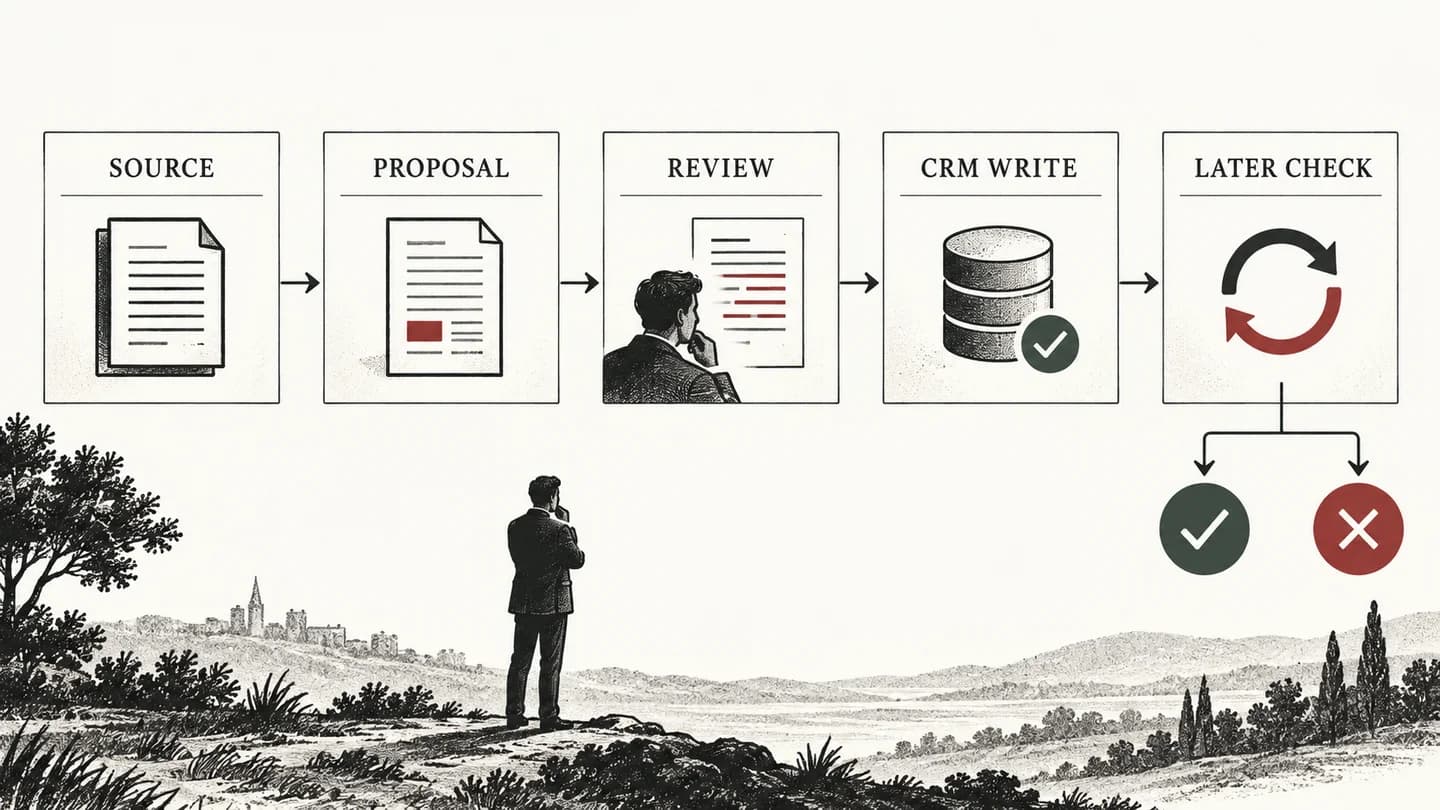
A tool can produce a plausible suggestion, receive a rep's approval and complete a CRM write while still leaving the wrong value on the wrong record. Those are different outcomes, and collapsing them into a single accuracy percentage prevents useful diagnosis. This protocol defines a local evaluation of conversation-derived CRM updates. It presents no observed sample, vendor ranking or industry target.
The evaluation unit is a field-level proposed change attached to one intended CRM record and one source event. Preserve related proposals under the same operation identity so that one conversation can contain several field changes without becoming several customer conversations. Keep a separate record-level view for actions that create or reassign records, because those actions can have consequences that a field accuracy score misses.
Freeze the evaluation contract
Before collecting results, list the included fields, record types, teams, languages, call types and observation period. Record the prompt or extraction configuration, mapping version, CRM validation rules and sync mode. Define which cases are outside the study. A pilot of next-step notes should not be presented as evidence about automatic forecast-stage changes.
Choose what counts as sufficient source evidence for each field. A directly stated date, a summarized pain point and an inferred buying role have different review requirements. Write the rubric before showing reviewers the generated answer. Otherwise the answer itself can shape the definition of correctness. Preserve uncertainty as an outcome rather than forcing every ambiguous case into correct or incorrect.
Follow the proposal through five observations
First record whether the source was available and usable. Next record the generated proposal and its intended record association. Then retain the reviewer decision where review applies. Observe the initial CRM write result. Finally inspect the value after the next relevant synchronization or business update, using a declared follow-up window. Each observation answers a different question and should retain its own timestamp.
The last observation is important because an initially correct write can later be overwritten by another legitimate system. Conversely, a later human correction can hide a poor initial result. Keep the sequence so that the study can distinguish these cases. Do not credit the generating tool for a value that became correct only after unrecorded manual repair.
Use denominators that match the question
Extraction coverage is the number of eligible field opportunities that produced an assessable proposal divided by all eligible field opportunities. Proposal correctness is the number supported by the rubric divided by assessed proposals. Report unassessable proposals separately. Reviewer acceptance measures a person's decision, not objective truth, so it should never silently replace the correctness measure.
Write success is the number of authorized attempted writes confirmed by the CRM divided by authorized attempted writes. Durable correctness is the number of initially verified changes still correct at the declared follow-up point divided by changes with completed follow-up. Report records not yet observed separately. These definitions are proposed measurement choices, not published performance estimates for any vendor.
Keep identity errors visible
A perfect sentence on the wrong opportunity is an operating failure. Track incorrect account, contact and commercial-record associations separately from incorrect field values. In a record with several open opportunities, a participant match may establish a customer relationship without proving which deal the conversation concerned. Include those ambiguous cases deliberately in the review population.
Record whether the system held the proposal, requested clarification or selected a record. An abstention may be the correct result when the evidence is insufficient. A study that penalizes every held case while ignoring wrong confident assignments will encourage unsafe behavior. Compare the action to the intended decision policy, not simply to the desire for more automatic completion.
Review a balanced, documented sample
Sample across the cases the intended workflow must handle, including missing evidence, unusual terminology, conflicting statements and changed CRM values. Also include routine calls so the study is not exclusively a stress test. State how the cases were selected and retain the eligible population count. A hand-picked demonstration set cannot establish an operating rate for the wider team.
Have a second reviewer assess a subset independently when resources allow. Capture disagreements before reconciliation and record the reason for the final decision. If reviewers repeatedly disagree on a field, improve its definition before adjusting the model or expanding automation. Report raw counts alongside rates, especially for small samples where one case can materially change the percentage.
Separate system behavior from business outcomes
Attention's documentation distinguishes fields derived from a single call from fields synthesizing multiple calls, and provides execution details for workflow runs. These are useful implementation distinctions to preserve in the study. The evaluation should not mix a current-call extraction with a deal-wide synthesis and then attribute differences only to model quality.
Technical success does not establish revenue impact, better forecasting or improved retention. Those outcomes need separate populations, observation periods and a credible way to distinguish the effect of the workflow from other changes. For this protocol, the useful result is narrower: whether the right authorized information reached the right record and remained correct through the declared follow-up.
Decide what to change from the failure pattern
If association errors dominate, repair identity rules before tuning prose. If proposals are supported but rejected, inspect the mapping, allowed values and validation boundary. If correct writes are later overwritten, resolve writer ownership. If reviewers cannot agree, revisit the field definition. A single blended score obscures each of these different interventions.
Publish the study with its scope, dates, sample counts, rubric, configuration versions, unresolved cases and follow-up coverage. State what the evidence supports and which fields remain review-only. Repeat the relevant portion after a substantive mapping or workflow change. The purpose of measurement is to choose a defensible operating boundary, not to manufacture a universal accuracy badge.
Compare outcomes at the correct grain across vendors
Use separate outcome definitions when a study covers more than one tool. A Clay enrichment result should be checked against independently supported identity and field values. An Attio workflow creating an Asana task should be checked for association, owner and duplicate creation. A Braze sync should be checked at the person-and-attribute grain. Counting all three as successful writes hides the difference between a correct fact, an accepted handoff and a usable audience attribute.
Create a common study ledger with source identifier, attempted operation, expected outcome, observed destination, review time and unresolved reason. Add product-specific evidence alongside that core. Preserve cases that never produced an output, not only records that appear in the destination. For a delayed sync, wait for the documented or locally agreed observation boundary before classifying absence as a permanent failure, and retain the actual elapsed time.
Run the same business cases through the current process and proposed process when feasible. Include ambiguous identity, stale input and a retry after interruption. Report each workflow’s raw counts separately before presenting an aggregate. If the product populations or error consequences differ, explain why a pooled rate would be misleading. A useful comparison shows where an operator must intervene and what evidence supports the intervention; it does not manufacture a winner by combining unlike units.
Source notes
These official sources support the workflow model and product concepts. They do not prove a specific retention outcome, benchmark, or vendor claim.
- Attention field configuration: Distinguishes single-conversation fields from deal fields that summarize linked calls, plus manual and automatic triggers.
- Attention workflow runs: Documents trigger, step, branch and failure inspection. Technical execution evidence is only one part of this protocol.
- HubSpot CRM API validation announcement: A successful or rejected write must be interpreted against the API version and configured validation boundary.
- Clay Credit Budgets: Official capability reference; the operating test is DailyRevOps analysis.
- Attio workflow apps: Official capability reference; the operating test is DailyRevOps analysis.
- Braze visual mapper: Official capability reference; the operating test is DailyRevOps analysis.
Last updated: 2026-09-10