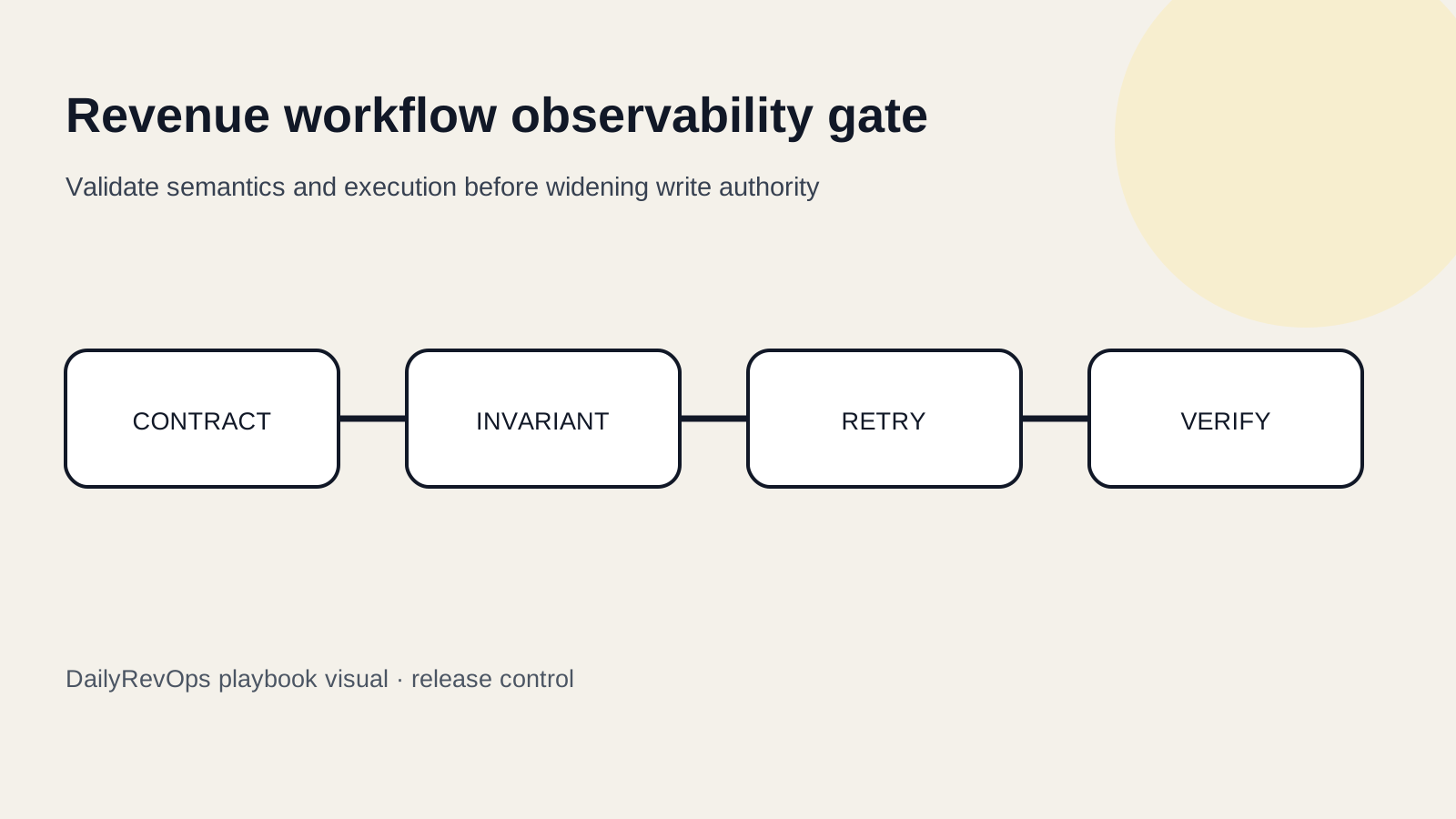
Problem
A workflow can be technically healthy while carrying the wrong business meaning. Successful API calls do not prove that a metric uses the intended denominator, a subscription amount uses the right currency, a renewal preserved its pricing model, or a write happened exactly once.
Why it matters
Intercom's custom metrics, Maxio's September corrections to billing/export semantics and Apollo's structured API errors all expose different parts of the same operating problem. RevOps needs a bounded release gate that validates meaning, execution and resulting state instead of treating successful transport as proof of correctness.
1. Name one durable business outcome
Choose one workflow and describe its final durable outcome in a sentence. Examples are assign the correct account owner, export the recurring subscription price in the subscription's currency, create one renewal-review task, calculate an email-only closure rate, or enrich one contact with verified company data. Avoid goals such as automate reporting or improve efficiency because they do not identify the business state that must remain true.
Record the consequence class. Internal informational reads, reversible internal writes, customer-facing communication, commercial fields, billing, entitlement and consent do not need identical controls. The release gate should be stricter when a wrong result can alter money, customer access, contractual interpretation or an externally visible action.
2. Write the semantic contract
For every material output, write what the field or metric means in business language. For a ratio, name numerator, denominator, filters, exclusions and time basis. For a recurring price, name the currency, pricing model, effective period and authoritative source. For a stage or owner, define which record and policy can change it. Put this next to the technical schema rather than assuming a field name explains itself.
Add an effective date and owner. If the definition changes, version it instead of silently editing the old description. Intercom's custom metrics illustrate why this matters: a reusable metric can apply team-defined filters and ratios across historical data. The calculation may be valid, but operators still need to know which definition governed a past decision and when that definition became official.
3. Map source authority and identity
List the stable business object IDs the workflow touches: company, contact, opportunity, subscription, component, conversation, cohort, invoice or task. Then map every material input to the system that owns it. A CRM can own current account ownership while billing owns recurring price, support owns conversation state and analytics owns observed product behavior. Combining context does not transfer authority between those systems.
Create at least one identity collision in the test set. Use two similar company names, multiple subscriptions for one customer, a merged contact or parallel opportunities. The workflow should either resolve the intended object through stable associations or return an explicit ambiguity. Choosing the first text match merely to keep the workflow moving is a correctness failure.
4. Define invariants before testing success
Write one or more invariants that must hold after the workflow runs. An exported recurring price must equal the active subscription price in that subscription's currency. A renewal must preserve both primary and secondary pricing rules. A support metric's numerator and denominator must match its documented population. A task creation request using the same business-action key twice must leave one task, not two.
Make the invariant independently checkable. Do not verify a transformed value by reading the same transformed output from another screen. Reconcile against the authoritative source or a separate query. Sample enough variation to cover currencies, pricing shapes, null values, permissions and record associations that the workflow actually sees in production.
5. Build a failure taxonomy
Separate authentication, authorization, invalid input, missing dependency, stale source, ambiguity, rate or capacity limit, transient transport failure, destination validation failure, unknown provider error and uncertain write outcome where relevant. Apollo's new error_details format is useful because stable machine-readable codes make these distinctions easier to automate, but the same principle can be implemented internally when a provider exposes only coarse errors.
For each class, define one policy: retry, repair input, refresh credentials, hold, route to review or stop. Generic exponential retry is not a policy for every failure. Invalid input will remain invalid. An authentication failure needs repair. An uncertain write may need destination reconciliation before retry. Unknown errors should surface rather than inheriting the nearest convenient behavior.
6. Prove idempotency and changed-state handling
Run the same action twice with the same stable action key and confirm that the business result is not duplicated. Simulate a timeout after the destination may have committed. The retry path should query or otherwise reconcile the destination before creating a second task, association, message or billing action. Store the resulting destination object ID when possible.
Then change a material source field between proposal and execution. Change owner, currency, pricing state, consent, stage or another field the action depends on. The workflow should re-read material state or reject the stale proposal. A release test that validates only the initial read cannot prove that a delayed execution still targets the state that was reviewed.
7. Test semantic failure, not only transport failure
Inject a technically valid but business-wrong value into a controlled test. Use the wrong currency, an outdated owner mapping, a denominator that includes the wrong queue or a pricing record from the wrong effective period. Confirm that an invariant or reconciliation catches it. This test is important because ordinary API monitoring will not: the request can return 200 and the payload can satisfy every schema rule.
Maxio's September 23 release notes are a concrete example of why this class deserves attention. The company documents corrections where exported recurring price could use the wrong currency semantics and renewed hybrid pricing could lose secondary pricing. The lesson is not to distrust one vendor; it is to recognize that semantic correctness needs its own control because transport success cannot detect it.
8. Decide how corrections propagate
Before launch, define what happens when an upstream vendor, mapping or internal rule is corrected. Decide whether historical data is restated, preserved as originally observed, or stored with both original and corrected values. Identify which downstream reports, queues, forecasts or customer actions need reconciliation. A full refresh and an incremental pipeline should not accidentally create different policies for the same correction.
Keep source version or release evidence for high-consequence fields. A vendor release note, API version, mapping commit or metric-definition version can be enough for a bounded workflow. The goal is not universal lineage. It is the ability to answer which records could have been produced under the old semantics and who owns the decision to repair them.
9. Verify the final destination
After each consequential write, verify the destination state. Capture prior value, resulting value, destination ID, checked-at time and reconciliation result. For an export, compare a representative sample with source records. For a metric, reproduce a small sample manually or with an independent query. For a task or CRM update, confirm the intended entity and state after the write completes.
Do not keep the only evidence in a transient agent conversation or workflow log. Store enough execution context in the system of action, an audit table or another durable operating record so the team can reconstruct the result after logs rotate. Include denied and held-back cases; a safe refusal is part of the control record, not noise to discard.
10. Expand authority only after representative cases pass
Approve the exact population, action type, source version and permission scope that passed. Start with read-only or a reversible internal action before customer-facing or commercial writes. Keep an emergency stop path and name the person who can use it. Expansion should follow evidence from the tested workflow, not a general belief that the underlying platform or model is reliable.
After the first production cycle, review successful executions, denials, unknown failures, duplicate-prevention events and corrections together. A high success rate can hide silent semantic errors if the team reviews only failed jobs. Sample ordinary successes against the invariants too. The release gate is complete when the workflow can explain both why it acted and why the resulting business state is trustworthy.
Step-by-step workflow
- Describe one durable business outcome and its consequence class.
- Write the semantic definition for every material output, including units, currency, population and time basis.
- Map stable business IDs and authoritative sources for each required input.
- Create representative clean, ambiguous, stale, multi-currency and permission-limited test records.
- Write independently checkable invariants before running the happy path.
- Classify failures and assign retry, repair, hold, review or stop behavior to each class.
- Run the same business action twice and prove duplicate prevention.
- Change material source state between proposal and execution and require revalidation.
- Inject one technically valid but semantically wrong value and prove reconciliation catches it.
- Verify destination state after writes and preserve resulting object IDs.
- Document correction/backfill policy for a future source or vendor fix.
- Approve only the tested population, permissions and action class, with a stop and rollback owner.
CRM fields and signals needed
- Business object type, stable source ID, association IDs and target population
- Metric numerator, denominator, filters, exclusions, units and time basis
- Currency, pricing model, effective period, renewal configuration and source record
- Provider error code, internal failure class, request or execution ID, retry safety and attempt count
- Prior destination state, proposed state, action key, destination object ID and verified resulting state
- Source or workflow version, correction scope, reconciliation result, reviewer and reviewed-at timestamp
Common mistakes
- Treating HTTP success or job completion as proof of business correctness.
- Using a field name as the complete semantic definition for money, dates or ratios.
- Retrying authentication, invalid-input and uncertain-write failures with the same policy.
- Validating transformed data against another view derived from the same transformation.
- Testing only clean records and never forcing wrong currency, duplicate identity or changed-state cases.
- Backfilling corrected data without documenting whether historical values were restated.
- Keeping success logs but discarding held, denied and reconciled cases.
- Expanding agent or workflow permissions because read-side output looked fluent or plausible.
Example operating rhythm
- Before launch: run the complete representative cohort and reconcile every invariant.
- Daily during the first production week: sample successful outputs as well as failures and denials.
- After vendor release, schema, mapping, prompt, permission or API-version changes: rerun semantic and failure cases.
- Weekly: review unknown error codes, retry volume, duplicate-prevention events, stale-source holds and destination mismatches.
- Monthly: confirm metric definitions, source authority, currency and pricing semantics, unused permissions and backfill policies.
- After a silent correction: establish scope first, reconcile affected records, record the repair decision and add the case to regression tests.
Tooling options
- Use source systems for authoritative commercial and customer state; preserve source IDs through transformations.
- Use provider machine-readable error codes when available and map them to explicit internal policies.
- Use dry-run or preview modes for mutable operations where products expose them, such as Common Room CLI mutations.
- Use an exception queue for ambiguity, stale data, unknown failures and uncertain writes rather than forcing completion.
- Keep semantic definitions and representative test cases in version-controlled files close to the workflow they govern.
Source notes
These sources support the workflow model and product concepts. They do not prove a specific business outcome, benchmark result, or vendor claim.
- Intercom custom metrics: Official September 23 release describing reusable custom metric definitions and ratios.
- Maxio September 2026 Product Release: Official release record for billing, renewal and export changes used as semantic-failure examples.
- Apollo structured API errors: Official API changelog for machine-readable failure details.
- Common Room CLI: Official documentation updated September 23; every CLI mutation supports a dry-run preview.
Last updated: 2026-09-24
Decision frameworks to read next
FAQ
Does every revenue workflow need this full gate?
No. Match control depth to consequence. A read-only internal summary needs less evidence than billing, consent, entitlement, customer messaging or a commercial field. The gate is a menu of controls, with semantic correctness and destination verification strongest where a wrong result is expensive.
What is the difference between a schema test and a semantic invariant?
A schema test checks shape, such as decimal, date or required string. A semantic invariant checks business meaning, such as recurring price matching the subscription's actual price in the subscription's currency. A value can pass its schema and still violate the business invariant.
Should a transient failure always be retried?
Only when the operation is safe to retry. Reads usually are. Writes need an idempotency strategy or destination reconciliation because the destination may have committed before the client observed the failure.
When should a vendor correction trigger a backfill?
When affected historical values matter to current reporting, finance, customer state or another operating decision. First establish scope and downstream use; then choose whether to restate, preserve the original observation or store both with an explicit correction marker.