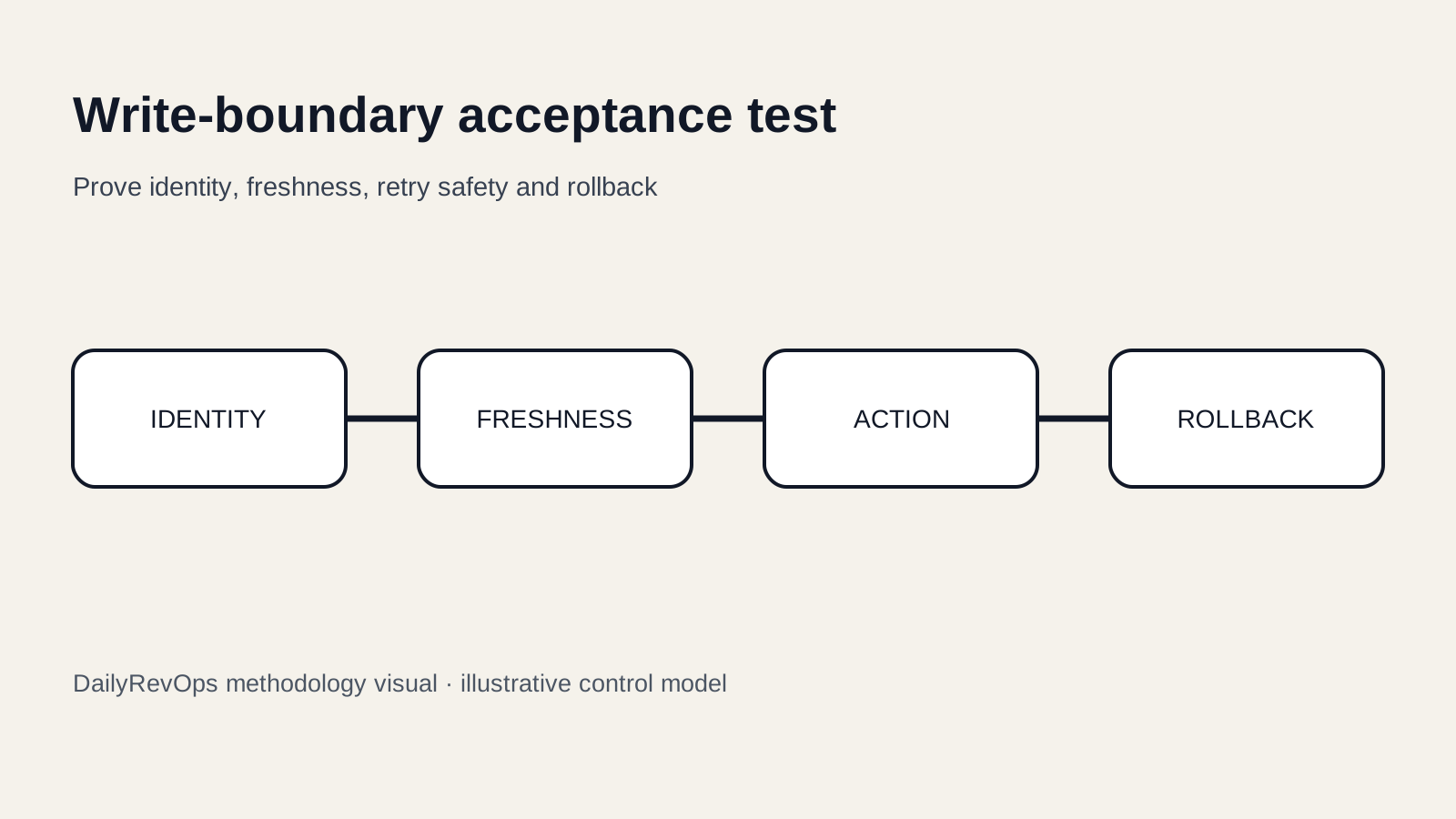
Problem
Agent interfaces can turn a natural-language request into a CRM or workflow mutation in seconds. The dangerous gap is between an apparently correct proposal and the actual write: the target may be ambiguous, material state may have changed, approval may no longer apply, a retry may duplicate work or the destination may accept a technically valid but wrong update.
Why it matters
Outreach's September release adds confirmation before Omni changes Prospect, Account or Opportunity records, while Hightouch's September changelog adds more precise destination lookup conditions. These product mechanics reinforce a general RevOps rule: prove the exact target and current business state immediately before a consequential write, then verify the destination afterward.
1. Name one write and one consequence
Choose a single mutation for the test: update an opportunity field, assign an account, create a task, enroll a person, change an audience membership, alter a routing rule or another bounded effect. Write down the business consequence, target object and system of record. Do not start with a broad capability such as let the agent manage accounts because it prevents a precise acceptance criterion.
Classify the write as internal-only, reversible, customer-facing, commercial or permission-changing. Consequence determines how much evidence and approval the release needs. A tagged internal task can tolerate a different review model from changing an opportunity amount, sending outreach or modifying customer consent state.
2. Build the target-resolution contract
List the stable identifiers and match conditions required to select the destination record. Include parent-child account rules, record type, active or archived state, owner constraints and any fixed conditions used by the integration. Define what zero matches, one match and multiple matches mean. Multiple plausible records should produce an explicit exception rather than an arbitrary first match.
Create at least one duplicate and one near-match test case. Use similar company names, merged contacts or records with the same external key under different record types. Confirm the agent or integration shows which ID it selected and why. The test passes only when the same deterministic rules resolve the same target without depending on a conversational guess.
3. Name the blocking current-state fields
Write the smallest set of facts that can invalidate the proposed action after it was created. Common examples are owner, lifecycle stage, customer status, open opportunity, suppression, consent, record version, account assignment, active campaign membership and billing or contract state. Give each field an authoritative source and a maximum acceptable age.
Do not make freshness a generic requirement to reload everything. Re-read only the fields that matter to the action. This keeps the checkpoint fast enough for normal operations while preventing a proposal from executing against materially changed state. The release record should show which facts were checked and at what time.
4. Make the approval surface inspectable
Before the write, present the target record, prior value, proposed value, evidence or policy that justified the change, execution identity and downstream consequence. If required information was collected through a form or agent survey, display the resulting values rather than only stating that missing information was resolved.
Ask the reviewer to approve the actual state transition, not the prose describing it. The same natural-language summary can hide different IDs or values. If the action is policy-approved rather than reviewed by a person each time, store the policy version and the exact checks that substituted for human approval.
5. Force a changed-state case
Generate an approval-ready proposal, then change one blocking field before execution. Reassign the account, close the opportunity, add suppression, archive the destination user or change the qualifying record type. Execute the old proposal and verify the system refuses it or re-evaluates against the new state. A write that proceeds using the original context fails this test.
Repeat with a non-blocking field to prove the checkpoint is not needlessly invalidating every proposal. The purpose is to protect material business state, not to force full re-approval after irrelevant edits. This distinction should be documented so operators know which changes expire an approval.
6. Test permission and execution identity
Run the action with the intended production identity and verify it has only the permissions required for the named write. Test a record outside the approved scope and confirm access is denied. If the agent can perform several action types, separate the permissions or policy checks so read access does not imply broad write authority.
Store the effective user, service key or integration identity on the execution record. When an action begins from Slack, mobile or another assistant, the initiating interface and the destination credential can be different identities. Incident review needs both: who requested the action and which credential actually changed production state.
7. Prove idempotency under an uncertain response
Execute the write with a stable action key, then simulate a timeout after the destination may have committed the change. Retry the same business action. The workflow should query or recognize the existing result instead of creating a duplicate task, enrollment, message or object. Record the final business outcome once, even if several transport attempts occurred.
Use business identity, not only request identity, for duplicate protection. A fresh HTTP request ID does not mean the customer or CRM action is new. The action key should represent the target, purpose and relevant time or version so the workflow can distinguish a legitimate later action from a transport retry.
8. Verify the destination, then test rollback
After a successful response, re-read the destination and compare the material final state with the approved proposal. Confirm object ID, field values, associations and any downstream status that the write was supposed to create. A technically successful request to the wrong record is a failed acceptance test.
Where the action is reversible, execute and verify the rollback. Where rollback is not safely available, document the compensating action and escalation owner. The release should not depend on a person discovering the remediation path during an incident. Store the rollback result beside the original execution record.
9. Classify every blocked and failed case
Tag outcomes as target-resolution, stale-state, policy, collision, approval, permission, transport, destination-validation or unknown. Keep safe blocks separate from unexpected errors. Ambiguous identity or expired approval can be a correct refusal; an authentication outage is an operational failure. The distinction matters for both reliability reporting and remediation ownership.
Review the first production week by outcome class rather than only total success rate. Repeated target-resolution blocks indicate mapping debt. Stale-state blocks can indicate a long proposal window. Permission failures can expose a deployment mismatch. Duplicate-prevention events can reveal overlapping workflows. Treat these outcomes as diagnostic data instead of pressure to remove controls.
Step-by-step workflow
- Choose one bounded write, target system and business consequence.
- Document stable target IDs, match conditions and zero/one/many-match behavior.
- Name blocking current-state fields, authoritative sources and freshness limits.
- Create clean, duplicate, ambiguous, stale and out-of-scope test records.
- Produce an approval-ready proposal showing target, prior state, proposed state and evidence.
- Change one blocking field after proposal and require revalidation or rejection.
- Run with the intended production execution identity and prove scope denial outside the boundary.
- Execute with a stable action key and retry after a simulated uncertain response.
- Re-read the destination and compare actual state with the approved proposal.
- Run rollback or the documented compensating action and verify the result.
- Classify blocks and failures by operational cause.
- Approve wider use only after the release record can reconstruct target, evidence, authority, execution and final state.
CRM fields and signals needed
- Target system, object type, stable object ID and qualifying match conditions
- Prior value, proposed value, record version and blocking current-state fields
- Approval identity or policy version and approval timestamp
- Execution credential, action key, dispatch time and destination response
- Destination verification result, rollback state and failure taxonomy
- Source timestamps, collision state and any suppressed or excluded records
Common mistakes
- Approving a natural-language summary without showing the exact target record and state transition.
- Resolving duplicate destination records by taking the first successful lookup.
- Using proposal-time state without rechecking fields that can invalidate execution.
- Treating read permission as evidence that the same identity should have write authority.
- Retrying after a timeout without checking whether the business action already committed.
- Calling a 200 response successful without verifying the destination state.
- Removing safe blocks from the denominator to improve the apparent automation-success rate.
Example operating rhythm
- Before launch: complete duplicate, changed-state, permission, timeout, destination-verification and rollback tests.
- Daily in the first production week: review all unexpected failures and sample safe blocks and successful writes.
- After any prompt, policy, mapping, credential, source schema or destination API change: rerun the representative acceptance set.
- Weekly: review repeated block categories and overlapping automations.
- Monthly: remove unused permissions, obsolete policies and stale exception paths.
Tooling options
- Use the system of record for stable object IDs and final mutation history.
- Use integration logs for source timestamps, match conditions and provider responses.
- Use the agent surface to collect intent and present the proposal, not as the sole audit trail.
- Use a durable action key or idempotency strategy across transport retries.
- Use an exception queue with owners for ambiguous identity, stale state and policy conflicts.
Source notes
These sources support the workflow model and product concepts. They do not prove a specific business outcome, benchmark result, or vendor claim.
- Outreach September 2026 release notes: Official release notes describing confirmation widgets before CRM-changing Omni actions.
- Hightouch September 2026 changelog: Official changelog describing additional Salesforce object lookup conditions.
- Intercom outbound call failure reasons: Official September 21 product update used for failure-state design context.
Last updated: 2026-09-22
Decision frameworks to read next
FAQ
Does every agent write require a person to approve it?
No. Low-impact, reversible and deterministic actions can be policy-approved once the release gate proves target identity, current state, permission and duplicate protection. Higher-consequence or ambiguous writes need stronger per-action review.
What should invalidate an existing approval?
Any change to a blocking field that materially affects target identity, eligibility, authority or consequence should expire or revalidate the proposal. Non-material edits do not need to invalidate it.
Why verify the destination after a successful API response?
The request can succeed technically while resolving the wrong record, applying an unexpected mapping or being overwritten by another workflow. Verification checks business state rather than transport status.
What is the minimum durable record?
Keep target IDs, prior and proposed state, blocking evidence, approval or policy version, execution identity, action key, destination result, verification state and rollback or exception outcome.