Problem
AI assistants and programmatic interfaces can retrieve customer context faster than operators can inspect every source screen. The failure mode is not only a bad answer: a workflow can resolve the wrong account, use stale evidence, blend facts from different authority domains or turn useful context into an action that the source never authorized.
Why it matters
Gainsight is exposing more relationship and conversation context through Copilot, Slack and MCP; Close is moving an AI question path into the CRM command palette; Mixpanel Headless exposes a broad analytics surface to code. RevOps needs one repeatable gate that keeps context attributable and separates retrieval from execution regardless of interface.
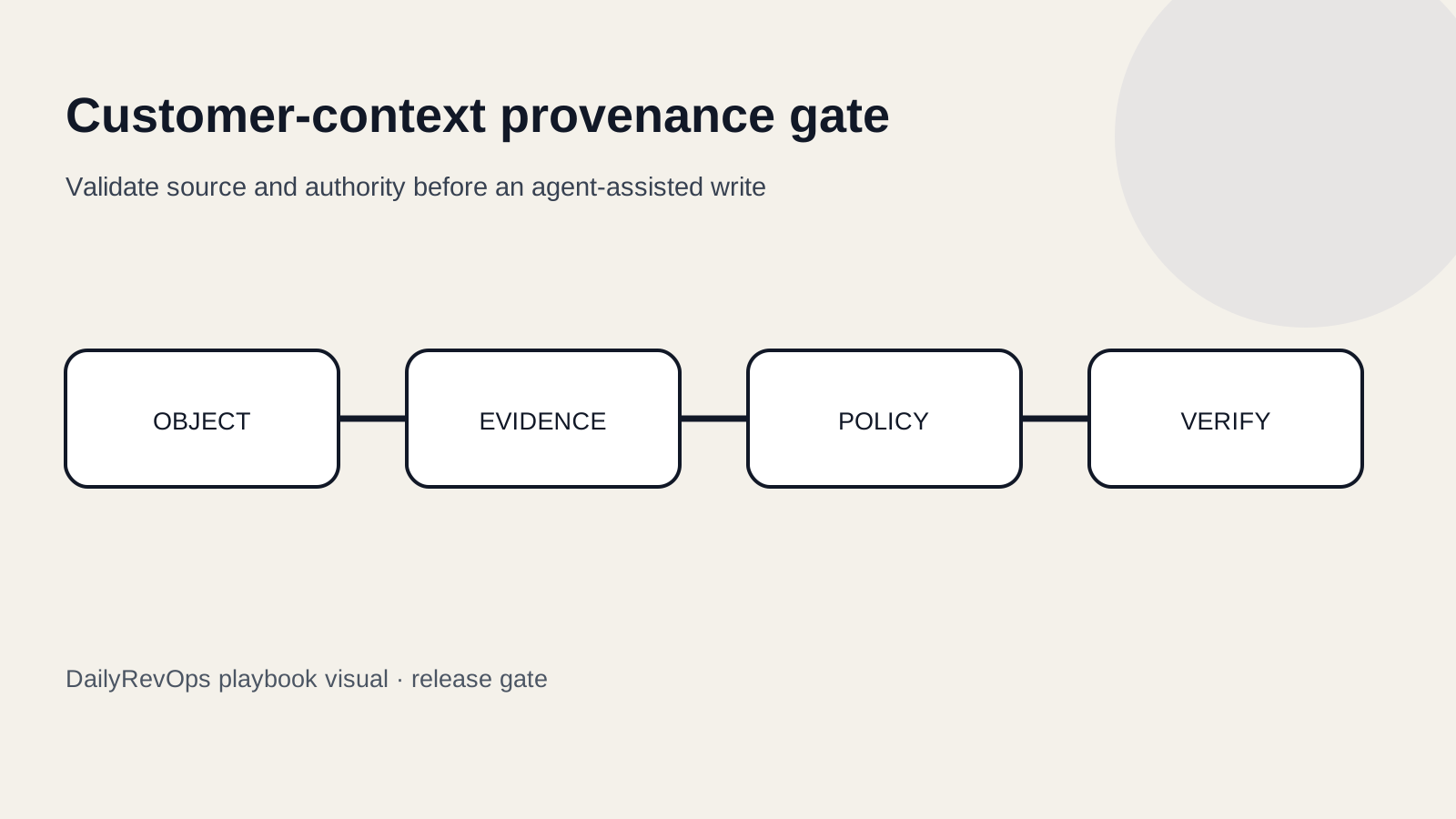
1. Define the business object before the question
Write the unit of work in business terms before configuring the assistant: one company, one product relationship, one opportunity, one renewal, one user cohort or one analytics project. Record the stable system ID and any required parent-child association. Human-readable names remain useful for operators, but they are not sufficient identity when duplicates, subsidiaries or parallel commercial motions exist.
Create ambiguity cases deliberately. Use two similar company names, several active opportunities, a contact attached to more than one account and a customer with multiple product relationships. The correct result can be an explicit ambiguity state. Do not force the assistant to choose merely to keep the workflow moving; an unresolved identity is safer than a confident action against the wrong customer.
2. Build an evidence contract
List the facts the job requires and the system that owns each one. Separate binding commercial facts from supporting context. CRM may own account identity and current opportunity state, billing may own entitlement, a CS platform may own health logic, support may own current case state and product analytics may own observed usage. The assistant can combine these facts without making one system authoritative for all of them.
For every required evidence class, record the source object or event, business field, stable ID, observed-at timestamp and allowed age. Mark optional context separately. If a required source is unavailable or stale, define whether the workflow must stop, degrade to an informational answer or route to review. Do not let absence silently become a neutral or healthy value.
3. Prove retrieval in read-only mode
Run a representative test set before enabling writes. Include a clean account, duplicate identity, stale activity, recently changed owner, restricted record, missing association, conflicting signals and a question the available systems cannot answer. Compare the assistant-visible context with the source records and keep a mismatch log that names the failure class rather than simply marking the answer wrong.
Check target resolution, required-source coverage, freshness and material-claim traceability. A fluent summary should not compensate for using the wrong opportunity or missing a blocking contract fact. Preserve the exact prompt or query version for the test and note the effective identity used to retrieve each source so permission behavior can be reproduced later.
4. Separate interpretation from source facts
Store retrieved facts and generated interpretation as separate artifacts. A stakeholder departure, open escalation and usage decline can all be evidence, while the label account at risk is a derived conclusion. Keep source IDs and observed values under the conclusion so another operator can inspect why the classification appeared and whether the source state has changed since then.
Require the workflow to preserve uncertainty. If the data shows quiet usage but no contractual issue, the output can say usage declined without asserting churn. If support context is missing, the answer should not imply there are no open problems. This makes the assistant useful as a synthesis layer without promoting every inference into durable CRM truth.
5. Add one reversible internal action
Choose the smallest write that creates operational value, such as a tagged internal task or a review-queue entry on controlled records. Immediately before execution, resolve the target again and re-read material blocking fields. Show or log the current state, proposed action, evidence, policy or approver and execution identity. The proposal should expire when a material field changes.
Use a stable idempotency or business-action key. Simulate an uncertain network result after the destination may already have committed the write, then retry. The second attempt must not create a duplicate task or association. After execution, read the destination state and store the resulting object ID instead of treating a transport-level success response as the final proof.
6. Test permission and denial paths
Run the same workflow under an identity that should not access one source and under an identity that can read but not write. Confirm that denied data does not leak through synthesis and that the final answer distinguishes unavailable evidence from no evidence found. A safe denial is a successful control, not an availability defect.
For cross-system jobs, document whether credentials belong to the initiating user, a shared service identity or an application. If a broad service identity is required, narrow the record population and action types with application-level policy. The interface a person uses to ask the question should not accidentally determine a broader backend authority than the business intended.
7. Version the context and action contract
A production result can change when the prompt, model, query, connector, schema, permission, mapping logic or SDK version changes. Store a release version that points to those dependencies. A change record should name the affected jobs, expected behavior, representative tests, owner, rollout population and rollback path. Treat a new data source as a behavior change even if the user-facing prompt is unchanged.
Re-run the representative test set after meaningful changes. Add incident cases to the suite when a wrong record, stale field, permission leak or duplicate action is discovered. Keep reference cases under human review so the system being tested cannot redefine its own expected answers. Retire cases only when the underlying business process genuinely no longer exists.
8. Expand authority by consequence, not enthusiasm
Widen scope only after the bounded workflow shows stable identity, source coverage, freshness, permission behavior, duplicate prevention and destination verification. Move from read-only retrieval to an internal reversible write before considering customer-facing messaging, commercial fields, entitlement, billing, consent or irreversible actions. Each consequence class deserves its own evidence requirements and rollback design.
Keep the customer-context layer useful even when an action remains human-owned. Faster retrieval and better provenance can improve review quality without delegating the final decision. Autonomy is not the only return on investment from agent-ready context; a well-designed evidence layer can reduce investigation time while preserving the decision rights the business already understands.
Step-by-step workflow
- Name the business object and stable source ID for the job.
- List required and optional evidence, source authority and freshness limits.
- Create clean, ambiguous, stale, restricted and missing-data test cases.
- Run read-only and reconcile every required fact with its source record.
- Store source facts separately from model-generated interpretation.
- Define the smallest reversible internal action and its blocking fields.
- Re-read target identity and material state immediately before the write.
- Execute with a stable action key and verify the destination object after success or timeout.
- Test denied reads, denied writes, retries and changed-state rejection.
- Version the prompt, query, connector, schema, permissions and action policy before wider rollout.
CRM fields and signals needed
- Company, relationship, contact, opportunity, renewal, cohort or project stable ID
- Source system, source object or event, source record URL and observed-at timestamp
- Mapping confidence, association type, duplicate state and unresolved identity reason
- Required-source coverage, freshness result and material-claim traceability
- User or service identity, read scope, write scope and explicit denial reason
- Prior destination state, proposed state, action key, execution ID, resulting object ID and rollback state
Common mistakes
- Treating a polished answer as proof that the intended customer or opportunity was resolved.
- Copying a generated risk label into CRM without preserving the facts that produced it.
- Using one freshness assumption for contract, CRM, support and product-usage evidence.
- Allowing the interface that launches the assistant to define backend write authority implicitly.
- Retrying after a timeout without checking whether the business action already committed.
- Recording only successful actions and losing denied, ambiguous and held-back cases.
- Expanding to customer-facing writes before read-side evidence and identity are stable.
Example operating rhythm
- Before launch: reconcile the complete representative test set in read-only mode.
- Daily during the first production week: inspect successful actions, denials, ambiguities and stale-context blocks together.
- After prompt, model, connector, schema, permission or SDK changes: rerun identity, freshness and retry cases.
- Weekly: review unresolved mappings, recurring missing sources, manual overrides and duplicate-prevention events.
- Monthly: narrow unused permissions, retire obsolete context fields and confirm source authority with business owners.
- After an incident: stop the affected action class first, preserve execution evidence, reconcile destination state and add the failure to the test suite.
Tooling options
- Use CRM and domain systems for stable business IDs and authoritative state rather than asking the model to invent joins.
- Use Gainsight, Close, Mixpanel or other assistant surfaces within an explicit evidence and permission contract.
- Keep versioned scripts, prompts and query definitions in source control for repeatable production jobs.
- Use an exception queue for ambiguous identity, stale required context, permission denials and destination failures.
- Store final business-action IDs in the system of record so chat or agent history is not the only audit trail.
Source notes
These sources support the workflow model and product concepts. They do not prove a specific business outcome, benchmark result, or vendor claim.
- Gainsight CS September 2026 release: Official September 21 release describing relationship mapping and customer-context access through AI surfaces.
- Close: Ask Chloe from the command palette: Official September 22 changelog entry.
- Mixpanel Headless: Official September 18 announcement for the early-access programmatic analytics SDK.
Last updated: 2026-09-23
Decision frameworks to read next
FAQ
Does every context-driven action require human approval?
No. Low-impact reversible actions can be policy-approved once identity, evidence, freshness and duplicate prevention are proven. Higher-consequence or ambiguous actions need stronger review. The gate is based on consequence and evidence, not on whether a model was involved.
What should block an action immediately?
Unresolved target identity, stale material state, missing required evidence, conflicting source authority, denied permission, expired approval or an unavailable destination should block any action that depends on that condition.
Why keep retrieved facts separate from the generated summary?
Because interpretation can change while the evidence remains the historical record. Separating them makes it possible to review a decision, update a model or prompt and still reconstruct what the workflow actually knew at execution time.
How much context should an agent retrieve?
Only the context required for the named job plus clearly optional supporting evidence. More data is not automatically safer. Excess context increases permission scope, identity ambiguity and the chance that a weak signal is mistaken for authority.