Problem
Automation can appear healthy because a workflow completes while the business path remains hard to explain. When the trigger record, source evidence, workflow version, resulting action or final state are unclear, operators spend incident reviews reconstructing basic context instead of fixing the repeated failure.
Why it matters
Attio's new workflow history and agent log make run-level review more practical, while Customer.io's direct Databricks import and Zendesk's expanding knowledge sources increase the amount of external context that can influence operational work. A release gate turns those product capabilities into a repeatable RevOps control rather than relying on ad hoc inspection after something goes wrong.
Define the business unit of work
Start with the record the workflow is meant to move forward: a company, deal, person, account, ticket, subscription or another stable business object. Write down the event that makes it eligible and the source field or query that proves eligibility. The release gate should fail when a reviewer cannot point from the run back to one concrete record and explain why the workflow started.
Keep business identity separate from interface labels. Names, domains, email addresses and human-readable titles can change or collide. Preserve the stable source identifier used by the system and the relationship to associated records. For account-level work, make the person-to-account relationship explicit so later reviewers do not have to guess which customer context was intended.
Record source evidence and time
List the information that materially influences the workflow. For CRM data, name the object and fields. For warehouse data, name the query or model and the stable row key. For knowledge retrieval, name the source system and document. Record the relevant source timestamp. The goal is not to archive everything; it is to preserve enough context to distinguish a stale source from a poor decision.
Set a freshness rule where time changes the meaning. Product usage, billing state, support status and customer activity can become misleading when a recent synchronization hides an older observation. The release review should confirm that operators can see when the source was observed as well as when it entered the workflow.
Separate evidence from the operational conclusion
A workflow can transform source evidence into a category, score, branch or proposed next step. Store that operational conclusion separately from the evidence used to produce it. This makes later review much clearer: the team can tell whether the input was wrong, whether the interpretation was weak or whether the downstream process failed after a reasonable conclusion.
Keep the workflow version or equivalent change reference alongside the conclusion. When a rule, prompt, data model or mapping changes, two runs with the same customer data may behave differently. The release gate should confirm that the team can identify which version applied without relying on the builder's memory.
Make the resulting work inspectable
Define what completion means in business terms. A created task should have a target customer, owner and due date. A CRM change should have a specific object and field. A lifecycle audience should have a reproducible population rule. The run itself is not the business outcome; it is the process that produced or proposed an outcome.
For material changes, include a simple post-run check. Compare the intended result with the destination state and record the result of that comparison. This can be a sampled control for low-risk work and a stronger requirement for high-impact processes. The release gate is successful when another operator can see both what the workflow intended and what the business system now contains.
Test the cases that make review difficult
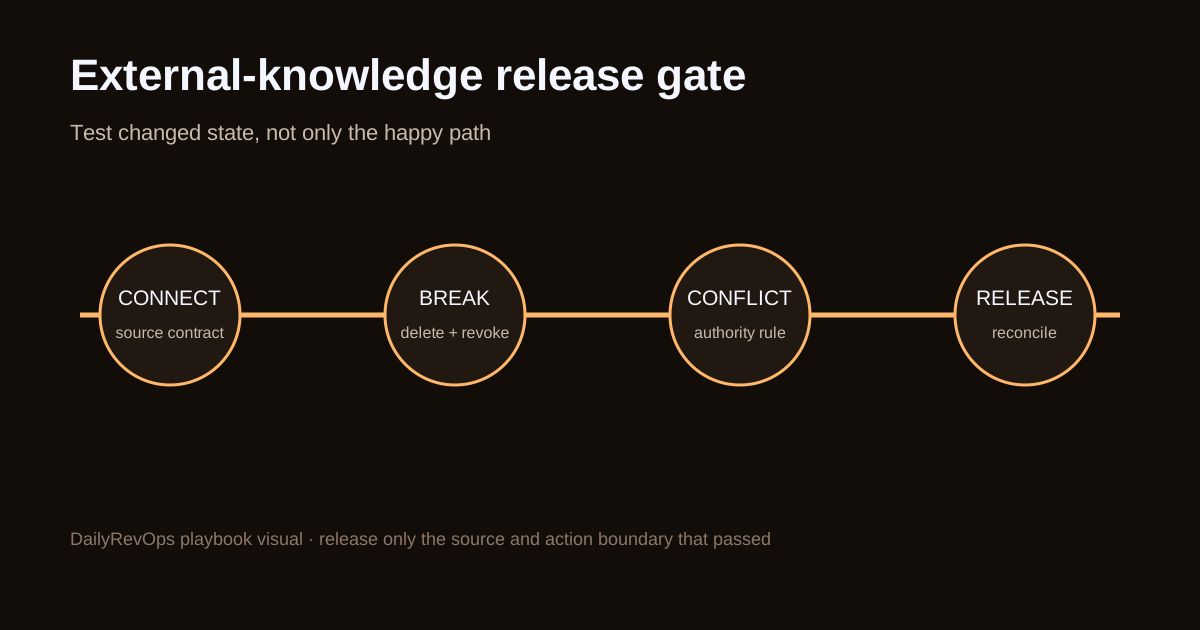
Do not approve a workflow using only the clean path. Include a recently changed source value, a missing identifier, a duplicate or ambiguous relationship, a delayed warehouse record, a replayed run and a record that is no longer eligible by the time it is reviewed. These cases expose whether the evidence model survives the conditions that generate real exceptions.
Document the expected business result before running each case. A missing identifier might route to a data-quality queue. An old source value might hold the workflow for review. A rerun might show that no new business work is required because the earlier result is already present. The expected behavior should be understandable without reading implementation details.
Approve expansion only from evidence
Review a small sample of completed runs and score whether each contains the trigger record, source evidence, decision context, resulting work and final-state check. Group missing elements by cause. The release decision should describe what population and use case passed, what exceptions remain and who owns those exceptions.
Do not use a successful pilot to justify every adjacent automation. Expanding from a read-only summary to a customer-facing or commercially material process changes the consequence and therefore the evidence required. Re-run the gate when the workflow changes source systems, business objects, audience, timing or outcome.
Step-by-step workflow
- Name the stable business object and the event that makes it eligible.
- List the source fields, documents or data models that materially influence the workflow.
- Record observation time separately from synchronization or run time when freshness matters.
- Define the operational conclusion the workflow produces and preserve the workflow version.
- Describe the resulting business work in a form another operator can inspect.
- Add a post-run comparison between the intended result and the current destination state for material work.
- Build test cases for stale data, missing identity, ambiguous relationships, delayed data and repeated runs.
- Run the pilot on a bounded cohort and sample successful plus exception cases.
- Score trace completeness and assign every missing element to a named owner.
- Expand only the population and use case that passed; repeat the gate after material workflow changes.
CRM fields and signals needed
- Stable company, deal, person, account, subscription or ticket identifier
- Trigger event and material source state
- Source record, document or warehouse model reference
- Observed-at time, synchronized-at time and run time where relevant
- Workflow or model version
- Operational category, branch, score or proposed outcome
- Destination record or resulting task reference
- Owner and due date for human follow-up
- Final-state check for material outcomes
- Exception reason, reviewer and reviewed-at time
Operating quality check
Use this check before adding more tooling. The goal is to prove that the workflow is owned, current, and inspectable inside the system of action.
| Area | Healthy pattern | Risk pattern |
|---|---|---|
| Business identity | Every sampled run resolves to one stable business record. | Reviewers infer the customer from names, text or surrounding context. |
| Source evidence | Material sources and timestamps are visible. | The workflow result has no inspectable source context. |
| Decision context | The operational conclusion and version are recorded. | Source facts and interpreted output are mixed together. |
| Outcome | Resulting business work is inspectable in the destination. | Only the automation run reports completion. |
| Verification | Material outcomes are compared with destination state. | The team assumes the intended result became the actual result. |
Common mistakes
- Treating a completed workflow run as proof that the business outcome is correct.
- Using a recent synchronization timestamp as if it were the source observation time.
- Flattening source facts and workflow interpretations into one field with no provenance.
- Relying on customer names or other changeable labels instead of stable identifiers.
- Testing only clean successful records and skipping ambiguous or delayed-data cases.
- Expanding a pilot to a broader use case with different consequences without another review.
- Keeping execution detail while omitting the business record that triggered the work.
- Measuring automation volume before the team can reconstruct a sampled run.
Weekly traceability review
- Stable record identifier
- Trigger reason
- Source references and relevant timestamps
- Workflow version
- Operational conclusion
- Resulting business record or task
- Exception reason if incomplete
- Named owner and next review date
Example operating rhythm
- Before release: run the full traceability gate on a bounded test cohort.
- First production week: sample successful and exception runs daily and record missing evidence.
- Weekly: review repeated failure classes and assign source, workflow or process fixes.
- After a material source or workflow change: repeat the gate before expanding scope.
- Quarterly: remove trace fields that no longer support review and add new evidence only when a real investigation requires it.
Tooling options
- Attio workflow history and agent log for CRM run inspection
- Customer.io import and audience views for warehouse activation review
- Zendesk knowledge-source references for content provenance
- CRM record history for source and destination comparison
- Warehouse query or model version history for derived data
- A lightweight exception register for failed traceability checks
Source notes
These sources support the workflow model and product concepts. They do not prove a specific business outcome, benchmark result, or vendor claim.
- Attio 2026 changelog: Official September 23, 2026 workflow-history and agent-log release.
- Attio workflows: Official workflow product page used for run-inspection context.
- Customer.io release notes: Official September 25, 2026 Databricks import release.
- Zendesk external knowledge announcement: Official September 25, 2026 external knowledge-source announcement.
Last updated: 2026-09-27
Decision frameworks to read next
FAQ
Is traceability the same as proving automation quality?
No. Traceability proves that a team can reconstruct the business path. Quality and business impact need separate measures once the path is inspectable.
Should every workflow keep the same amount of evidence?
No. Keep evidence proportional to consequence. Low-risk internal work can use sampling; customer-facing or commercially material work deserves stronger review.
When should the gate be repeated?
Repeat it when the source system, business object, workflow logic, data model, audience or intended business outcome changes materially.
Does run history replace source governance?
No. Run history helps reconstruct execution. Source definitions, timestamps and ownership still determine whether the evidence itself was trustworthy.