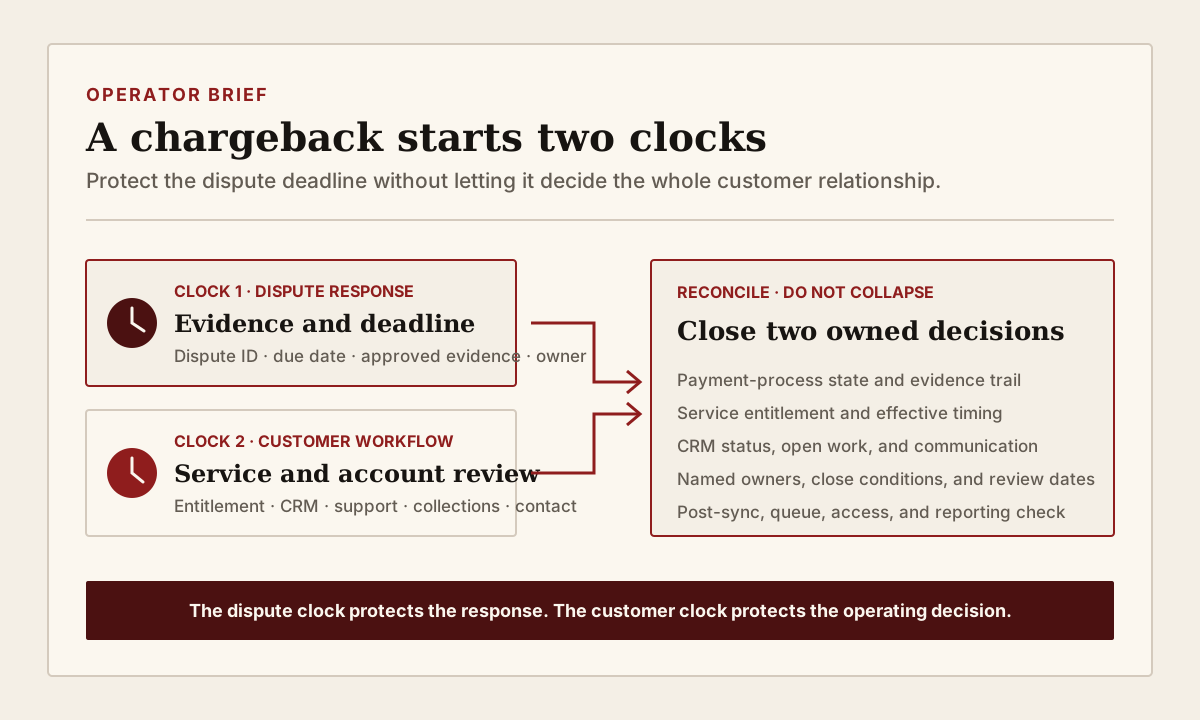
A chargeback starts a payment dispute and a customer-workflow review at the same time. The payment team may need to preserve evidence and respond before a deadline. RevOps may need to decide whether service continues, which customer status is accurate, who communicates with the customer, and which renewal, support, collections, or reporting work stays open. Those clocks are related, but they should not be collapsed into one automatic status change.
The dispute proves that a cardholder challenged a payment through the card network process. It does not by itself prove that the customer cancelled, that access should end, that a contract is void, that a renewal is lost, or that every collection and customer-success action should stop. RevOps should preserve the dispute trail while routing a separate, evidence-based customer decision to a named owner.
What to watch today
Watch for newly opened payment disputes linked to active customers, recent renewals, onboarding work, service incidents, duplicate-charge complaints, cancellation requests, or accounts with a current Customer Success plan. Prioritize records with an evidence deadline, a material amount, several subscriptions or products, unclear account identity, an open support issue, or an automation that already changed the CRM customer status.
The first warning is one disputed payment turning into a global customer state. A payment integration may flag the payment as disputed while another workflow marks the company inactive, closes a renewal opportunity, pauses service, suppresses customer communication, changes health, or removes the account from a managed queue. That chain can make the systems look consistent while hiding the decision that still needs human review.
The second warning is a dispute with no customer or contract context attached. The payment record may show an amount, currency, reason category, deadline, and current state. RevOps still needs the customer account, invoice, subscription, product or service, contract, billing contact, support history, and most recent customer evidence before deciding what the wider relationship should do.
The third warning is mixed ownership. Finance or Payments may own the dispute response. Support may own an unresolved service issue. Customer Success may own the relationship and next call. Sales may own a renewal or expansion. Legal, Risk, or Security may control parts of the evidence process. A single account owner cannot represent every responsibility, especially while the evidence clock is running.
Why RevOps should care
A payment dispute can affect cash reporting, payment status, collections, service entitlement, customer health, renewal forecasting, support follow-up, marketing audiences, account ownership, and executive reporting. If each workflow reacts independently to the dispute flag, the customer can receive conflicting messages while the CRM records a commercial outcome that nobody approved.
Stripe documents disputes as a process in which a cardholder challenges a payment and the business can accept or challenge the dispute, submit evidence, and later receive an issuer decision. Stripe separately documents subscription cancellation, including immediate, scheduled, and end-of-period behavior. HubSpot separately documents payment statuses, including Dispute (action required), and lifecycle stages for contacts and companies. These records answer different operating questions.
The official documentation supports the event, status, deadline, and record model. It does not decide whether the customer remains entitled to service, whether a contractual obligation continues, who was right in the underlying disagreement, whether the account should be classified as churned, or which customer communication is appropriate. Those decisions require the approved contract, service, payment, support, risk, and customer policies of the business.
RevOps should therefore separate at least three decisions. What must happen before the dispute response deadline? What customer, service, and commercial work remains open while the dispute is unresolved? Which CRM and reporting states should change now, later, or not at all? Keeping those decisions visible prevents deadline pressure from becoming an unsupported customer-state rule.
CRM and workflow signals to inspect
- Account or company ID, billing customer ID, payment ID, charge ID, dispute ID, invoice ID, subscription ID, contract ID, and product or service record
- Disputed amount, currency, original payment time, dispute created time, evidence due date, reason category, and current dispute status
- Payment status, invoice status, subscription status, service entitlement, access state, paid-through date, and cancellation effective date where one exists
- CRM lifecycle stage, customer status, account type, Customer Success stage, health status, renewal stage, forecast treatment, and reporting cohort
- Customer evidence such as a cancellation request, duplicate-charge report, fraud concern, service complaint, support case, contract amendment, billing correction, or confirmed misunderstanding
- Dispute response owner, evidence owner, Finance or Payments owner, CSM, commercial owner, renewal owner, Support owner, Risk or Legal reviewer, and next-action owner
- Evidence deadline, internal review deadline, customer-response due date, service-review date, renewal milestone, and next customer commitment
- Open support case, renewal, opportunity, collections task, account plan, onboarding step, customer communication, access review, or contractual obligation
- Workflow, webhook, integration, audience, report, health rule, access rule, or forecast logic that reads payment or dispute status
- Reviewed customer outcome, evidence source, authority decision, monitoring window, correction owner, and explicit close condition
15-minute operator action
Open the five newest disputes for active or recently active customers. For each one, capture the dispute ID, payment and invoice, amount, reason, evidence deadline, subscription or contract, service state, CRM customer status, open support or renewal work, and all current owners. Do not change the lifecycle stage yet. First identify which clock and business question each field belongs to.
Classify each sample as duplicate or processing issue, customer recognition problem, cancellation or refund conflict, service complaint, fraud or unauthorized-payment claim, active evidence response, accepted dispute, customer-state conflict, account-identity conflict, or evidence unclear. These are review labels, not conclusions about the cardholder or the final dispute result.
Then choose one material conflict. Assign the dispute response and its deadline to the authorized Payments or Finance owner. Separately assign the service, customer-status, and communication review to the appropriate account owner. Record one next review date and the evidence that will close each decision. The output is five classified disputes and one account with two owned clocks, not a new portal-wide chargeback policy.
Keep the evidence clock and customer clock separate
The evidence clock follows the dispute process. Preserve the original payment, dispute reason, response deadline, source records, submitted material, submission time, reviewer, and final dispute state. Limit access to sensitive material under the company's policy. A complete CRM account note is not a substitute for the approved dispute response, and a submitted response is not proof that the customer workflow is resolved.
The customer clock follows the continuing relationship. Confirm current entitlement, subscription or contract state, paid-through date, product scope, customer intent, unresolved service issue, renewal timing, and open commitments. A customer may continue service while a dispute is reviewed. A dispute may also expose a real cancellation, duplicate charge, or service problem that needs a separate correction. The evidence should decide, not the existence of the dispute flag alone.
Use explicit dates for both clocks. The card-network deadline can differ from the date service changes, the date a cancellation becomes effective, the date a customer response is due, and the date reporting should classify an account. Store those meanings separately. Do not let the newest timestamp overwrite the timeline the next operator needs to understand.
Coordinate customer communication without inventing intent
Do not send an improvised customer message merely because a dispute appeared. First check whether Payments, Support, Customer Success, Legal, Risk, or another approved team owns communication. A poorly timed message can conflict with the evidence process, repeat a support response, promise an unauthorized refund, or treat an unverified reason category as the customer's full explanation.
If customer contact is appropriate, name its purpose. The team may need to confirm account identity, explain a charge descriptor, resolve a duplicate-payment concern, clarify service status, acknowledge an open support issue, or confirm whether cancellation was requested. Keep that conversation separate from any pressure to withdraw a dispute. Record the source conversation, owner, outcome, and next step in the permitted system.
Preserve communication boundaries. A dispute does not create new marketing consent or remove an existing suppression rule. A billing contact may not be the product owner or renewal decision maker. A cardholder can differ from the commercial account contact. Resolve the identity and role before updating account relationships or routing broader messages.
Protect service, collections, and open customer work
Do not suspend service from the dispute flag alone unless the approved contract, risk, entitlement, or security policy requires it. Confirm which product or subscription the payment covered, whether other paid services remain active, whether the charge is partial, and whether the dispute affects current access. Record the authority, effective date, and owner for any service decision.
Collections also needs a controlled state. Avoid sending routine dunning or collection messages that conflict with an active dispute review, but do not erase the invoice and payment trail. The approved Finance or Payments process should decide whether a collection task pauses, changes owner, resumes, or closes. RevOps can route the exception and keep downstream CRM workflows from making a second independent decision.
Keep customer work visible while the account is under review. Support may owe a resolution. Customer Success may owe a relationship check. A renewal owner may need to reassess amount, timing, or scope. Finance may need evidence or a customer explanation. Closing the customer record can hide the exact obligations that help resolve the account situation.
Reconcile automation and reporting after the decision
List every workflow that reacts to disputed payment status, failed payment, refund, cancellation, or customer-status change. Check lifecycle automation, health models, renewal alerts, access controls, collections, marketing audiences, account queues, warehouse models, forecast views, and executive reports. Narrow only the path that is producing an unsupported decision.
When the dispute state changes, review the customer workflow again. A won or lost dispute is a payment-process outcome. It may support a finance update, but it still does not automatically decide service entitlement, relationship status, renewal outcome, or customer health. Apply the approved business decision and keep the source result available for audit rather than using the final dispute label as a universal account status.
After one normal sync and reporting cycle, confirm that the payment trail remains intact, the CRM status did not revert, open work stayed with active owners, service matches the approved decision, and the account appears in the intended renewal, support, customer, and reporting views. Reopen the exception when another system restores an old value or an automated message runs from stale dispute data.
Risks and limits
Do not delay the evidence response while waiting for a perfect CRM review. The authorized dispute owner should follow the approved deadline and evidence process. Do not upload unnecessary customer, payment, identity, security, health, or support data either. Use only the evidence permitted and relevant under the company's policy and the payment process.
Do not assume the dispute reason proves fraud, customer dishonesty, cancellation, service failure, or a valid commercial outcome. The cardholder, account contact, and buyer may be different people. Reason categories and technical statuses can be incomplete. Keep uncertainty visible and avoid unsupported labels in CRM notes, health fields, or customer communications.
Finally, platform behavior varies by payment method, card network, processor, subscription model, integration, contract, and business policy. Test the current setup on a small sample and use the current official documentation. The useful outcome is not zero disputes. It is a traceable payment process running beside an explainable customer workflow, with separate deadlines, evidence, owners, decisions, and verification.
Related reading
Customer status after a refund deserves its own review · Billing changed first. Did the CRM customer status follow? · Customer Success Operations · Renewal management workflows · CRM data quality workflows · Ticket closed, customer follow-up still open · Will your CRM correction survive the next sync? · HubSpot profile · Salesforce profile · Vitally profile · Sighub profile
Source notes
These official sources support the workflow model and product concepts. They do not prove a specific retention outcome, benchmark, or vendor claim.
- Stripe disputes overview: Official reference for card disputes, dispute notifications, response activity, evidence, and dispute outcomes in Stripe.
- Stripe dispute lifecycle: Official reference for the stages of a card dispute, issuer decisions, and won or lost dispute states.
- Stripe responding to disputes: Official reference for dispute response deadlines, accepting or challenging a dispute, submitting evidence, and monitoring the final status.
- Stripe cancel subscriptions: Official reference for immediate, end-of-period, and scheduled subscription cancellation behavior and related invoice handling.
- HubSpot manage payments: Official reference for HubSpot payment records and payment statuses, including the Dispute (action required) state.
- HubSpot lifecycle stages: Official reference for contact and company lifecycle stages and their controlled manual or automated updates.
Last updated: 2026-08-03