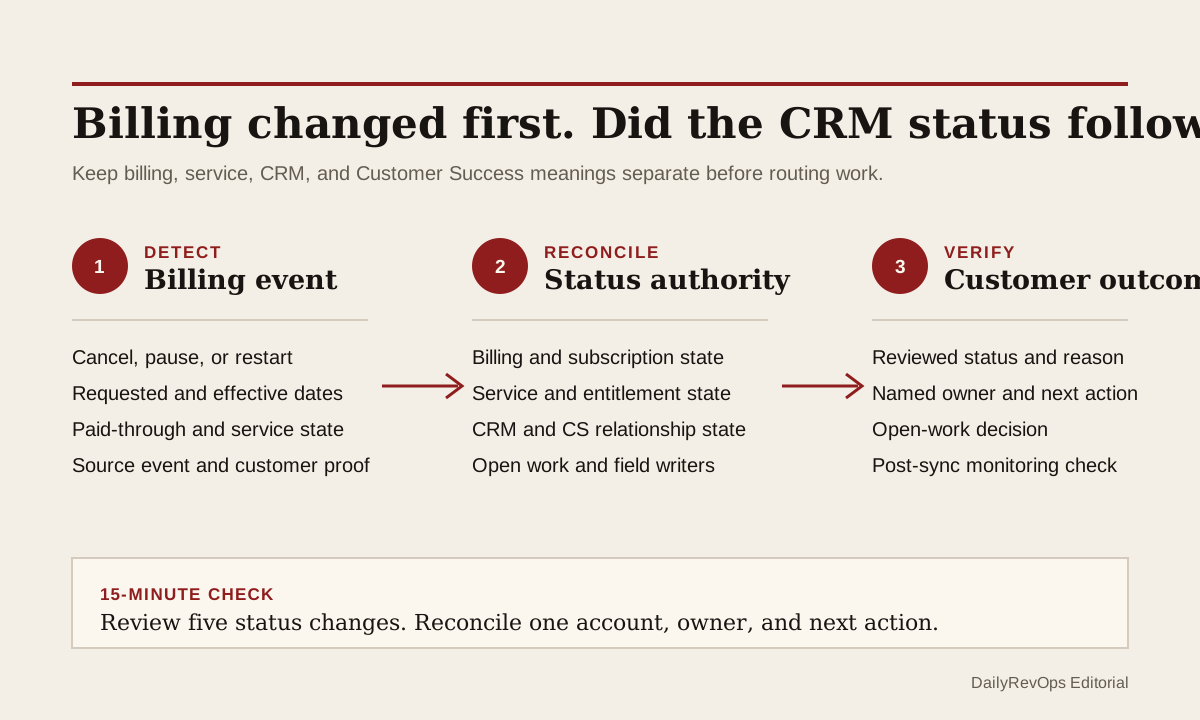
Billing can change before the rest of the customer record catches up. A subscription is cancelled at period end, payment collection is paused, or a customer restarts service. Billing reflects the event immediately, while the CRM still says customer, Customer Success keeps an active plan, a renewal opportunity remains open, and product access follows a different schedule. Every field can be technically accurate for its own purpose while the combined account story is wrong.
RevOps should treat a cancellation, pause, or reactivation as a status-reconciliation event. The job is not to copy one system's label everywhere. It is to name what each status controls, preserve the effective dates and source evidence, decide which customer work remains open, and assign one owner to close the conflict. A billing status can describe collection. A subscription status can describe service entitlement. A CRM lifecycle stage can describe the commercial relationship. Those meanings should not be collapsed by one automatic update.
What to watch today
Watch for accounts whose billing or subscription status changed since the last Customer Success or renewal review while the CRM lifecycle stage, customer status, health state, renewal stage, or account-plan status did not. Prioritize cancellations scheduled for a future date, newly paused subscriptions, resumed collection, reactivated service, and accounts with open customer commitments. The mismatch is the trigger. It is not proof that any individual field is wrong.
Also watch for a status change that closed or reopened work automatically. A cancellation event may close renewal tasks even though the customer remains entitled through the paid period. A pause may mark an account churned even though service and the relationship continue under an approved exception. A reactivation may reopen onboarding, reset health, or create a new renewal record while old tasks, contracts, support cases, and conversation history remain attached to the prior state.
A third warning is a single label such as cancelled, inactive, paused, former customer, or active appearing without an effective date or reason. Operators need to know whether the event is requested, scheduled, effective, reversed, expired, or under review. Without that timing, a dashboard can show the final state before the customer loses access, or show an active state before service, ownership, and the next customer action are actually restored.
Why RevOps should care
Customer status can control renewal forecasting, account ownership, Customer Success queues, lifecycle reporting, product access, support entitlement, marketing suppression, billing operations, and executive reporting. If these workflows read different labels without an authority rule, one cancellation or restart can create several operating realities. The team may contact a customer through the wrong motion, omit a valid renewal from review, count a customer twice, or hide open work behind a closed status.
HubSpot documents lifecycle stages for contacts and companies and notes that default automatic lifecycle-stage updates move forward rather than backward. HubSpot separately documents subscription records and actions such as pausing, resuming, and cancelling. Stripe documents subscription lifecycle states and distinguishes payment-collection pauses from a fully paused subscription. These sources show why one billing event does not automatically define every CRM and Customer Success state.
The documentation supports the feasibility of tracking status transitions, effective timing, and source events. It does not decide when a business should classify an account as churned, paused, active, retained, or reactivated. Contract terms, service delivery, customer confirmation, accounting policy, privacy rules, and the team's own operating definitions still matter.
CRM and workflow signals to inspect
- Account or company ID, billing customer ID, subscription ID, contract ID, product tenant ID, and any prior subscription or customer record
- Billing status, subscription status, service-access status, CRM lifecycle stage, customer status, health status, renewal stage, and account-plan state
- Requested cancellation date, scheduled cancellation date, effective cancellation date, paid-through date, pause start, expected resume date, and actual reactivation date
- Status reason, source system, source record URL, event ID, event time, received time, changed-by user or process, and latest sync result
- Contract term, notice status, billing cadence, open invoice context, current entitlement, and the approved evidence that defines continuing service
- Current CSM, commercial owner, renewal owner, billing owner, support owner, status-review owner, and next-action owner
- Open renewal, opportunity, onboarding plan, support case, task, meeting, customer commitment, and next customer action
- Last meaningful customer conversation, stated intent, approved pause or cancellation request, restart confirmation, and unresolved condition
- Lifecycle automation, health workflow, renewal alert, access rule, marketing audience, reporting cohort, and other downstream process that reads the status
- Reconciliation state, reviewed outcome, correction owner, review date, monitoring window, and explicit close condition
15-minute operator action
Open five accounts whose billing or subscription state changed most recently. For each one, write down the source event, effective date, paid-through or service-through date, CRM customer status, lifecycle stage, Customer Success state, renewal status, current owner, and open customer work. Do not update the fields yet. First identify which question each field is meant to answer.
Classify each sample as scheduled cancellation with service active, cancellation effective, payment collection paused, service paused, reactivation pending, service restored, status conflict, duplicate customer record, or evidence unclear. Then select one account with a real conflict. Name the authority for billing, entitlement, commercial relationship, Customer Success work, and reporting. Assign one owner to correct or confirm the statuses and one date to review the result after the next normal sync or workflow event.
The output is five classified accounts and one reconciled customer-status decision. It is not a portal-wide lifecycle redesign. If all five accounts need reconstruction, create a temporary status-conflict view with source event, effective date, billing state, service state, CRM state, CS state, open work, owner, and close condition.
Separate the statuses before choosing authority
Use more than one field when the business questions are genuinely different. Billing status answers whether invoices or collection are active under the billing setup. Subscription or entitlement status answers whether the customer should receive service. CRM lifecycle or customer status answers how the commercial relationship is classified. Customer Success status answers whether an account plan, onboarding motion, recovery plan, or monitored pause remains open.
A scheduled cancellation can therefore coexist with active service and an open Customer Success action until the effective date. A payment-collection pause can coexist with an active subscription when the platform and approved policy allow it. A reactivation can create a new subscription while the continuing CRM account preserves relationship history. The model is trustworthy when another operator can explain these combinations, not when every system displays the same word.
Create a small authority table for each high-impact field. Record the system of record, allowed writers, event that changes the field, effective-time rule, conflict behavior, human-review boundary, downstream workflows, and rollback path. Keep the raw billing and subscription values available as evidence even when RevOps writes a reviewed commercial status into the CRM.
Preserve open work across cancellation and pause
Do not close all customer work from one cancellation event. Review open support cases, promised follow-ups, contract or billing questions, offboarding steps, data-return or access tasks, renewal decisions, and customer communications. Some work ends with the service. Some work remains necessary because the service is ending. The cancellation status should route those obligations rather than hide them.
Use an effective-date rule for workflow changes. A scheduled cancellation can create an offboarding or save-review task without immediately removing the account from every active-customer view. When cancellation becomes effective, the customer may leave service and renewal queues while remaining visible in completion, reporting, and evidence-retention workflows. The exact sequence belongs to the company's contract, billing, privacy, and service policy.
For a pause, record what is actually paused. Collection, invoicing, product access, Customer Success cadence, renewal timing, and customer communication can follow different rules. Avoid using one pause flag as permission to stop every action. Keep a named owner, expected review date, and restart condition so the account does not disappear into a permanent inactive state.
Reconcile the return path after reactivation
A reactivation should not erase the prior cancellation or pause trail. Preserve the original event, effective dates, prior subscription or contract ID, customer request, owner decisions, and work completed during the inactive period. Then link the new or resumed subscription to the continuing CRM account when the entity and relationship are the same.
Review the current service scope before restoring automation. Confirm the active product or entitlement, billing start, contract or subscription term, customer contact, CSM, renewal owner, health baseline, open support context, and first customer action. A successful payment or active subscription status does not by itself prove that onboarding, success planning, consent context, support routing, and renewal timing are current.
Close reactivation only after one normal operating cycle confirms that the account appears in the intended queues, ownership is current, old cancellation automation did not run again, duplicate records were not created, and the next customer commitment is visible. If a sync restores the old status, route the field-authority conflict instead of asking operators to repeat the same manual correction.
Risks and limits
Do not infer churn, retention, or customer intent from a technical status alone. A failed payment, collection pause, scheduled cancellation, ended subscription, and confirmed customer decision are different events. Use the strongest approved commercial and customer evidence available, and keep uncertainty visible when those sources disagree.
Do not let RevOps redefine accounting, legal, entitlement, privacy, or service rules outside its authority. Finance or Billing may own collection state. Legal or Contract Operations may own the agreement. Product or Support may own access. Customer Success and Sales may own the customer plan. RevOps should connect the evidence and workflow decisions without pretending one team controls every meaning.
Finally, platform behavior varies by configuration, subscription model, integration, and release. Test the current setup on a small sample, preserve event IDs and field history, and verify the next sync before scaling an automation. The useful outcome is not identical labels. It is one explainable customer relationship with authoritative source states, effective dates, open work, named owners, and a reviewed next action.
Related reading
Customer Success Operations · Renewal management workflows · CRM workflows · CRM data quality workflows · Renewal alerts should start from date authority · Will your CRM correction survive the next sync? · Customer health exception review · HubSpot profile · Salesforce profile · Vitally profile · Sighub profile
Source notes
These official sources support the workflow model and product concepts. They do not prove a specific retention outcome, benchmark, or vendor claim.
- HubSpot lifecycle stages: Official reference for contact and company lifecycle stages, including default forward-only automatic stage movement and manual lifecycle-stage updates.
- HubSpot manage subscriptions: Official reference for subscription records, statuses, contacts, billing details, and supported pause, resume, and cancellation actions in HubSpot.
- Stripe subscription lifecycle: Official reference for subscription lifecycle statuses, status transitions, invoicing behavior, access decisions, and webhook-driven processing.
- Stripe cancel subscriptions: Official reference for immediate, end-of-period, and scheduled subscription cancellation behavior and its effect on the subscription record.
- Stripe pause payment collection: Official reference distinguishing paused payment collection from a fully paused subscription and documenting related billing behavior.
Last updated: 2026-08-01