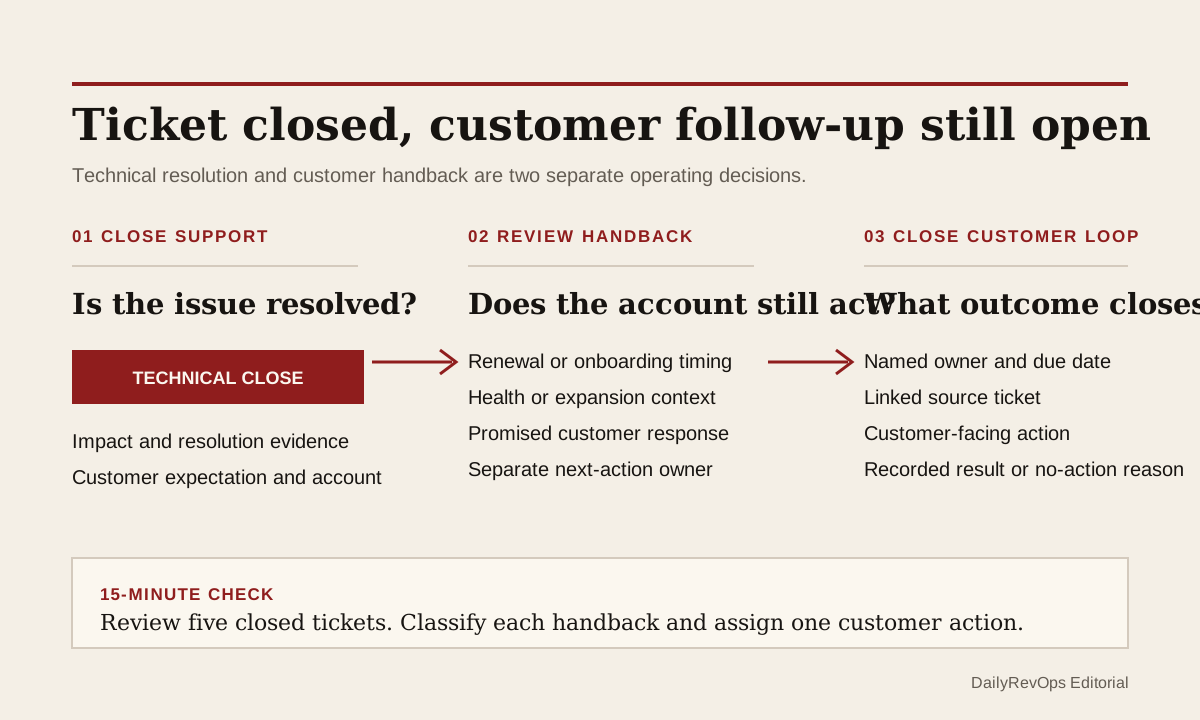
A support ticket can be resolved correctly while the customer workflow remains unfinished. Support may fix the technical issue, document the answer, and close the ticket. The account can still need a commercial follow-up, a renewal-plan update, a customer-health review, or confirmation that the customer accepts the resolution. Ticket status and customer follow-up status answer different operating questions.
RevOps should inspect the handback after material support issues close. The useful control is small: connect the resolved ticket to the affected account, identify whether another team owes a customer action, and keep that action open until an owner records the outcome. This does not turn every ticket into a revenue alert. It protects the support moments that can change a renewal, expansion, onboarding, or executive relationship decision.
What to watch today
Watch for recently closed high-priority tickets linked to customers inside an active renewal, expansion, onboarding, or strategic-account window. Prioritize issues with repeated contacts, service interruption, billing or access impact, an executive escalation, a missed milestone, or language showing that the customer expects another update. A closed ticket is a review trigger only when the account context makes the handback material.
Also watch for closure without a linked company, account, contact, subscription, renewal, deal, or opportunity. Support may have enough context to resolve the case while the account team cannot see which commercial workflow was affected. The missing association is not proof of customer risk, but it prevents another operator from deciding whether follow-up belongs in the account plan.
A third signal is an account note or health change with no named next-action owner. The support owner can remain responsible for the technical resolution while a CSM, account executive, renewal owner, implementation lead, or manager owns the customer handback. If one owner field is forced to represent both jobs, the ticket can look complete while the next conversation is effectively unowned.
Why RevOps should care
Support status can influence customer health, renewal inspection, account planning, executive escalation, onboarding, and expansion timing. When closure ends the whole workflow, the CRM may show a resolved case while the customer still expects reassurance, a root-cause explanation, a commercial decision, or confirmation that the fix works in their environment. The missed action often appears later as weak conversation history rather than as an open support problem.
HubSpot documents tickets and help-desk work with record properties such as status, priority, and ownership, and it documents associations between CRM records. Salesforce documents case teams for shared work around customer cases. These sources show that support records, owners, and connected customer context can be structured. They do not prove that a resolved ticket creates renewal risk, that every case needs commercial follow-up, or which team should own a particular customer response.
RevOps should therefore keep two decisions separate. Is the support issue technically resolved under the team's support process? Does the account still need a customer-facing or commercial action because of that issue? Closing the first should not silently answer the second.
CRM and workflow signals to inspect
- Ticket or case ID, company or account, primary contact, owner, team, priority, category, and created time
- Current status, resolved time, closed time, resolution reason, resolution summary, and reopen count
- Associated subscription, contract, renewal, opportunity, onboarding project, product, asset, or service where available
- Customer impact: access, outage, billing, implementation, adoption, security, data, service level, or another controlled category
- Last customer message, requested update, promised response, resolution confirmation, and source activity
- Current CSM, account executive, renewal owner, support owner, executive sponsor, and next-action owner
- Renewal date, contract milestone, onboarding milestone, customer-health change, open expansion, or strategic-account flag
- Handback status, handback reason, assigned time, due date, customer-facing action, outcome, and exception close condition
15-minute operator action
Open the five most recent closed high-priority tickets for active customers. For each record, confirm the associated account, customer impact, resolution evidence, final customer message, current commercial or Customer Success owner, and any renewal or onboarding milestone. Then ask one question: after technical resolution, does this account still owe the customer a documented action?
Classify each sample as support-only closure, customer confirmation pending, CSM follow-up, commercial review, renewal-plan update, onboarding recovery, executive handback, association missing, or evidence unclear. For one real handback, assign a named next-action owner, set a due date, link the source ticket, and define the outcome that will close the follow-up.
The output is five classified closures and one owned customer action. It is not a redesign of the support process. If all five records need manual reconstruction, create a temporary closed-ticket handback view with account, impact, priority, closed time, renewal or onboarding context, final customer message, next-action owner, due date, and handback status.
Give the handback its own status
Do not keep a support ticket open only because Customer Success or Sales owes a different action. That can distort support queues, service reporting, and workload. Let support close the technical work when the support close condition is met. Create a separate handback status, associated task, or account-plan action for the customer or commercial follow-up.
A practical handback state can be not required, review required, assigned, customer action sent, customer response pending, resolved, or returned for support evidence. Keep the list short. The status should tell the next operator whether another team has accepted the work, not create a second copy of the ticket lifecycle.
Use a materiality rule. High priority alone may be too broad, while renewal proximity alone can miss a severe customer event. Combine support impact with account timing or customer expectation. For example, a resolved access issue during onboarding, a repeated billing case near renewal, or an executive escalation with a promised follow-up may deserve review. A routine how-to question with confirmed resolution may not.
Close on a customer outcome, not task completion
The handback should close when the chosen account action is inspectable. That may be a customer confirmation, a scheduled review, an updated success plan, a renewal-risk decision, an executive follow-up, a corrected account field, or a documented decision that no further action is appropriate. Completing an automatically created task without an outcome should not be enough.
Preserve the source ticket and a bounded resolution summary instead of copying the full support history into a broadly visible commercial field. Access rules, sensitive content, security details, and customer privacy can limit what other teams should see. The account owner often needs the impact, resolution state, customer expectation, and next action, not every internal troubleshooting note.
Sample closed handbacks weekly. Check whether the customer action happened, whether the owner was correct, whether the account plan or renewal view changed when needed, and whether support had to reopen the issue. Repeated false positives mean the materiality rule is too broad. Repeated missed follow-ups mean the association, owner mapping, or close condition is too weak.
Risks and limits
Do not treat every support case as churn or expansion evidence. A resolved issue can have no commercial consequence, and a quiet customer can still be satisfied. The handback is an inspection control, not a prediction. Use customer impact, account timing, stated expectation, and operator judgment before routing work.
Do not make Support responsible for interpreting contracts, renewal probability, or commercial commitments outside its role. Support should preserve accurate resolution evidence and customer context. The account, renewal, Customer Success, Finance, Legal, or executive owner should make the decision that belongs to that workflow.
Finally, ticket associations and ownership can be incomplete after migrations, shared inboxes, merged accounts, partner support, or integrations. If the correct account or customer impact cannot be confirmed, classify the record as a data-quality exception instead of inventing a commercial story. The goal is a clean support closure plus a separate, traceable customer action when the account still needs one.
Related reading
Customer Success Operations · What a customer health score cannot tell RevOps · Handoff debt is where RevOps work quietly breaks · The customer conversation your renewal review is missing · CRM workflows · CRM data quality workflows · Vitally profile · Sighub profile · HubSpot profile · Salesforce profile
Source notes
These official sources support the workflow model and product concepts. They do not prove a specific retention outcome, benchmark, or vendor claim.
- HubSpot create tickets: Official reference for tickets as CRM records that can be connected to customers and support work.
- HubSpot manage tickets in help desk: Official reference for managing ticket records, owners, status, priority, and related help-desk work.
- HubSpot CRM associations: Official developer reference for associating CRM records so a ticket can remain connected to relevant customer and commercial context.
- Salesforce case teams: Official reference for bringing multiple people into work around a customer case in Salesforce.
Last updated: 2026-07-26