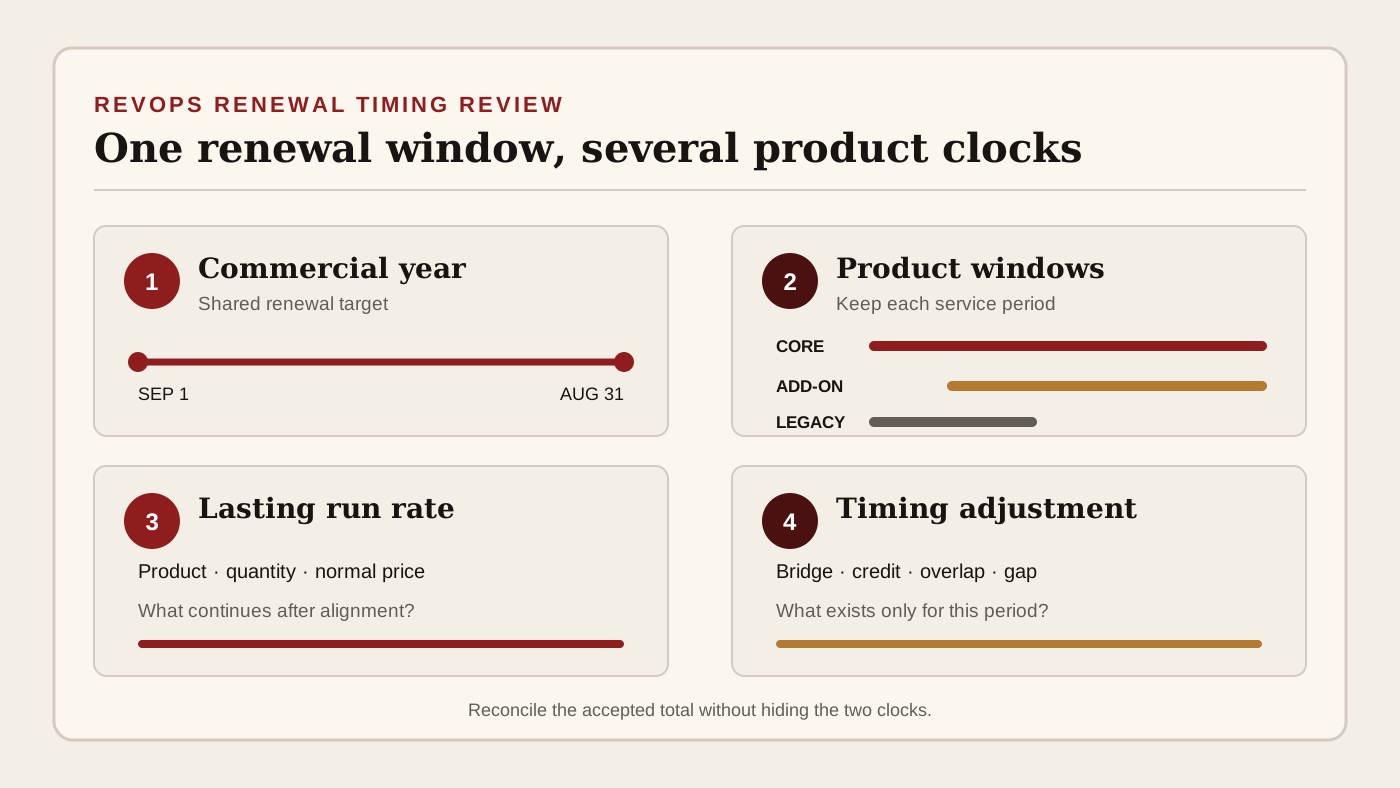
A customer renews for twelve months on September 1, but not every product follows that exact service window. The core platform renews for the full year. An add-on starts November 1 after implementation. A legacy module ends December 31 after migration. The accepted quote includes a credit that aligns another line to the shared renewal date. If the CRM compares total line value without those service periods, a timing adjustment can look like product expansion, contraction, or churn.
RevOps should separate the commercial renewal window from each product line's service window. Preserve the prior line, record the accepted future line, calculate the comparable recurring run rate under the approved definition, and classify the partial-period amount separately from the lasting product decision. The operating question is not only what the customer will be invoiced this term. It is which scope continues after the alignment period and which amount exists only because two clocks are being brought together.
What to watch today
Watch for renewals described as co-term, alignment, bridge term, stub period, partial period, delayed start, ramp, phased rollout, early termination, migration overlap, mid-cycle addition, billing-anchor change, true-up, proration, credit, or catch-up invoice. Prioritize records where product start and end dates differ from the opportunity's renewal dates, where the same product has a short first or final period, or where the quote total moves while quantity and long-run unit price appear unchanged.
The first warning is an annualized comparison made from invoice or quote totals alone. A three-month bridge and a twelve-month renewal should not be compared as if they represent equal service periods. A lower partial-period amount can be correct even when future recurring scope is unchanged. A higher invoice can include a catch-up period without proving durable expansion.
The second warning is one renewal date copied onto every line. A common commercial date can help future administration, but it can erase a delayed product launch, temporary overlap, migration end, trial, service credit, or product-specific obligation. Keep the account-level alignment date and line-level service dates as separate fields with their own evidence.
The third warning is a negative line labelled contraction without a successor relationship. A credit may reverse an earlier invoice, shorten one billing period, or offset overlapping service. It may also represent a real cancellation. RevOps should require the affected line, reason, covered dates, successor if any, and approved metric treatment before the value changes retention or forecast reporting.
Why RevOps should care
Partial-period adjustments connect commercial intent to forecasting, bookings, recurring-revenue bridges, gross and net retention, billing, commissions, entitlements, provisioning, implementation, and Customer Success plans. A technically correct invoice can still feed an incorrect operating conclusion when its covered period is not visible beside the amount.
Stripe documents time-based prorations and billing-cycle anchors, including partial periods and invoice adjustments when subscription timing changes. HubSpot documents separate line-item records and buyer-facing quote workflows. Salesforce documents opportunity products and product schedules that can represent quantity or revenue over time. These sources support a dated line-level model. They do not decide contract meaning, accounting treatment, retention definitions, commission credit, or whether a temporary amount is expansion or contraction.
The core distinction is run-rate movement versus timing movement. Run-rate movement changes the continuing product, quantity, recurring unit price, or approved recurring scope after the transition. Timing movement changes how much of that scope falls inside the current invoice, quote, forecast period, or renewal term. One commercial event can contain both, so RevOps needs a bridge that preserves each component.
CRM and workflow signals to inspect
- Account or company ID, renewal opportunity or deal ID, quote ID and version, contract or order ID, subscription ID, billing customer ID, product ID, price ID, line-item ID, schedule ID, and entitlement ID
- Account renewal date, commercial term start and end, notice date, quote acceptance date, billing-cycle anchor, invoice period, forecast period, fiscal period, timezone, and date authority source
- Prior and future product or SKU, quantity, unit, recurring unit price, discount, currency, billing frequency, full-period recurring value, one-time value, and approved product relationship
- Prior line start and end, future line start and end, service days or months, delayed-start reason, early-end reason, overlap period, gap period, migration window, and co-term target
- Partial-period charge, proration credit, catch-up amount, refund or credit-note link, tax context, invoice item, calculation inputs, calculation version, and rounding treatment
- Continuing run rate, added run rate, removed run rate, price movement, quantity movement, timing-only movement, one-time movement, currency movement, and the approved gross-to-net bridge
- Renewal stage, amount, close date, forecast category, manager judgment, line-level forecast source, snapshot date, retention category, and metric-definition version
- Subscription item status, scheduled update, pending change, cancellation timing, invoice state, entitlement start or end, provisioning dependency, implementation milestone, and rollback condition
- Customer acceptance evidence, product-specific note, amendment, superseded quote, approval, reviewer, effective time, and evidence-confidence or exception status
- Commercial owner, renewal owner, Billing or Finance owner, Deal Desk reviewer, Customer Success owner, Implementation owner, Product Operations owner, forecast owner, and data owner
15-minute operator action
Open the five most recent renewals containing a prorated, credited, co-termed, delayed-start, or early-ending product line. For each one, capture the account renewal window, each line's prior and future service dates, quantity, recurring unit price, full-period value, partial-period amount, customer evidence, quote version, subscription state, and owner. Do not edit invoices, subscriptions, entitlements, forecast, or retention fields during this first pass.
Classify every movement as continuing run rate, added run rate, removed run rate, price change, quantity change, timing-only adjustment, one-time service, currency effect, correction, or evidence unclear. Annualize or normalize only under the team's approved metric definition, and keep the actual contracted and invoiced amounts visible. Do not turn a normalized value into a customer commitment.
Choose one renewal where the reported expansion or contraction changes after timing is separated. Build a four-row bridge with prior product line, future product line, covered dates, continuing run-rate change, timing-only amount, evidence, owner, and downstream treatment. The output is five classified renewals and one reviewed bridge, not a bulk recalculation of renewal reporting.
Build two linked timelines
Create an account-level commercial timeline and a product-line service timeline. The account timeline records the renewal decision, quote acceptance, common renewal target, forecast period, and next review. Each product timeline records its own prior end, future start, future end, overlap or gap, billing anchor, entitlement window, and implementation dependency.
Link the timelines rather than forcing them to match early. A product can be accepted as part of the renewal but start later. A legacy product can remain active during migration after its replacement is commercially agreed. A bridge period can be intentionally short so the next term shares one date. The record should explain these differences until the target alignment is reached.
Store dates with meaning and source. Start date can mean contract start, service availability, billing start, entitlement start, implementation start, or forecast recognition date. End date can mean service end, billing period end, cancellation effective time, or migration completion. A date without its type and authority creates false precision.
Separate lasting value from timing value
Calculate the lasting recurring state from the approved future product, quantity, price basis, currency, and normal service period. Then calculate the partial-period amount from the actual covered dates and supported billing behavior. Reconcile both to the accepted quote or amendment, but do not replace the contractual line values with an operator normalization.
For a delayed start, show the full future recurring scope and the shorter first-period charge separately. For an early end, show whether the line is cancelled, migrated, replaced, or only aligned. For an overlap, show whether both products are entitled and billable or whether one amount is credited. For a gap, show the service and customer-success plan rather than assuming the missing time is harmless.
Keep gross components. A negative credit and positive replacement can net to zero while changing product scope. A catch-up invoice can increase cash collection while recurring scope stays flat. A short bridge can reduce booked term value without reducing the future run rate. Reports should consume the component supported by their definition and retain a route back to the dated line evidence.
Reconcile forecast, billing, and customer work
Before the next forecast review, compare the opportunity amount and category with the accepted quote, line bridge, covered periods, continuing run rate, timing adjustment, and manager explanation. Decide whether the forecast view is reporting contracted term value, expected invoice value, annualized recurring value, or another governed measure. Do not silently switch definitions because one view looks cleaner.
Then inspect the supported billing path. Stripe's documentation shows that billing-cycle changes and subscription updates can create prorated invoice items depending on configuration and behavior. Other CRM, CPQ, and billing combinations can differ. Test the target setup, preserve request and response evidence, and confirm whether credits, immediate charges, pending updates, trials, or period-end changes match the approved commercial record.
Align entitlement and implementation with the product dates. A delayed charge does not always mean delayed access, and a delayed start does not always permit early provisioning. A migration overlap may require both products temporarily. Name the authorized service state, protected users, customer communication, owner, verification point, and rollback route for each line.
After the first normal billing and service cycle, reconcile quote lines, opportunity products, subscription items, invoice items, credits, entitlements, implementation milestones, forecast snapshot, renewal reporting, and warehouse output. Reopen the exception when a sync removes the line dates, annualizes a short period twice, treats a credit as churn, counts overlapping products twice, or carries a temporary bridge into the next full term.
Risks and limits
Do not use a normalized run rate as a substitute for the signed or accepted commercial amount. Normalization can support comparison, forecast explanation, and retention reporting only under an approved definition. Finance, Accounting, Tax, Legal, Billing, Deal Desk, and the commercial owner retain the decisions within their authority.
Do not infer customer satisfaction, churn cause, adoption, or product success from a partial-period adjustment. A short line may reflect implementation timing, contract alignment, migration, seasonality, a correction, or an approved commercial concession. Keep observed scope and timing separate from inferred cause.
Do not force every small timing difference into a committee review. Focus on material value, several products, overlapping or missing service, credits, migrations, forecast impact, retention impact, uncertain evidence, or workflows that cannot reproduce the calculation. A simple supported co-term adjustment can follow a lighter sampled check.
Finally, proration, scheduling, quote, subscription, invoice, tax, entitlement, and revenue behavior depends on platform configuration, permissions, currency, timezone, contract terms, and release. Verify current documentation and representative records in the target environment. The useful result is not one perfectly aligned total. It is a renewal where lasting product scope, temporary timing value, customer evidence, system actions, and reporting treatment remain traceable across both timelines.
Related reading
One renewal total can hide three product decisions · The renewal says 80 seats. Five systems still say 100. · How to track renewals across your CRM · Renewal management workflows · The forecast review after a quote expires · CRM data quality workflows · Customer Success Operations · Sighub profile · HubSpot profile · Salesforce profile
Source notes
These official sources support the workflow model and product concepts. They do not prove a specific retention outcome, benchmark, or vendor claim.
- Stripe subscription prorations: Official reference for time-based proration behavior when subscription prices, quantities, periods, trials, or billing-cycle anchors change.
- Stripe billing cycle: Official reference for subscription billing-cycle anchors, partial billing periods, prorated invoice items, trials, and supported timing controls.
- HubSpot Line Items API: Official developer reference for line-item properties, product references, quantities, prices, terms, and associations to deals and quotes.
- HubSpot create and send quotes: Official reference for buyer-facing quotes, associated deals and line items, billing frequency, terms, approvals, signatures, and payment-related workflows.
- Salesforce product schedules: Official Salesforce reference for product schedules used to represent product quantity or revenue over time.
- Salesforce create an opportunity and add products: Official Salesforce exercise showing products as separate opportunity records with quantity, sales price, price-book context, and amount.
Last updated: 2026-08-12