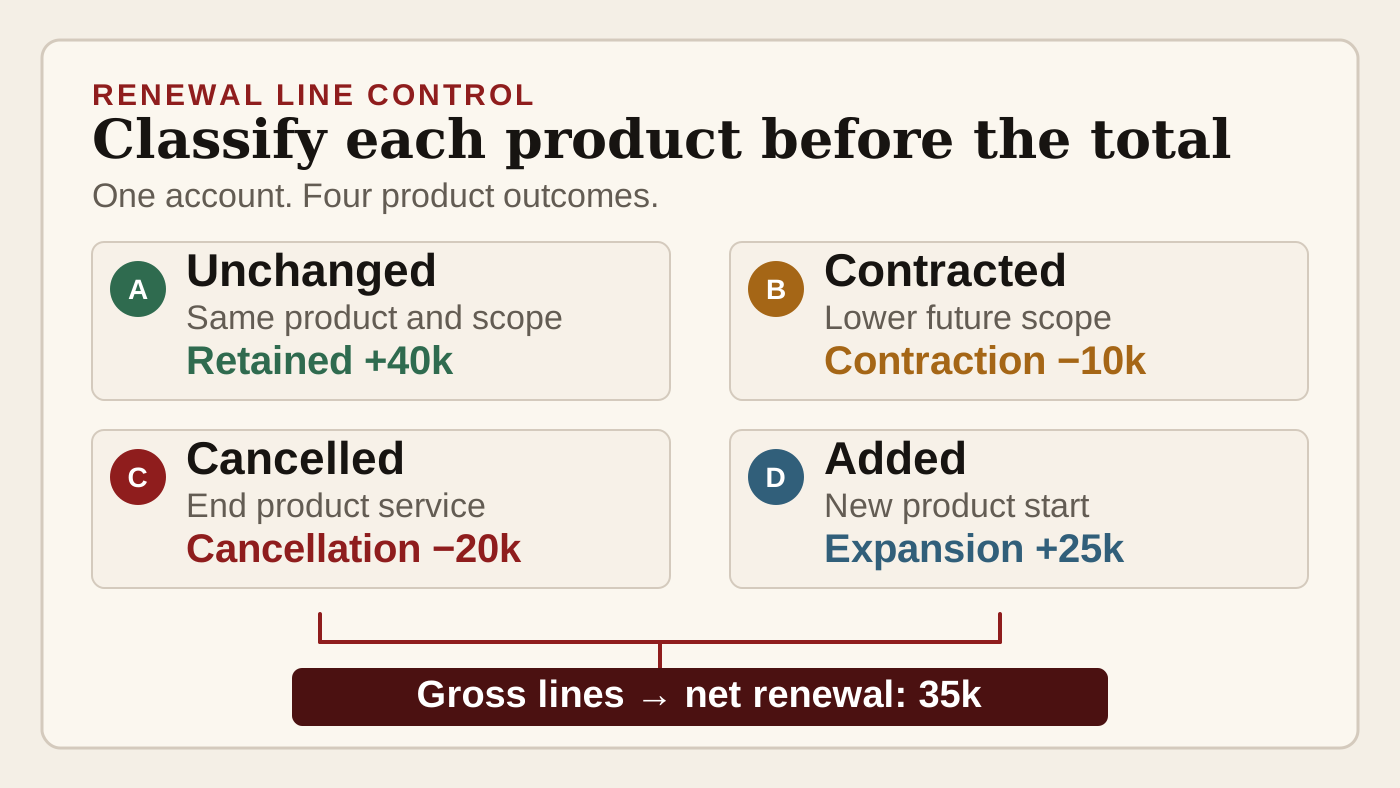
A customer renews Product A at the same scope, reduces Product B, and cancels Product C. A new Product D is added. The opportunity total falls by only five percent because the new line offsets most of the cancellation. The CRM can therefore show a small net contraction while Customer Success loses one workflow, Product Operations must remove one entitlement, Billing must end one subscription item, and the forecast still needs to explain four different product decisions.
RevOps should review a multi-product renewal at line level before accepting the aggregate amount. Preserve the prior product set, classify each future line, connect every outcome to customer evidence and an effective date, then reconcile the total without letting it replace the underlying decisions. The operating question is not only how much the account renewed for. It is which products continue, change, stop, migrate, or begin, and what each decision requires next.
What to watch today
Watch for renewals with more than one product, subscription item, SKU, service package, workspace, region, or commercial term. Prioritize records where the total amount changed only slightly but product mix changed materially, where a quote contains both positive and negative line movement, or where a seller summarizes the outcome as flat, renewed, downsell, or expansion without a line-level disposition.
The first warning is one renewal status for the whole account. Renewed can be correct for the customer relationship while one product is cancelled. Contracted can be correct for value while another product expands. Churned can be wrong when only one subscription item ends. The account outcome and each product-line outcome answer different questions and should not overwrite each other.
The second warning is a net amount with no bridge. A 20,000 cancellation and a 15,000 addition produce a net reduction of 5,000. That total does not show whether the new product is active on the same date, whether the cancelled line still has service obligations, whether the addition is recurring or one-time, or whether the two products belong to the same retention definition. RevOps needs the gross movements as well as the net result.
The third warning is an old line that disappears from the new quote. Absence may mean cancelled, superseded, bundled into another SKU, intentionally excluded, accidentally omitted, or still governed by a separate contract. Do not infer a cancellation from a missing row. Require an explicit disposition and source evidence for every material prior line.
Why RevOps should care
Multi-product renewals connect commercial decisions to forecast, gross and net retention reporting, billing, entitlements, provisioning, commissions, product reporting, customer health, support coverage, and ownership. An aggregate amount can balance correctly while these workflows make conflicting decisions about the underlying products.
HubSpot documents line items as records with product references, properties, and associations to deals and quotes. Its quote workflow brings line items into a buyer-facing commercial record. Salesforce's official opportunity-products exercise similarly shows separate products with quantity and sales price on an opportunity. Stripe documents per-item subscription quantities, item changes, and cancellation behavior. These sources support a line-level operating model, but they do not decide the customer's intent, contract interpretation, retention definition, revenue treatment, or service entitlement.
The distinction also protects honest reporting. Gross retention, net retention, product retention, logo retention, bookings, recurring revenue, and forecast movement can use different populations and timing rules. RevOps should not force every metric to use one label. It should preserve the line decisions and let each approved metric definition consume the relevant fields without losing the bridge back to the customer record.
CRM and workflow signals to inspect
- Account or company ID, legal entity, renewal opportunity or deal ID, prior contract or order ID, active quote ID, subscription ID, billing customer ID, workspace or tenant ID, and stable cross-system associations
- Prior product ID, SKU, product family, line-item ID, subscription-item ID, entitlement ID, quantity, unit, unit price, discount, recurring amount, one-time amount, currency, term, and effective dates
- Proposed and accepted product ID, replacement SKU, quote version, line status, quantity, price, discount, billing frequency, start date, end date, and customer acceptance evidence
- Line outcome such as unchanged renewal, quantity contraction, price change, cancellation, replacement, migration, bundle consolidation, addition, expansion, correction, pending decision, or evidence unclear
- Prior recurring value, renewed base, gross retained value, contraction value, cancellation value, expansion value, new-product value, one-time value, and the calculated net bridge with metric definitions
- Customer decision source, product-specific note, acceptance date, effective date, notice date, superseded record, amendment reference, approval, reviewer, and confidence or exception status
- Opportunity amount, renewal type, stage, close date, forecast category, manager judgment, line-level forecast source, and the snapshot used before and after the change
- Subscription item status, scheduled change, cancellation timing, proration setting, invoice treatment, entitlement state, provisioning change, protected users, customer communication, and rollback path
- Commercial owner, renewal owner, Customer Success owner, Billing or Finance owner, Deal Desk reviewer, Product or Provisioning owner, data owner, forecast owner, and receiving-owner acceptance
- Last writer, sync direction, integration identity, error or retry state, post-change sample, first invoice check, service check, report check, unresolved reason, and close condition
15-minute operator action
Choose the five most recent multi-product renewals with a changed total or a changed product set. For each account, export or open the prior product lines and the accepted or active future lines. Match them by stable product, price, subscription, and line-item IDs where available. Do not match by display name alone, and do not update billing, access, forecast, or retention status during this discovery pass.
Classify every prior line as unchanged renewal, quantity contraction, price-only change, cancellation, replacement or migration, combined into a bundle, missing without evidence, or not part of the current obligation. Classify every new line as continuation, replacement, expansion of an existing product, genuinely new product, one-time service, correction, or evidence unclear. Record the customer source and effective date beside each classification.
Choose one account where the net amount hides at least two opposing movements. Build a four-row bridge showing prior line, future line, gross change, effective date, customer evidence, operational owner, and next system action. Compare the line bridge with the opportunity total. The output is five classified renewals and one reconciled product bridge, not a bulk rewrite of product or subscription records.
Build a product-line disposition table
Create one row for every material prior and future product line. Use stable IDs and keep labels for readability. Record prior SKU, future SKU, relation between them, quantity, price basis, recurring or one-time treatment, line outcome, customer evidence, effective time, operational owner, and downstream actions. A replaced line should point to its successor. A cancelled line should carry its own end condition. A new line should not be presented as retained value unless the approved metric definition allows it.
Do not calculate the bridge from total opportunity amount alone. Separate prior recurring base, retained recurring value, contraction, cancellation, expansion, new product, price movement, currency movement, term movement, discount movement, and one-time amounts. The components should reconcile to the approved commercial total, but the reconciliation must preserve why each component moved.
Keep account and line outcomes separate. The account may be retained while a product churns. The renewal may be a net contraction while one line expands. A product migration can create a negative old line and positive new line without representing customer loss or new acquisition. Store enough relationship and reason data for reports to apply the approved definition instead of guessing from positive and negative amounts.
Sequence billing, entitlement, and customer work
Start from the accepted customer-facing source. Confirm which quote, order, amendment, contract, or other authorized record contains the final product set. Preserve prior versions. When one line is absent or ambiguous, hold that line's operational change and route the evidence gap instead of interpreting the account total as permission to cancel it.
Then plan each line's effective-time cutover. One product may renew immediately, another may continue until period end, and a replacement may start only after data migration or provisioning is complete. Stripe's documentation shows that item changes and cancellations can have timing, proration, and invoice consequences. The exact path depends on the billing setup and approved commercial policy. Test the actual configuration and record the supported action, result, and recovery route.
Align entitlement and provisioning by product. Do not remove all account access because one line is cancelled, and do not keep a cancelled product active indefinitely because another product renewed. Confirm protected users, data retention, exports, dependencies between products, support obligations, customer communication, and the owner who verifies the resulting service state.
Route Customer Success and commercial work from the line outcome. A cancellation may need an offboarding or product-feedback action. A migration may need adoption and implementation ownership. A contraction may need a scope confirmation. An addition may need onboarding. The account should have one coherent plan, but each product decision should retain its specific owner and close condition.
Reconcile forecast and retention reporting
Before the next forecast review, compare the line bridge with the opportunity amount, quote total, manager judgment, renewal category, contraction field, expansion field, and snapshot history. Explain the net movement as a sum of line outcomes. A manager should be able to see that a small net change contains a larger cancellation and a partly offsetting addition without opening four systems during the call.
Apply metric definitions after the line classification. Decide whether a replacement SKU belongs to retained value, migration, contraction plus expansion, or another governed category. Decide whether a new product on an existing account counts as expansion and from which effective date. Decide how one-time services, credits, currency changes, and term changes are excluded or displayed. These are company measurement decisions, not conclusions supplied by the CRM vendor documentation.
After the effective dates, reconcile the accepted product set, opportunity lines, subscription items, invoice, entitlement, provisioning, customer-success plan, forecast snapshot, retention model, and warehouse output. Reopen the exception when an old integration restores a cancelled line, a replacement counts twice, a missing line was never cancelled, or the net amount matches while the product outcomes do not.
Useful operating measures include reviewed multi-product renewals, prior lines with explicit disposition, future lines with source evidence, unresolved missing lines, line bridges that reconcile to the commercial record, late billing or entitlement changes, duplicate replacement lines, post-sync reversals, and reporting corrections. These measures show whether the workflow is inspectable. They are not universal performance benchmarks.
Risks and limits
Do not interpret a lower product quantity, removed line, or reduced amount as proof of dissatisfaction, churn cause, poor customer health, or preventable loss. The customer evidence may show consolidation, migration, seasonality, corrected scope, pricing structure, business change, or another reason. Keep the observed commercial outcome separate from an inferred cause.
Do not let RevOps decide contract meaning, accounting, tax, revenue recognition, pricing, credit, entitlement, data retention, or customer communication outside its authority. RevOps can preserve the records, expose the mismatch, define CRM fields and workflow states, route accountable owners, and verify reconciliation. Legal, Finance, Billing, Deal Desk, Product Operations, Customer Success, and the commercial owner must approve the decisions they own.
Do not make every multi-line renewal a heavy committee review. Focus the controlled bridge on material value, several products, opposing line movements, migrations, cancellations, effective-date differences, active billing or access consequences, unclear customer evidence, and reports that consume the outcome. A simple renewal with two unchanged lines and one trusted quote can follow a lighter sampled check.
Finally, CRM, CPQ, billing, subscription, product, quote, line-item, entitlement, and integration behavior depends on configuration, edition, permissions, and release. Verify current documentation and representative records in the target environment. The useful result is not a perfectly tidy net amount. It is a renewal where every product decision, effective date, owner, system action, forecast effect, and reporting treatment can be traced from the customer evidence to the first normal post-renewal cycle.
Related reading
The renewal says 80 seats. Five systems still say 100. · How to track renewals across your CRM · Renewal management workflows · Trace every deal before retiring a CRM product · The quote trail behind a late-stage amount increase · CRM data quality workflows · Customer Success Operations · Sighub profile · HubSpot profile · Salesforce profile · Vitally profile
Source notes
These official sources support the workflow model and product concepts. They do not prove a specific retention outcome, benchmark, or vendor claim.
- HubSpot Line Items API: Official developer reference for line-item properties, product references, quantities, deal and quote associations, updates, archival, and relationship handling.
- HubSpot create and send quotes: Official reference for quote records, associated deals and line items, buyer-facing commercial details, approvals, signatures, and payment-related quote workflows.
- Salesforce create an opportunity and add products: Official Salesforce exercise showing price-book selection and products added to an opportunity as separate opportunity product records with quantity and sales price.
- Stripe set subscription quantities: Official reference for per-item subscription quantities and quantity updates in Stripe Billing.
- Stripe change subscriptions: Official reference for changing subscription items or prices and for the billing behavior, prorations, payment handling, and update choices that can follow a subscription change.
- Stripe cancel subscriptions: Official reference for subscription cancellation timing, end-of-period behavior, cancellation configuration, and invoice-related consequences in Stripe Billing.
Last updated: 2026-08-10