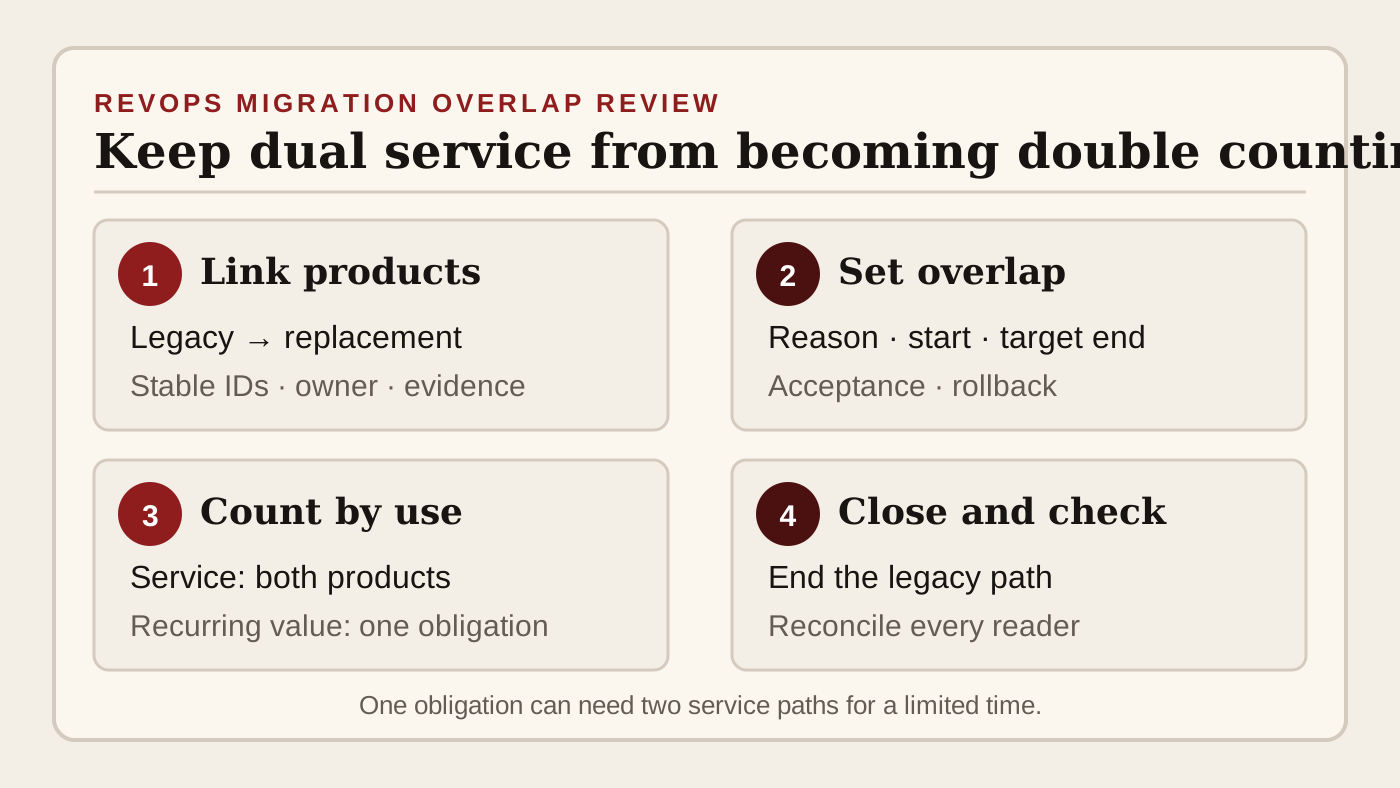
A customer renews onto a replacement product, but the old product must remain active for 30 days while data, users, integrations, and support procedures move. The accepted commercial record contains the replacement. The legacy subscription has not ended. Both entitlements are active, both product lines reach a warehouse model, and two Customer Success tasks are open. Nothing is necessarily wrong with temporary dual service. The defect begins when systems count the overlap as two continuing products or when nobody owns the event that ends it.
RevOps should treat migration overlap as a bounded service state with one customer obligation. Record the old and replacement products separately, connect them through a migration relationship, define why both remain active, name the approved overlap window, and decide how billing, entitlement, forecast, retention, and customer work treat each line. Close only after the replacement passes its acceptance checks, the legacy path ends under the approved rule, and every downstream view stops carrying the temporary duplicate.
What to watch today
Watch for renewals described as migration, replacement, platform move, SKU transition, phased cutover, parallel run, dual access, grace period, bridge, co-term, legacy access, sandbox-to-production move, data transfer, integration cutover, or temporary coexistence. Prioritize accounts where the replacement is active while the old subscription, entitlement, opportunity product, invoice line, renewal line, support plan, implementation task, or usage feed also remains active.
The first warning is two active products with no relationship field. An old SKU and a new SKU can look like separate retained products, expansion, or an accidental duplicate. A name such as legacy or replacement helps a person, but reports and integrations need stable product IDs, a relationship type, the migration case or change record, effective dates, and the rule that says which line belongs in each metric.
The second warning is an overlap end date with no acceptance condition. A planned date can arrive before data reconciliation, user access, integration testing, customer confirmation, or support readiness is complete. It can also pass without action. Store both the target end and the evidence required to end the old service, then route overdue overlaps as exceptions instead of extending them silently.
The third warning is one net commercial amount used by every downstream workflow. The quote may correctly charge only for the replacement while both products remain entitled. A credit can offset the old line. Billing can keep a subscription open until period end. Forecast and retention reporting can require a different treatment from service access. Preserve the gross lines and the approved treatment for each operating view.
Why RevOps should care
Migration overlap connects a customer commitment to CRM product lines, subscriptions, invoices, entitlements, provisioning, implementation, support, usage, renewal reporting, forecast, retention, commissions, and customer communication. A safe parallel run can therefore create several false signals: duplicate recurring revenue, apparent expansion, delayed churn, two active installed products, duplicate owner tasks, excess access, or a legacy service that never closes.
Stripe documents subscription schedules with phases and transitions, and separately documents cancellation timing and state. HubSpot documents subscription records and line items as distinct record surfaces. Salesforce documents opportunity products and entitlement-management concepts. These sources support a model with separate product, subscription, line, timing, and service records. They do not decide contract meaning, whether dual access is authorized, accounting treatment, retention definitions, invoice treatment, or when a particular migration is complete.
RevOps should keep three decisions separate. First, what did the customer accept commercially? Second, which products or services may the customer use during the transition? Third, which recurring value and product state should each internal report count? One answer should not overwrite the others. The overlap record connects them through dates, evidence, owners, and explicit metric treatment.
CRM and workflow signals to inspect
- Account or company ID, legal entity, workspace or tenant ID, renewal opportunity or deal ID, quote ID and version, contract or order ID, migration case or change ID, and stable cross-system associations
- Legacy product ID, SKU, price ID, opportunity product or line-item ID, subscription-item ID, entitlement ID, invoice line, service plan, usage source, and historical reporting family
- Replacement product ID, SKU, price ID, opportunity product or line-item ID, subscription-item ID, entitlement ID, invoice line, service plan, usage source, and future reporting family
- Relationship type such as replaces, migrates from, bundled successor, temporary parallel service, or unrelated; approved mapping; decision source; reviewer; and evidence confidence
- Commercial renewal start and end, legacy service end, replacement service start, overlap start, target overlap end, actual cutover time, billing-cycle anchor, invoice period, timezone, and date authority
- Legacy and replacement quantity, recurring unit price, discount, currency, billing frequency, contracted term value, continuing run rate, timing-only value, credit, one-time migration fee, and approved bridge treatment
- Subscription status, scheduled phase or change, cancellation timing, invoice state, credit state, entitlement status, provisioned users, protected accounts, active sessions, and rollback window
- Data migration scope, record counts, rejected records, reconciliation status, integration switch, last legacy write, first replacement write, duplicate-write protection, support readiness, and customer acceptance evidence
- Renewal stage, forecast category, amount, retained value, expansion, contraction, product retention, installed-product count, customer-health input, and the metric-definition version used by each report
- Commercial owner, Customer Success owner, Implementation owner, Product Operations owner, Billing or Finance owner, Support owner, forecast owner, data owner, cutover approver, rollback owner, and close-condition owner
15-minute operator action
Open the five most recent renewals where an old and replacement product are both active. For each account, capture the accepted quote or order, both product IDs, both subscription and entitlement states, overlap start, target end, customer evidence, migration owner, billing treatment, and the reports that consume product or recurring value. Do not cancel subscriptions, remove access, change forecast, or rewrite retention fields during this first pass.
Classify each pair as approved parallel service, scheduled replacement, billing-only overlap, entitlement-only overlap, data-migration hold, rollback protection, legacy record awaiting closure, unrelated products, accidental duplicate, or evidence unclear. Then mark whether billing, service, forecast, retention, installed-product reporting, and customer work currently count zero, one, or both lines. A count of both can be valid for service and wrong for recurring-value reporting.
Choose one overlap whose target end has passed or whose reporting treatment is unclear. Write one cutover card with the old and replacement IDs, customer obligation, approved overlap reason, target date, acceptance checks, metric treatment, owner, next test, rollback condition, and close event. The output is five classified overlaps and one owned cutover decision, not a bulk shutdown of legacy access.
Build one migration relationship
Create a durable relationship between the legacy and replacement lines. Store both stable IDs, the migration record, relation type, approved commercial source, overlap reason, effective dates, customer evidence, responsible owners, and current state. Do not rely on similar product names or a free-text note. One legacy product can map to several replacement components, and several old SKUs can consolidate into one new package.
Keep the relationship separate from the product catalog. The old product may remain valid for other customers, and the replacement may already serve new business. The migration record explains what these two lines mean for this account and term. It should survive label changes and allow a report or integration to identify the continuing customer obligation without pretending the records are identical.
Define states that describe the transition: approved, not started, parallel service, validation, customer acceptance pending, cutover scheduled, legacy read-only, rollback window, completed, reversed, or exception. Each state needs entry evidence, permitted actions, owner, due date, and exit evidence. A status called migration in progress with no rules only hides age.
Separate service from recurring-value treatment
Service access may count both products during the overlap because users, integrations, or support work need both. Installed-product reporting may show both with a migration flag. Billing may charge one, both, or a net amount under the approved commercial terms. Forecast and retention reports may need one continuing recurring obligation plus a separate timing or migration component. Document the treatment rather than deriving it from active equals true.
Preserve gross components. If the replacement line is positive and a legacy credit offsets it, a net-zero result does not prove nothing changed. If both subscriptions show active while only one is billable, active subscription count is not recurring value. If usage arrives from both products, combined activity is not product expansion without identity, cutover, and metric rules.
Give every metric an inclusion key and reason. Useful fields include report family, legacy inclusion, replacement inclusion, effective period, approved definition, migration relationship, deduplication key, source snapshot, reviewer, and exception status. The same overlap can appear as two service entitlements and one retained commercial relationship without contradiction when the definitions remain visible.
Close access and downstream duplicates deliberately
Before ending the legacy path, verify the accepted replacement scope, migrated records, user and role mapping, integration endpoints, scheduled jobs, data freshness, customer confirmation, support runbook, billing action, protected exports, and recovery window. Platform state alone does not prove the customer can work normally. Use representative records and one normal workflow cycle where the risk justifies it.
Then execute the approved end action through the supported system owner. Depending on the setup, that can mean scheduling or confirming a subscription transition, ending or narrowing an entitlement, removing a legacy integration writer, closing a migration task, or marking the old line historical. Preserve request, response, prior state, effective time, actor, approval, and rollback evidence.
After the cutover, reconcile the accepted commercial record, opportunity products, quote lines, subscription items, invoices and credits, entitlements, provisioning, usage feeds, support records, renewal forecast, retention bridge, customer-health inputs, warehouse models, and owner queues. Reopen the exception when the old writer returns, both lines remain in continuing run rate, customer access breaks, a report drops both products, or a duplicate task survives.
Close the migration only when another operator can see why overlap existed, what the customer could use, what was billed, which value each report counted, which acceptance checks passed, who ended the legacy path, and what happened after the next normal sync and reporting cycle. Completion is an evidence state, not the disappearance of one product label.
Risks and limits
Do not remove legacy service solely to clean a dashboard. The old product can remain necessary for data export, audit history, contractual access, customer validation, rollback, regulatory retention, or a dependency that the migration plan has not closed. Customer access, records, and integrations should change only under the approved contract, security, privacy, retention, and service process.
Do not keep dual access indefinitely because nobody can prove completion. Parallel systems increase permission, support, data-sync, reporting, and operational cost. Route overdue overlaps by materiality and customer impact, give them a named owner, and require a new approved reason and date when an extension is necessary.
Do not infer expansion, churn, adoption, satisfaction, or migration success from two active products, changed usage, or a net invoice. Those observations require context and an approved metric definition. Keep commercial scope, service availability, usage, and customer outcome as separate evidence classes.
Finally, CRM, CPQ, billing, subscription, entitlement, product, integration, and reporting behavior depends on configuration, edition, permissions, timing, and release. Verify current documentation and representative records in the target environment. The useful result is not an overlap forced to zero. It is one migration where customer continuity, product state, recurring value, ownership, and final closure remain explainable without counting the same renewal twice.
Related reading
The renewal year starts before every product does · One renewal total can hide three product decisions · Trace every deal before retiring a CRM product · How to track renewals across your CRM · Renewal management workflows · CRM data quality workflows · Customer Success Operations · Sighub profile · HubSpot profile · Salesforce profile · Vitally profile
Source notes
These official sources support the workflow model and product concepts. They do not prove a specific retention outcome, benchmark, or vendor claim.
- Stripe subscription schedules: Official reference for subscription schedules, phases, phase transitions, iterations, start and end timing, and supported changes across a subscription lifecycle.
- Stripe cancel subscriptions: Official reference for immediate and period-end cancellation behavior, cancellation configuration, invoice consequences, and subscription state.
- HubSpot manage subscriptions: Official reference for subscription records, status, billing details, line items, associations, and supported subscription-management actions in HubSpot.
- HubSpot Line Items API: Official developer reference for line-item properties, product references, quantities, prices, terms, updates, and associations to deals and quotes.
- Salesforce Entitlement Management: Official Salesforce learning reference for entitlements, entitlement processes, service milestones, cases, and service-level support context.
- Salesforce create an opportunity and add products: Official Salesforce exercise showing products as separate opportunity records with quantity, sales price, price-book context, and amount.
Last updated: 2026-08-14