Quick summary
| Best for | Revenue teams that want prospecting data and sales execution close to workflow design while retaining explicit CRM, preference and commercial authority |
|---|---|
| Website | www.apollo.io |
| Primary users | Revenue operations, Sales operations, Sales development and outbound teams, Growth and demand generation, GTM systems and data teams |
| Ecosystem | Prospecting and enrichment / CRM / sales engagement / dialing / marketing campaigns / advertising audiences / agent and MCP workflows |
| Implementation complexity | High |
| Pricing model | Tiered commercial packaging and usage-based credits vary by plan and capability. Verify Builder Studio and Messaging OS availability, current limits, data terms and message or API usage directly with Apollo. |
| Status | established |
| Main limitation | Builder Studio and Messaging OS were announced as available soon rather than available now on September 30. |
| Last updated | 2026-10-01 |
Editorial verdict
Apollo is a strong candidate when a team needs prospect and account context close to outreach and wants to assemble Apollo-centered GTM workflows. The connected surface increases the importance of identity, data provenance, communication preference, channel coordination, CRM field authority and a tested shutdown. Do not make Builder Studio or Messaging OS a production dependency until the target account confirms the announced availability and controls.
What the tool does
Provides B2B prospect and company data, enrichment, search, scoring and workflow context; supports sequencing, email, dialing and related execution; exposes integrations, API and MCP capabilities; and announces Builder Studio for constructing pages, databases and automations, an Intelligence Layer for unified context and reasoning, and Messaging OS for signal-based email and advertising execution.
Where it fits in the RevOps stack
Apollo commonly sits beside a CRM and may connect to marketing, communication, warehouse and agent environments. Keep the CRM authoritative for defined account, owner and opportunity fields; a preference service or approved CRM field authoritative for contact permission; and billing or contract systems authoritative for commercial truth. Use Apollo context as evidence under a stated purpose, not as permission to overwrite those systems.
How to operationalize Apollo
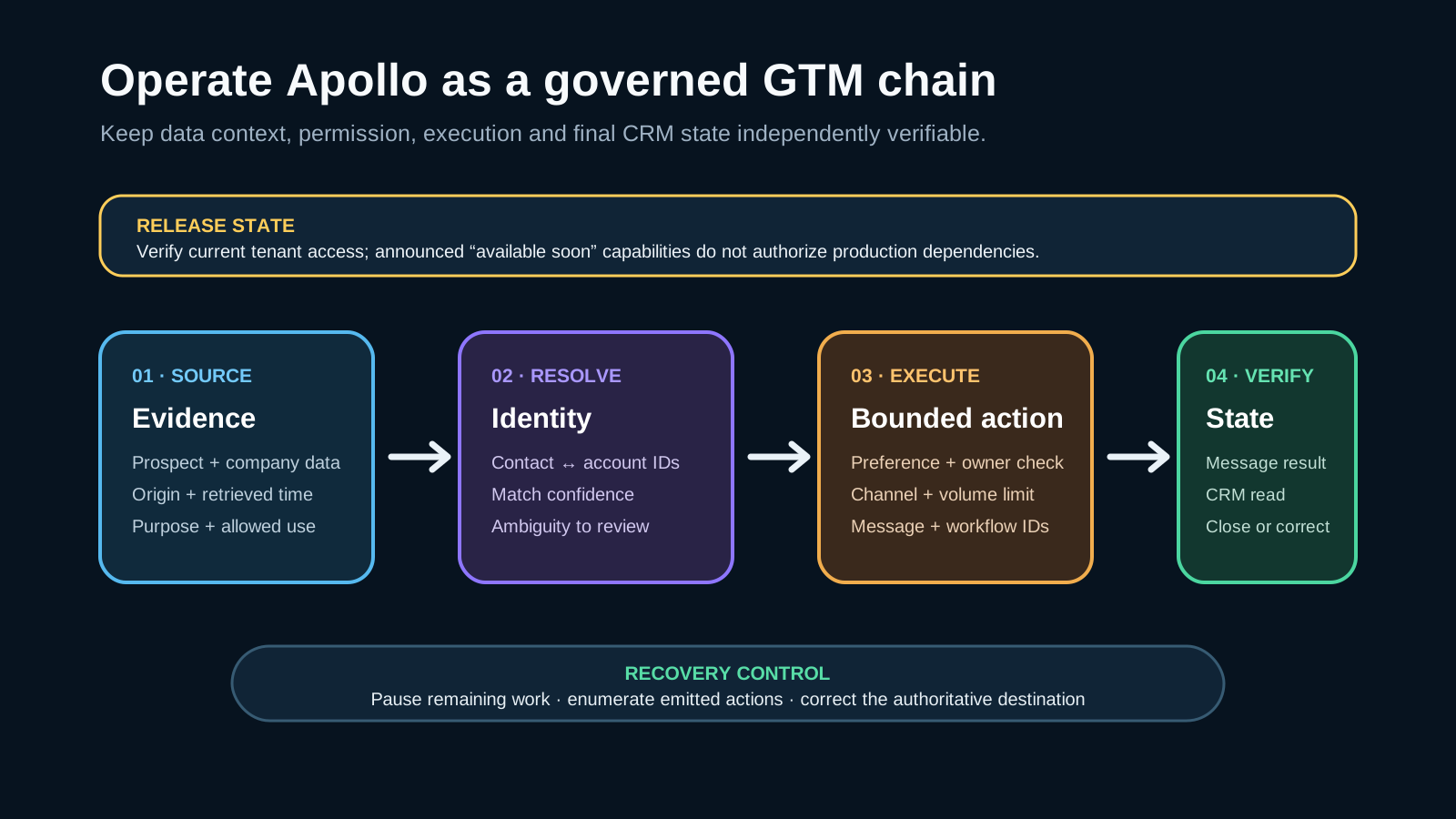
- Observe: Collect prospect, company, engagement and connected-source evidence with provenance and freshness.
- Resolve: Map people to the correct account and preserve duplicate or ambiguous cases.
- Propose: Produce priority, workflow, audience or message recommendations without assuming authority.
- Approve: Apply preference, ownership, territory, volume and field-authority checks.
- Execute: Run the bounded sequence, call, message, audience or record action with stable IDs.
- Verify: Read the message disposition and authoritative CRM state, then close or correct the run.
CRM and revenue data requirements
| Data area | Required inputs | Operator check |
|---|---|---|
| Identity | Apollo contact and account IDs, CRM IDs, source IDs, match confidence and merge history | Can the team explain the person-to-account link and keep uncertain matches out of automatic contact? |
| Permission | Channel preference, suppression, region, lawful basis where required, checked-at time and source | Is current permission checked immediately before outreach instead of inferred from data availability? |
| Commercial | Owner, territory, lifecycle, opportunity, customer and contract context from authoritative sources | Can Apollo read context without becoming the silent writer of fields another system owns? |
| Execution | Workflow, campaign, sequence, message, agent and correlation IDs plus result | Can an operator enumerate emitted work, duplicates, retries and the final destination state? |
Implementation sequence
- Verify which announced and existing Apollo capabilities are available in the target account.
- Select one bounded workflow and freeze its purpose, audience, tools, limits and stop conditions.
- Map Apollo contacts and accounts to stable CRM IDs and route ambiguity to review.
- Document data purpose, enrichment provenance, freshness and allowed downstream use.
- Configure current preference, suppression, ownership, territory and customer-state checks.
- Test normal, duplicate, stale, changed-owner, revoked, rejected and retry cases.
- Release a small cohort with a message or write ceiling and a named pause owner.
- Reconcile Apollo execution evidence with CRM and communication state.
- Review credits, exceptions and correction work before widening scope.
Governance checks
- Treat Builder Studio and Messaging OS as unavailable until the target account verifies current access and behavior.
- Apply least privilege to APIs, MCP, connected AI environments, CRM writes, email, dialing and advertising audiences.
- Separate builder, approver and recovery authority for consequential outreach and record changes.
- Preserve source, match confidence and checked-at time for enriched fields.
- Do not let enrichment overwrite contract, billing, consent or forecast truth.
- Coordinate sequence, campaign and ad-audience writers across the stack to prevent duplicate contact.
- Review retention, deletion, regional, security and data-provider terms before production use.
Buying and fit criteria
- Does the use case benefit from prospecting data and execution in one platform?
- Can the team verify the required product and plan availability now?
- Are identity, preference and CRM field authorities explicit?
- Can outreach channels be coordinated with existing marketing and sales systems?
- Can the team export or retain enough evidence for incident review?
- Can all remaining work be paused and all emitted work enumerated?
- Does the operating model remain sustainable after the initial builder creates the workflow?
How to measure operational value
Set a baseline before rollout. These are operating measures, not vendor performance benchmarks.
- Share of sampled contacts with stable and explainable account identity.
- Unmatched, ambiguous and duplicate identity rate.
- Share of consequential actions with current preference and ownership evidence.
- Held, rejected, retried and duplicate-prevention counts.
- Share of runs linked to final message and CRM state.
- Median time to resolve a data or execution exception.
- Correction and compensating-action rate by workflow version.
- Credits and operator effort per verified outcome, without treating cost alone as ROI.
Primary use cases
- Prospect and account research
- Contact and company enrichment
- Prioritization and targeting
- Outbound sequencing and dialing
- Signal-informed outreach
- Apollo-centered GTM workflow construction once available
- Agent and MCP-assisted prospecting
- Marketing email or ad-audience workflows once available and approved
Workflow fit
- Define the business question, subject grain, data purpose and authoritative destination.
- Search or enrich under a versioned source and checked-at time.
- Resolve contact-to-account identity and preserve ambiguity.
- Generate a recommendation, workflow or outreach proposal inside bounded tools.
- Recheck current preference, ownership, territory and commercial state.
- Require human approval for high-impact contact or CRM change.
- Execute with stable campaign, sequence, message, workflow and correlation IDs.
- Read the final CRM and messaging state independently.
- Close exceptions, retries and corrections before expanding volume.
Strengths
- Prospecting data and execution can live in one operating environment.
- The announced Intelligence Profile is designed to unify Apollo, CRM, engagement and connected-source context.
- The GTM Harness is described with orchestration, memory and governance for GTM-specific work.
- Apollo supports existing sales-execution capabilities alongside API, integration and MCP surfaces.
- The product direction can reduce manual context transfer for teams that govern the connected chain.
Limitations and risks
- Builder Studio and Messaging OS were announced as available soon rather than available now on September 30.
- Vendor-unified context does not settle which source owns identity, preference, commercial or forecast fields.
- Automated outreach can duplicate or conflict with CRM, marketing and sales-engagement systems.
- Credits and completed actions do not establish productivity, revenue or customer value.
- Data coverage, accuracy, permission, retention, regional terms and plan entitlements require account-specific verification.
- A platform stop does not retract delivered messages or automatically repair external CRM writes.
When not to use it
- Teams without a stable person and account identity model
- Organizations expecting enrichment to become contractual or billing truth
- Customer contact without governed preference and suppression checks
- Teams designing around announced products before tenant availability
- Workflows that require an irreversible action without a pause, evidence and recovery owner
Alternatives to compare
- ZoomInfo
- Clay
- Cognism
- 6sense
- Outreach
- Salesloft
- HubSpot
- Salesforce
RevOps evaluation checklist
- Name the workflow this tool should improve.
- Identify the source system and fields it needs.
- Assign the owner who acts on the tool output.
- Check whether it writes context back to the CRM or creates another data island.
- Measure whether manual review, missed follow-up, or routing confusion decreases.
Official sources
These sources support the product and implementation context. They do not prove revenue lift, adoption, rankings, or customer outcomes.
- Apollo: AI GTM System announcement: Official announcement updated September 30, 2026. It introduces Builder Studio, the Intelligence Layer and Messaging OS, and separately states that Builder Studio and Messaging OS will be available soon while the Intelligence Layer is available now.
- Apollo Builder Studio: Official product page linked from Apollo's announcement; confirm current access and behavior in the target account.
FAQ
Is Apollo Builder Studio available now?
Apollo's September 30, 2026 announcement says Builder Studio and Messaging OS will be available soon, while the Intelligence Layer is available now. Verify current status in the target account.
Does Apollo replace the CRM?
Usually no. Apollo can supply prospecting context and execution, but the organization should keep explicit authority for account, owner, opportunity, customer, contract and forecast fields in the appropriate systems.
Can Apollo automatically send outreach?
Apollo has established sequencing and outreach capabilities, and its announcement describes further Messaging OS execution. Automatic contact still requires current preference, suppression, identity, owner, volume, channel and recovery controls.
Does unified profile data prove the contact belongs to the right account?
No. Preserve source IDs, match method, confidence, effective timing and conflict handling, then route uncertain or multi-account cases to review.