Problem
An external assistant can make revenue work easier while hiding which tenant, permission, credit budget and destination state sit behind a fluent instruction. The user may see one successful answer even when a batch is partial, a protected write is denied or the authoritative record differs.
Why it matters
Apollo's first-party Claude connector is a timely example because its documented beta can research, enrich, create or update contacts, work with sequences, manage tasks and draft or send one-off emails under existing Apollo permissions, plan limits and credits. This playbook turns those boundaries into a reviewable production release.
Define the operating boundary
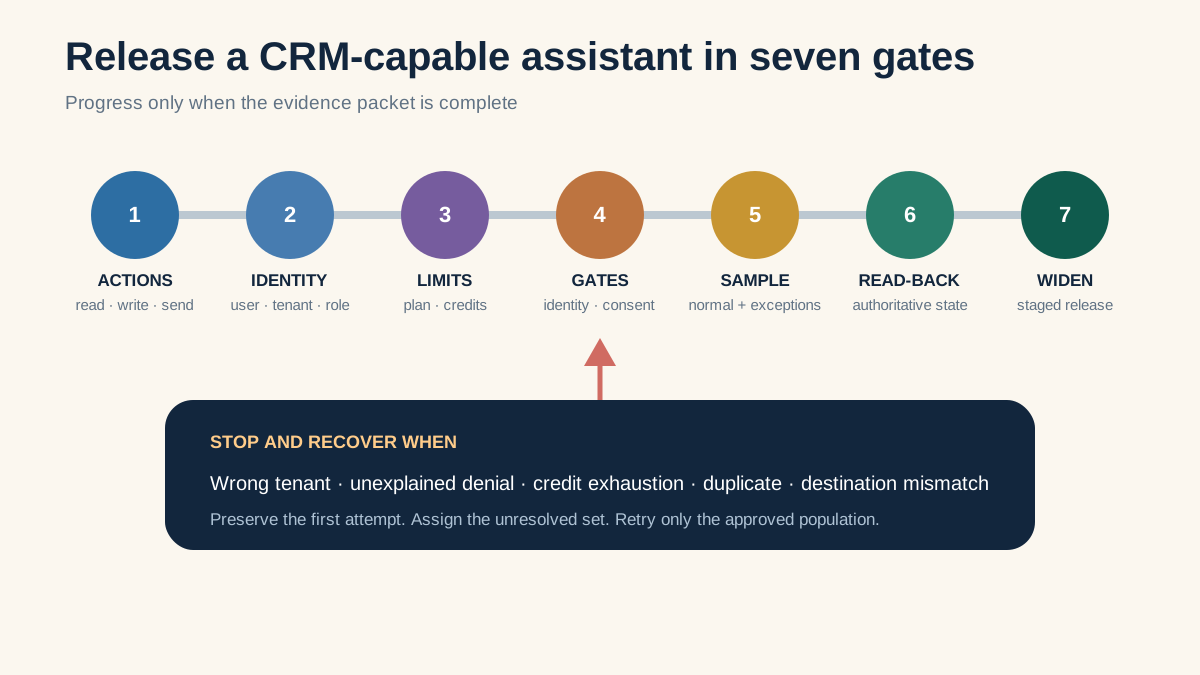
List every permitted action separately: search, enrich, create, update, draft, send, sequence enrollment, task change and analytics read. Name the authoritative system, record type and owner for each.
Separate read, propose and execute. Customer-facing, ownership, lifecycle, suppression and protected-field changes require stronger approval and verification than a read-only lookup.
Map identity and authority
Record the human user, assistant workspace, connected Apollo tenant, effective role and object or field permission. Test an intended denial in a safe environment so the boundary is evidence, not assumption.
Do not share a broad administrator identity. Use named accounts, least privilege and a documented access review. Show the acting tenant before a protected or bulk action.
Control limits and partial execution
Set credit and plan-limit ownership, warning thresholds and behavior at exhaustion. A partially enriched population must be marked partial at record level and routed for review.
Freeze the eligible population before bulk work. Retain completed, rejected, unresolved and untouched sets so a retry cannot create duplicates or overwrite incident evidence.
Add pre-action gates
For contact creation, check stable identity, duplicate rules, required fields and field ownership. For sequence enrollment or email, validate consent, suppression, sender, owner, audience, message source and timing.
Require an explicit confirmation that summarizes the action and eligible count for customer-facing or bulk execution. The confirmation should expose exclusions and irreversible consequences.
Verify authoritative state
After acknowledgement, read the destination again. Confirm the exact contact, changed fields, sequence membership, task state or message disposition. Store source time, request time, response time and read-back time.
Treat a missing read-back as unresolved, not successful. Assign every unresolved record to an owner with a deadline and a defined reconciliation query.
Design recovery before release
Record prior values for reversible writes and test the rollback on synthetic records. Define removal and suppression steps for sequence mistakes. Sent email is irreversible; recovery is escalation and correction, not database rollback.
Preserve the first attempt and the recovery result. Use idempotency, preflight reads or explicit manual reconciliation when the destination cannot safely repeat an action.
Widen in controlled stages
Start with internal or synthetic records, then a small approved business cohort, then a larger population only after evidence review. Keep stop conditions for duplicate rate, destination mismatch, credit exhaustion and unexplained denial.
Revalidate after connector, permission, schema, packaging or model changes. Beta status is a deployment fact to record, not a shortcut around release discipline.
Step-by-step workflow
- RevOps inventories assistant actions and produces an action-to-system boundary map.
- The platform owner verifies tenant and permissions and retains named-identity and denial-test evidence.
- The RevOps lead configures credit budget, alerts and a partial-run policy.
- Sales Ops and Legal validate suppression, consent, sender and customer-facing gates.
- The workflow owner runs a controlled sample and retains a record-level request and result log.
- The system owner reads back destination state and signs the final-state report.
- The business owner approves staged release and explicit stop conditions.
CRM fields and signals needed
- Assistant actions grouped by risk class
- Named tenant and effective role visible
- Credit and plan limits observable
- Destination read-back linked to each request
- Unresolved and partial results owned
- Rollback or correction path tested
Operating quality check
Use this check before adding more tooling. The goal is to prove that the workflow is owned, current, and inspectable inside the system of action.
| Area | Healthy pattern | Risk pattern |
|---|---|---|
| Identity | Named user, tenant and effective role | Shared or ambiguous connected account |
| Authority | Action-level permissions and denial evidence | One generic connected status |
| Limits | Credits, plan boundaries and partial-state policy | Silent exhaustion or inconsistent data |
| Evidence | Request, response and destination read-back | Conversational confirmation only |
| Recovery | Prior state, rollback or correction owner | Blind bulk retry |
Common mistakes
- Calling a connected workspace read-only when it can write or send
- Treating the assistant's confirmation as final state
- Using one shared administrator identity
- Retrying a partial batch without freezing prior results
- Ignoring credits as a production dependency
- Testing customer communication with unapproved live recipients
External assistant control review
- Connector and feature availability
- Action inventory and risk class
- Named user, tenant and role
- Protected objects and fields
- Credit owner and alert threshold
- Eligible-population snapshot
- Destination verification query
- Exception owner and SLA
- Rollback or correction procedure
- Release approver and review date
Example operating rhythm
- Daily during pilot: review denials, partial runs and destination mismatches.
- Weekly: sample permission receipts, credit consumption and final-state evidence.
- Monthly: recertify actions, roles, protected fields and recovery routes.
- On every material connector or packaging change: rerun the release gate.
Tooling options
- Named identity and tenant record
- Action-level permission inventory
- Credit and plan-limit monitor
- Structured request and response log
- Destination reconciliation query
- Rollback or correction runbook
Source notes
These sources support the workflow model and product concepts. They do not prove a specific business outcome, benchmark result, or vendor claim.
- Apollo: Integrate Apollo with Claude: Official documentation updated October 9, 2026. Apollo describes the first-party Claude connector as beta and subject to existing Apollo permissions, plan limits and credit balance.
- Outreach product release notes — October 2026: Official October 8, 2026 release notes used as supporting evidence for permission-aware external and measurement surfaces.
- Intercom: Macro Admin Mode: Official changelog shared October 9, 2026, used as supporting evidence for governed promotion and retirement of reusable knowledge.
Last updated: 2026-10-10
Decision frameworks to read next
FAQ
Does existing Apollo permission make the connector safe by default?
It provides an important enforcement boundary, but RevOps still needs to verify the active tenant, action-level authority, customer-facing gates, commercial limits and authoritative result.
What should require explicit confirmation?
Bulk work, protected-field changes, sequence enrollment and customer-facing sends should summarize scope, exclusions and irreversible consequences before execution.
How should a partial run be retried?
Freeze the original result sets, identify completed and untouched records, correct the dependency and rerun only the approved unresolved population with duplicate protection.
Is the assistant chat a sufficient audit log?
No. Keep structured action, permission, response and destination evidence outside the transient conversation, linked by stable IDs.
When should the gate be rerun?
After changes to connector behavior, model, permissions, schema, plan packaging, credit policy or any prior control failure.