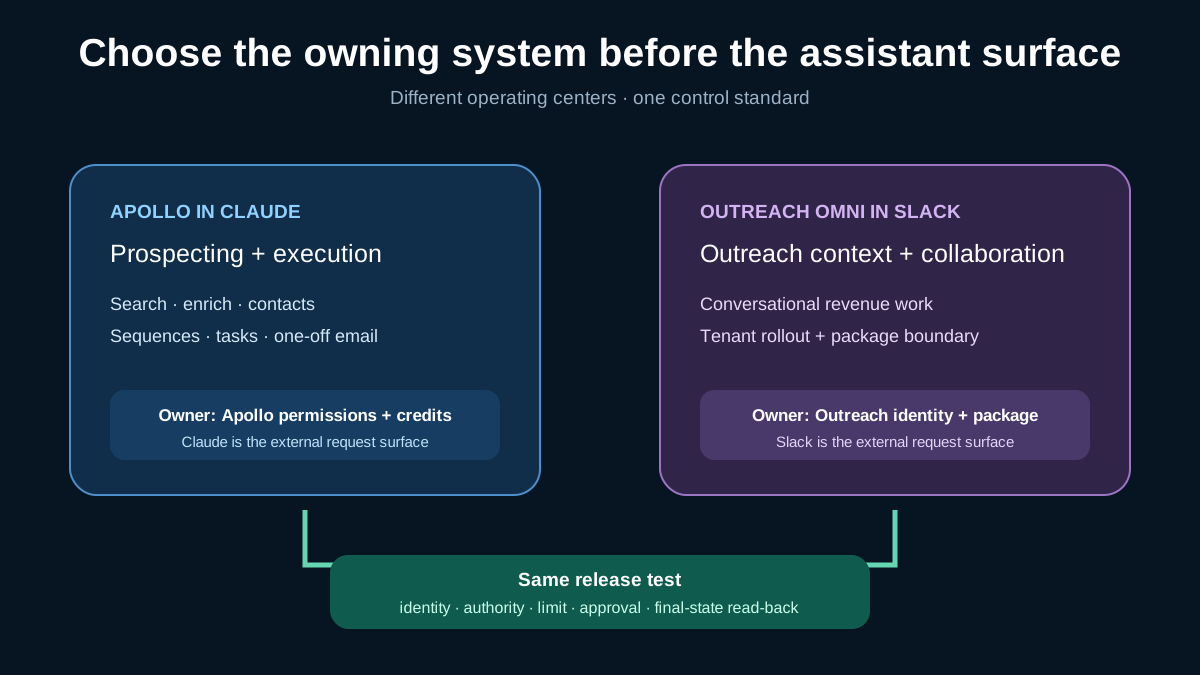
Short verdict
Choose based on the system that already owns the relevant work. Apollo in Claude is the documented fit for Apollo prospecting and execution tasks; Outreach Omni in Slack is the fit for an Outreach-centered motion using Slack. Do not choose on assistant familiarity alone. Verify exact account availability, permissions, packaging and destination evidence.
This comparison is written for RevOps, Sales Ops, GTM Operations, and Customer Success Ops teams that need a practical decision framework. It focuses on workflow ownership, CRM data quality, implementation effort, source-of-truth behavior, and the operating rhythm each option supports.
Who each option is best for
Apollo in Claude when teams want Apollo prospecting, enrichment, contact, sequence, task and one-off email capabilities in Claude; Outreach Omni in Slack when teams want Outreach-aware conversational work in Slack and already operate their engagement motions in Outreach.
The right answer depends on the job the team is trying to improve. A tool that is strong for one operating model can be a poor fit when the real problem is ownership, dirty CRM data, missing renewal dates, weak handoffs, or an unclear forecast process. Use this page to map the workflow before treating either option as the default.
Operating questions before choosing
- Which recurring meeting or workflow will change if the team chooses Apollo in Claude or Outreach Omni in Slack?
- Which CRM records, fields, activities, or customer signals are required for the workflow to be trusted?
- Who owns the next action when the system surfaces a risk, alert, forecast change, or customer signal?
- Does the option write usable context back to the system of record, or does it create another place to inspect?
- What manual review work should decrease after implementation?
Side-by-side table
| Criterion | Apollo in Claude | Outreach Omni in Slack | Editorial note |
|---|---|---|---|
| External workspace | Claude | Slack | The workspace affects interaction and collaboration, not record ownership. |
| Owning revenue platform | Apollo | Outreach | Start the decision with the system that already owns the action. |
| Documented operating center | Prospect search, enrichment, contact work, sequences, tasks, one-off email and performance analysis | Conversational Outreach work and context inside Slack; exact eligible actions depend on the documented rollout and account | Verify the exact action in the target tenant instead of generalizing the assistant label. |
| Availability evidence | Apollo documents the first-party connector as beta | Outreach documents Omni in Slack in its October 2026 release notes with rollout and packaging qualifications | Publication does not prove enablement in every account. |
| Permission boundary | Existing Apollo permissions | Outreach and Slack identity, permissions and enabled package | Test named roles and intended denials before release. |
| Commercial boundary | Apollo plan limits and credit balance | Outreach package and feature availability; verify current commercial terms | Commercial limits can become workflow dependencies. |
| Highest-risk actions | Contact writes, sequence enrollment and one-off sends | Customer-facing or record-changing actions made available through the Outreach integration | Require explicit scope and approval for consequential actions. |
| Required final evidence | Fresh Apollo or CRM read-back plus message or sequence disposition | Fresh Outreach and connected-system state plus Slack request trace | A conversational confirmation is not authoritative state. |
Workflow comparison
- Name the revenue system that owns the intended action.
- Verify tenant, user and feature availability in the target account.
- Map each assistant action to its effective permission and commercial limit.
- Test read-only, denied and approved paths on synthetic records.
- Require explicit confirmation for bulk or customer-facing execution.
- Read back authoritative state and retain exceptions.
- Review adoption, denials, partial runs and recovery evidence.
A RevOps workflow should produce a visible action, not only a report. When comparing Apollo in Claude and Outreach Omni in Slack, the team should look at the handoff from signal to owner to customer action. If the output does not change a task, meeting, field, renewal follow-up, forecast inspection, or manager review, the tool may become another dashboard rather than operating leverage.
Implementation complexity
Medium to high for both. The interaction is simple, but identity, permissions, customer-facing actions, commercial packaging, rollout state and final-state verification remain production controls.. The real complexity depends on data quality, ownership clarity, and whether the team changes its operating rhythm.
Implementation should start with source fields, permissions, integration points, and the review process. The most common failure is buying a tool before defining the workflow. A narrow pilot is usually safer than a full rollout because it reveals bad CRM fields, unclear owners, duplicate definitions, and gaps between the tool and the team operating cadence.
Data and CRM requirements
Reliable RevOps decisions need clean CRM data. Before choosing between Apollo in Claude and Outreach Omni in Slack, check owner fields, lifecycle stage, account and opportunity status, renewal or close dates, activity history, task ownership, and the fields that drive routing or reporting. If these fields are not trusted, the comparison should include a data cleanup step.
- Define the system of record for the workflow.
- List the fields that trigger action or reporting.
- Decide which fields can be written automatically and which need review.
- Document what evidence an operator should inspect before acting.
- Measure whether the workflow reduces missed follow-up or manual reconciliation.
Data model impact
- Retain initiator, connected tenant and source record.
- Store requested action, permission evidence and source observation time.
- Link platform response, final-state read-back and exception ID.
- Minimize customer data passed into the external workspace.
CRM fields and signals to check
- Stable contact, account and opportunity IDs
- Connected tenant and initiating user
- Source observation and request times
- Consent, suppression and sequence eligibility
- Owner, lifecycle and protected-field authority
- Platform response and destination read-back
- Message, task or sequence final disposition
- Exception and recovery status
Cost and maintenance considerations
Do not infer total cost from the external workspace alone. For Apollo, include the Apollo plan, credit consumption, Claude access and operating controls. For Outreach, include the applicable Outreach package, Slack environment and implementation. Verify current vendor pricing directly; neither source used here establishes a universal total-cost comparison.
Cost should include licenses, setup time, admin maintenance, integration work, enablement, governance, and the opportunity cost of manual review. A cheaper workflow can become expensive if it requires weekly spreadsheet cleanup. A larger platform can become expensive if the team only uses a narrow part of it. RevOps should compare total operating cost, not only subscription price.
Risks and limitations
- Wrong connected tenant or user context
- Broad permissions inherited by a convenient interface
- Credit or package limits creating partial execution
- Assistant confirmation mistaken for authoritative state
- Customer-facing action without consent or suppression checks
- Duplicate contact or enrollment on retry
- Chat history used as the only audit record
The main risk in any RevOps tool comparison is overgeneralizing. No tool is universally best. The fit depends on company stage, CRM maturity, sales motion, renewal volume, customer success model, admin capacity, and how disciplined the team is about acting on signals.
Implementation risk
- Bulk scope and customer communication raise consequence.
- Ambiguous identity or tenant selection can misdirect otherwise permitted work.
- Asynchronous completion requires a later authoritative read-back.
- Weak recovery makes partial retries likely to duplicate action.
Governance risk
- Shared channels and retained prompts need data-minimization rules.
- Connector identities require clear ownership, review and revocation.
- Beta or staged rollout status should be recorded for the exact account.
- Conversation history should not be the only audit record.
Alternatives and complements
- Use the native Apollo or Outreach interface for actions that need richer review context.
- Use CRM-native automation when the CRM is the authoritative decision surface.
- Use a warehouse or BI layer for governed cross-system measurement rather than asking an assistant to invent a joined metric.
- Use a controlled workflow platform when multi-system writes require versioning, retries and compensating actions.
Weekly operating rhythm
- Review newly enabled assistant actions and account rollout.
- Sample approved, denied and partial executions.
- Reconcile CRM, sequence, task and message outcomes.
- Inspect credit or package constraints and unusual consumption.
- Recertify broad roles and remove unused connector access.
- Close or escalate unresolved destination mismatches.
Decision framework
- Start from system ownership, not the external workspace.
- Choose Apollo in Claude when documented Apollo prospecting and execution actions are the required operating center.
- Choose Outreach Omni in Slack when the engagement model is centered in Outreach and Slack is the collaboration surface.
- If both are used, give every action one authoritative owner and one reconciliation path.
If the team cannot name the owner, source field, review cadence, and next action, pause the purchase and map the workflow first. Strong RevOps teams buy tools to close a defined operating gap. They do not use tools to discover the process after the contract is signed.
FAQ
Are Apollo in Claude and Outreach Omni in Slack direct substitutes?
Not generally. They expose work from different owning platforms in different external workspaces. Compare the specific job, authoritative system and available actions.
Can Apollo in Claude send email?
Apollo's October 9 documentation says eligible users can draft and send one-off emails, subject to existing permissions, plan limits and credit balance. Verify the exact beta behavior in the target account.
Does Omni in Slack replace Outreach?
No. It is an external conversational surface for Outreach-centered work, not a new system of record. Outreach remains the platform whose permissions, data and package govern the eligible capability.
Which option has better governance?
Governance depends on configuration and operating evidence. Evaluate identity, action-level permission, customer-facing gates, retained logs, destination read-back and recovery in the actual tenant.
Can a team use both?
Yes, when each owns a distinct job. Define one owner for every write, prevent duplicate execution and reconcile outcomes into the authoritative CRM and engagement records.
Source notes
These official references support the product and workflow context. DailyRevOps uses them to bound the comparison, not to imply outcomes, rankings, or adoption claims.
- Apollo: Integrate Apollo with Claude: Official documentation updated October 9, 2026. It identifies the connector as beta and documents capabilities plus existing-permission, plan-limit and credit boundaries.
- Outreach product release notes — October 2026: Official release notes published October 8, 2026. They document Omni in Slack with rollout and packaging context; verify exact tenant availability.
Last updated: 2026-10-10