Short verdict
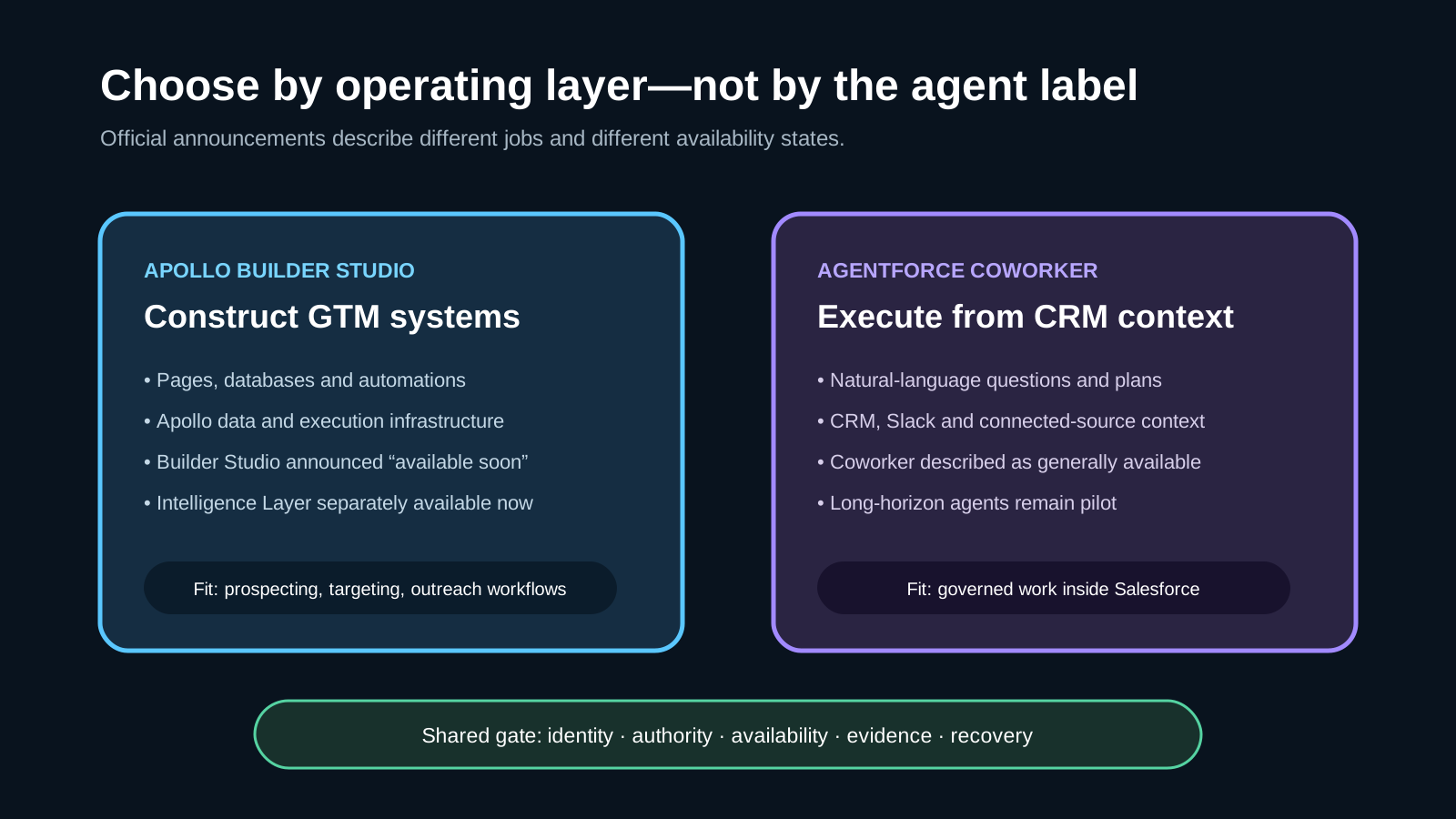
These products overlap in agent-assisted work but start from different operating layers. Apollo announced Builder Studio as available soon; Salesforce describes Coworker as generally available. Verify tenant status first, then compare data authority, callable actions, evidence, limits and recovery using one real workflow.
This comparison is written for RevOps, Sales Ops, GTM Operations, and Customer Success Ops teams that need a practical decision framework. It focuses on workflow ownership, CRM data quality, implementation effort, source-of-truth behavior, and the operating rhythm each option supports.
Who each option is best for
Apollo Builder Studio fits teams designing prospecting, targeting and outreach systems on Apollo's data and execution infrastructure once the announced product is available to them. Agentforce Coworker fits teams that want conversational planning and execution grounded in Salesforce, Slack and connected sources under existing Salesforce permissions.
The right answer depends on the job the team is trying to improve. A tool that is strong for one operating model can be a poor fit when the real problem is ownership, dirty CRM data, missing renewal dates, weak handoffs, or an unclear forecast process. Use this page to map the workflow before treating either option as the default.
Operating questions before choosing
- Which recurring meeting or workflow will change if the team chooses Apollo Builder Studio or Salesforce Agentforce Coworker?
- Which CRM records, fields, activities, or customer signals are required for the workflow to be trusted?
- Who owns the next action when the system surfaces a risk, alert, forecast change, or customer signal?
- Does the option write usable context back to the system of record, or does it create another place to inspect?
- What manual review work should decrease after implementation?
Side-by-side table
| Criterion | Apollo Builder Studio | Salesforce Agentforce Coworker | Editorial note |
|---|---|---|---|
| Primary job | Build pages, databases and automations for GTM workflows | Answer questions, build plans and execute from a Salesforce conversation | Compare the actual workflow, not the agent label |
| Context base | Apollo data and execution infrastructure plus connected sources | Salesforce CRM, Slack and other connected sources | Neither context layer automatically owns every business field |
| Availability stated | Announced as available soon on September 30 | Described as generally available on September 28 | Verify current account entitlement and region |
| Related intelligence | Intelligence Profile and GTM Harness in the Intelligence Layer | Salesforce permissions, CRM context and orchestrated agents | Preserve source and freshness of every input |
| Execution surface | Prospecting, pipeline monitoring, outbound and announced messaging extensions | Plans and actions orchestrated inside the Salesforce conversation | List actual callable actions and downstream queues |
| Marketing reach | Messaging OS announcement includes email campaigns, Bulk Send API and ad audiences | Coworker is not presented as a dedicated campaign-delivery system | Customer-contact governance differs |
| Long-running work | Confirm persistence, pause and retry behavior in the target release | Separate long-horizon agents are pilot with GA planned for November | Do not attribute pilot capabilities to Coworker GA |
| Approval | Define who approves generated systems, audiences and outreach | Define approval check-ins, action permissions and CRM field authority | Generated work remains a proposal until authorized |
| Observability | Require run, tool, record and message evidence available in the account | Salesforce also announced health monitoring, scorers and Optimizer states | Vendor telemetry still needs a final destination read |
| Recovery | Pause workflows and inspect already-emitted outreach or writes | Stop plans and reconcile actions already executed across agents and systems | Disabling an agent does not reverse terminal effects |
Workflow comparison
- Choose one representative workflow such as research-to-outreach or account-review-to-CRM action.
- Freeze the source identities, field authorities, allowed actions, human approvals and terminal outcome.
- Verify the exact availability and entitlement for each required capability in both environments.
- Build normal, duplicate, stale, changed-owner, rejected and retry cases with expected evidence.
- Run a bounded pilot and independently read the CRM, messaging or other destination after execution.
- Compare operator time, exception handling, evidence completeness, correction effort and ongoing admin ownership.
A RevOps workflow should produce a visible action, not only a report. When comparing Apollo Builder Studio and Salesforce Agentforce Coworker, the team should look at the handoff from signal to owner to customer action. If the output does not change a task, meeting, field, renewal follow-up, forecast inspection, or manager review, the tool may become another dashboard rather than operating leverage.
Implementation complexity
High. The real complexity depends on data quality, ownership clarity, and whether the team changes its operating rhythm.
Implementation should start with source fields, permissions, integration points, and the review process. The most common failure is buying a tool before defining the workflow. A narrow pilot is usually safer than a full rollout because it reveals bad CRM fields, unclear owners, duplicate definitions, and gaps between the tool and the team operating cadence.
Data and CRM requirements
Reliable RevOps decisions need clean CRM data. Before choosing between Apollo Builder Studio and Salesforce Agentforce Coworker, check owner fields, lifecycle stage, account and opportunity status, renewal or close dates, activity history, task ownership, and the fields that drive routing or reporting. If these fields are not trusted, the comparison should include a data cleanup step.
- Define the system of record for the workflow.
- List the fields that trigger action or reporting.
- Decide which fields can be written automatically and which need review.
- Document what evidence an operator should inspect before acting.
- Measure whether the workflow reduces missed follow-up or manual reconciliation.
Data model impact
- Apollo's Intelligence Profile is described as unifying Apollo, CRM, engagement and connected-source context. Map source IDs, match confidence, update time and allowed downstream uses rather than treating the unified profile as automatically authoritative.
- Salesforce context depends on object relationships, permissions and connected sources. Preserve account, contact, opportunity, task and activity IDs and record which object owns each consequential field.
- If both products touch outreach or CRM records, assign one writer or use idempotent coordination. Record campaign, sequence, message, workflow and agent IDs under a shared correlation key.
- Maintain current preference, suppression, territory, ownership and commercial-state checks at execution. Historical context can explain a proposal without authorizing present action.
CRM fields and signals to check
- Stable contact, account and opportunity IDs; source IDs; match confidence; merge history and effective-time associations.
- Owner, territory, stage, status, next step, last meaningful activity, preference and suppression with source and checked-at time.
- Workflow version, agent ID, tool call, approval, campaign or sequence, message and destination execution IDs.
- Previous and proposed value, allowed writer, write result, independent read, correction status and reviewed-at time.
Cost and maintenance considerations
Model subscription and usage packaging only from current account-specific quotes and official terms. Add implementation, data preparation, connector maintenance, permissions, testing, message or API usage, monitoring, human review and recovery work. Apollo's announcement does not define a universal Builder Studio price, and Salesforce packaging and entitlements vary. Do not convert announced availability or vendor adoption statements into a local ROI claim.
Cost should include licenses, setup time, admin maintenance, integration work, enablement, governance, and the opportunity cost of manual review. A cheaper workflow can become expensive if it requires weekly spreadsheet cleanup. A larger platform can become expensive if the team only uses a narrow part of it. RevOps should compare total operating cost, not only subscription price.
Risks and limitations
- Designing around Apollo Builder Studio before the target account can use the announced product.
- Attributing long-horizon pilot behavior to generally available Coworker.
- Letting enrichment or conversational context overwrite authoritative CRM, subscription or preference state.
- Giving a builder or agent permission to approve its own high-impact scope.
- Measuring completed tool calls without checking customer contact or final CRM state.
- Ignoring already-emitted messages, tasks or external actions during shutdown.
The main risk in any RevOps tool comparison is overgeneralizing. No tool is universally best. The fit depends on company stage, CRM maturity, sales motion, renewal volume, customer success model, admin capacity, and how disciplined the team is about acting on signals.
Implementation risk
- Builder-generated configuration can obscure the exact deployed audience, branch or tool scope unless the release version is frozen.
- Conversational execution can make a multi-step plan feel like one action even when several agents and downstream systems are involved.
- Start with synthetic and controlled records, then a bounded cohort with a hard message or write ceiling.
- Test unavailable capability, permission revocation, connector delay, duplicate identity, changed owner and destination overwrite before scale.
- Verify retention and export of evidence needed for incident review rather than assuming the interface preserves it indefinitely.
Governance risk
- Separate workflow builder, business approver, platform administrator and recovery authority for high-impact actions.
- Apply least privilege to profile context, CRM records, messaging, connected tools and agent orchestration.
- Treat release-state changes and new callable actions as production changes requiring renewed tests.
- Preserve held, rejected and manually corrected runs as control evidence.
- Review vendor marketing statements as capability descriptions, not proof of productivity, revenue or customer outcomes.
Alternatives and complements
- Deterministic CRM workflows remain appropriate when inputs, branches and actions are completely expressible and stable.
- Dedicated sales-engagement tools may fit teams that need mature sequence, dialer and rep-workflow controls without a broader agent builder.
- A governed integration or reverse-ETL layer can move approved data while keeping transformation and field authority explicit.
- A warehouse can support analysis and reconstruction but should not silently become the real-time authority for consent or commercial state.
Weekly operating rhythm
- Monday: review availability, permission, connector and source-freshness changes.
- Midweek: sample normal, rejected and duplicate-prevention cases across the active workflow.
- Friday: reconcile emitted messages, CRM writes, open tasks and corrections with destination state.
- Monthly: retest pause and recovery, remove unused scopes and compare admin effort against the original decision.
Decision framework
- Choose Apollo Builder Studio when the primary need is to assemble Apollo-centered prospecting, targeting, monitoring and outreach workflows and the required product is verifiably available.
- Choose Agentforce Coworker when the team works primarily in Salesforce and needs governed conversational planning and execution across CRM, Slack and connected sources.
- Use both only when system boundaries, stable identities, field authorities and duplicate-contact prevention are documented.
- Keep deterministic rules for fixed eligibility, suppression, amount, permission and routing constraints even when an agent proposes the surrounding work.
- Do not buy or expand either system until the team can pause a pilot, enumerate emitted work and verify the final authoritative state.
If the team cannot name the owner, source field, review cadence, and next action, pause the purchase and map the workflow first. Strong RevOps teams buy tools to close a defined operating gap. They do not use tools to discover the process after the contract is signed.
FAQ
Is Builder Studio generally available?
Apollo's September 30 announcement says Builder Studio and Messaging OS will be available soon, while the Intelligence Layer is available now. Verify the current target account before planning a production dependency.
Does Coworker include long-horizon agents?
Salesforce lists Coworker as generally available and long-horizon agents separately as pilot with GA planned for November 2026. Treat them as distinct release states.
Can the products be used together?
Potentially, but define identity, writer authority, outreach coordination, evidence and shutdown behavior so connected agents do not duplicate messages or overwrite the same CRM state.
Source notes
These official references support the product and workflow context. DailyRevOps uses them to bound the comparison, not to imply outcomes, rankings, or adoption claims.
- Apollo: AI GTM System announcement: Official announcement updated September 30, 2026. It introduces Builder Studio, the Intelligence Layer and Messaging OS, and separately states that Builder Studio and Messaging OS will be available soon while the Intelligence Layer is available now.
- Salesforce: 21 Things We Announced at Dreamforce 2026: Official roundup dated September 28, 2026. It gives distinct availability states for Coworker, long-horizon agents, Agent Optimizer, AI Skills and other Agentforce capabilities.
Last updated: 2026-10-01