Problem
A connected GTM workflow can move from customer context to outreach, CRM changes or financial action before operators have separated product availability, business authority, terminal state and recovery.
Why it matters
Apollo, Salesforce and Stripe document new connected execution surfaces with different availability and consequence boundaries. RevOps needs one release method that tests the complete chain without pretending the products are interchangeable.
Inventory systems, truth and release state
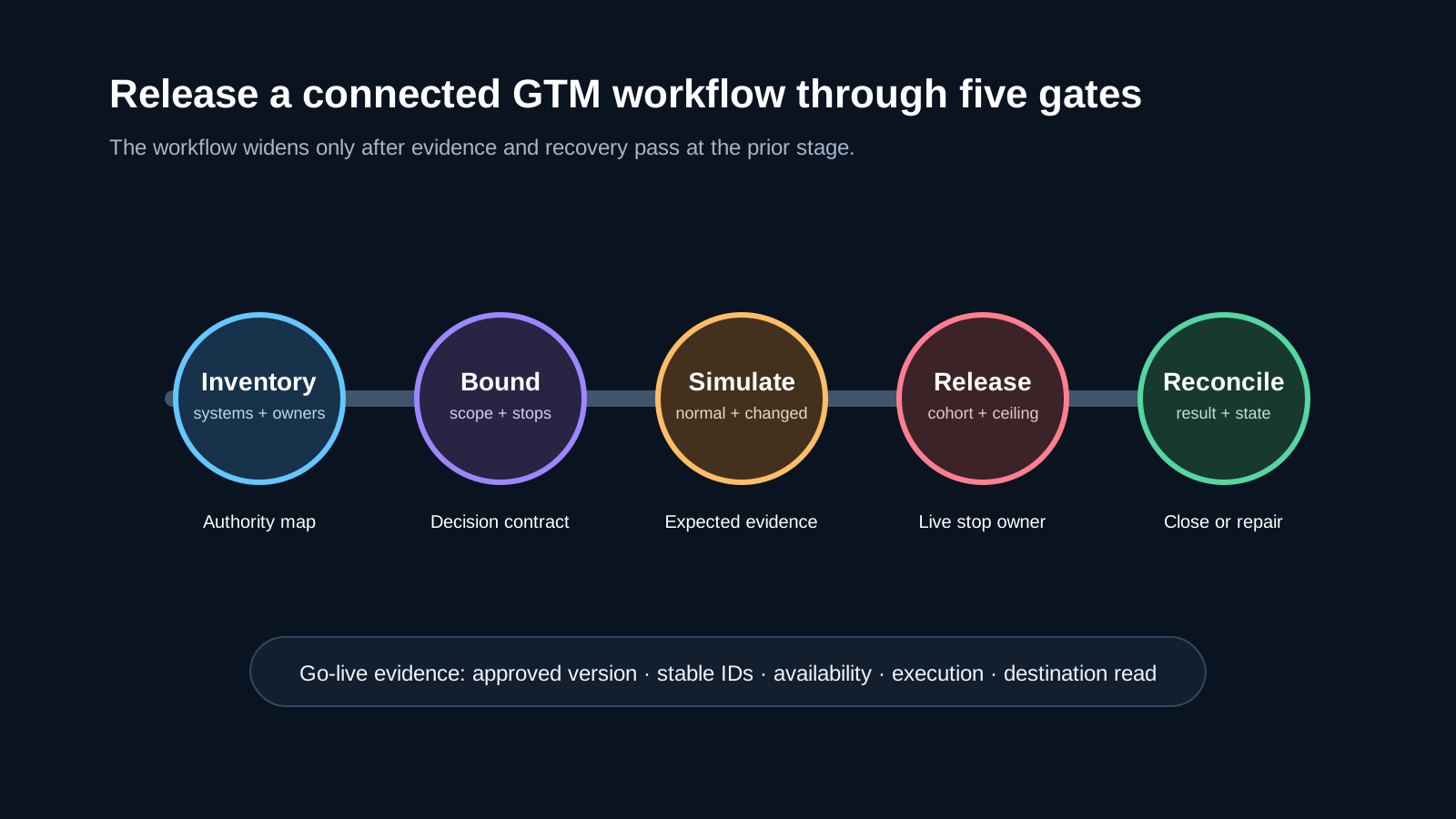
List every source, agent, workflow, destination and customer-facing or financial consequence. Name the system that owns identity, preference, CRM fields, subscription, payment, payout and reporting state. Record the official source date and actual tenant availability for every new capability.
Separate current from announced behavior. Apollo says its Intelligence Layer is available now while Builder Studio and Messaging OS will be available soon. Salesforce assigns GA, beta, pilot and planned dates across its announcements. A missing entitlement is a stop condition, not an invitation to design around a roadmap.
Write the decision contract
Define the subject and account grain, purpose, allowed observations, allowed tools, writable fields, contact channels, amount or volume limits, current-state checks and human approvals. Attach the contract to one executable version.
Classify each step as observe, propose, approve, execute or verify. The same person may perform several roles in a small team, but the evidence must still show when a proposal became authorized and which exact scope the approval covered.
Simulate normal and changed state
Create test cases for valid identity, duplicate contact, conflicting account, stale signal, changed owner, revoked preference, missing entitlement, unavailable feature, failed tool call, repeated retry, delayed confirmation and destination overwrite. Add payment or payout cases only where those consequences are actually in scope.
For each case, write the expected action, expected non-action, evidence, terminal state and recovery. Run the destination read independently. A builder preview or agent trace cannot prove that the authoritative system accepted and retained the intended result.
Release a bounded cohort
Choose a representative cohort, time window and hard ceiling for contacts, records or funds. Name the live monitor and the person authorized to pause. Keep irreversible actions behind a final human release until normal and exception evidence pass.
Track source volume, decision branches, approvals, tool errors, retries, customer-contact dispositions, financial statuses and final-state mismatches. Investigate an anomaly before retrying because late events and already-emitted work can turn a recovery attempt into a duplicate.
Reconcile and close
Sample completed, held, rejected and corrected runs. Reconstruct the source observation, identity, release state, approved version, action, destination read and settled business outcome. Resolve every unexplained difference before widening the cohort.
Exercise pause and recovery before declaring the release complete. Confirm which work stops immediately, which queue drains, which records need reversal, which financial action needs a separate return and which customer communication needs compensation. Store the evidence and schedule the next version review.
Step-by-step workflow
- Name the business outcome and classify its consequence.
- Inventory source systems, destinations, owners and release states.
- Assign stable subject, account, workflow, execution and correlation identifiers.
- Create the field-and-action authority register.
- Freeze the exact proposed configuration and approval scope.
- Define current-state, expiry, amount, volume and availability stop conditions.
- Build normal, duplicate, stale, changed-owner, revoked, rejected, retry and delayed tests.
- Verify every test through an independent destination or ledger read.
- Approve a bounded cohort, live monitor, ceiling and pause owner.
- Reconcile normal and exceptional runs before expansion.
- Exercise reversal or compensating action with named authority.
- Close only after final state, open exceptions and next review are recorded.
CRM fields and signals needed
- Official source date and tenant checked-at time
- Capability availability state
- Stable subject and account identifiers
- Approved workflow and policy version
- Current preference and commercial state
- Tool call and destination execution ID
- Requested and terminal amount or message status
- Independent destination read
- Pause, return, reversal or compensation owner
- Final reconciliation and reviewed-at time
Operating quality check
Use this check before adding more tooling. The goal is to prove that the workflow is owned, current, and inspectable inside the system of action.
| Area | Healthy pattern | Risk pattern |
|---|---|---|
| Availability | Official status and tenant behavior are verified | Roadmap language is treated as production |
| Authority | Every consequential field and action has an owner | Connected context is allowed to redefine truth |
| Execution | Limits, IDs, stops and terminal results are preserved | A tool success is the only evidence |
| Outcome | Independent destination or ledger state reconciles | The workflow ends before business settlement |
| Recovery | Pause, reversal or compensation is tested | The team assumes disabling the agent undoes effects |
Common mistakes
- Treating an announced or soon-available product as a current dependency
- Letting a prompt or generated plan stand in for approved configuration
- Allowing enriched context to overwrite an authoritative commercial field
- Using one mutable email or domain as the cross-system key
- Treating a successful tool call as a settled business outcome
- Retrying before checking delayed or already-emitted work
- Calling a delivered message or completed payout reversible
- Expanding volume before exception paths and recovery pass
Connected GTM release evidence review
- Provide the release ID, approved version and cohort.
- List source, field, channel and financial authorities.
- Link live execution, destination and reconciliation evidence.
- Name who may pause, retry, reverse, return or communicate.
- Record unresolved exceptions and the next review time.
Example operating rhythm
- Before release: approve sources, authority, version, tests, cohort, ceiling and recovery.
- First live hour: reconcile entries, decisions, actions, terminal statuses and destination reads.
- Next business day: sample normal, held, rejected, delayed and manually corrected runs.
- Weekly: review availability changes, stale context, permission changes, retries and unresolved mismatches.
- Monthly: retest pause and recovery, remove obsolete scopes and reapprove changed workflow versions.
Tooling options
- Use Apollo evidence for profile, intelligence and execution only within the product surfaces actually available in the target account.
- Use Salesforce agent, testing and monitoring surfaces according to their published and tenant-specific release state.
- Use Stripe product and ledger evidence for payment or funds movement, with separate commercial and accounting reconciliation.
- Use the CRM, billing, preference and data systems for authoritative current-state checks.
- Use a governed release register for decisions, versions, samples, exceptions and recovery results.
Source notes
These sources support the workflow model and product concepts. They do not prove a specific business outcome, benchmark result, or vendor claim.
- Apollo: AI GTM System announcement: Official announcement updated September 30, 2026. It introduces Builder Studio, the Intelligence Layer and Messaging OS, and separately states that Builder Studio and Messaging OS will be available soon while the Intelligence Layer is available now.
- Salesforce: 21 Things We Announced at Dreamforce 2026: Official roundup dated September 28, 2026. It gives distinct availability states for Coworker, long-horizon agents, Agent Optimizer, AI Skills and other Agentforce capabilities.
- Stripe: OUSD is now the default stablecoin on Stripe: Official product announcement dated September 30, 2026. It describes support across Treasury, Issuing, Global Payouts, Crypto Onramp and Payments, while preserving a choice of other stablecoins and blockchains.
Last updated: 2026-10-01
Decision frameworks to read next
FAQ
Can the same person build and approve the workflow?
A small team may combine roles, but it should still record the exact transition from proposal to approval, apply proportionate review and prevent an automated agent from authorizing its own material scope increase.
Does a generally available feature skip the release gate?
No. GA describes vendor availability, not local identity, permission, data, policy, integration or recovery readiness.
When is a run complete?
When the authoritative destination is read, the customer or financial outcome reaches the defined terminal state, mismatches are owned and any necessary correction is verified.