Three late-September announcements move different parts of the revenue stack toward more connected execution. Apollo introduced Builder Studio, an Intelligence Layer and Messaging OS. Stripe made OUSD available across several products and described it as the default stablecoin configuration on Tempo while retaining other choices. Salesforce's Dreamforce roundup described Agentforce Coworker as generally available, long-horizon agents in pilot and a set of testing, observability and optimization capabilities at different release stages. The products are not substitutes, but together they reveal the same operating problem: context, decision and action are becoming easier to join than authority and evidence.
A connected system is useful because it removes handoffs that exist only to move data or repeat configuration. Apollo says Builder Studio can turn a description into pages, databases and automations on its data and execution infrastructure. Its Intelligence Layer combines profile context with a GTM-specific harness. Messaging OS uses signals to recommend audience, timing and channel. Those links can reduce fragmented prospecting and outreach work. They also make it possible for one interpretation to travel from a profile into several customer-contact surfaces before a human notices that the underlying identity, eligibility or commercial state was wrong.
Availability is the first boundary. Apollo's announcement says the Intelligence Layer is available now, while Builder Studio and Messaging OS will be available soon. Salesforce distinguishes Coworker as generally available, long-horizon agents as pilot with GA planned for November, Optimizer as GA in October and AI Skills as pilot with October GA. Stripe says OUSD support launches across its products while also describing a continued rollout. RevOps should record the exact account, region, plan, release state and checked-at time. A roadmap sentence is not permission to design a production dependency.
The second boundary is the proposal. A natural-language builder, contextual recommendation or agent-generated plan can accelerate design without becoming the approved operating configuration. Preserve the instruction, retrieved evidence, proposed audience or subject, intended writes, channel, limits and tool scopes. Then freeze the exact version that a named owner reviews. Approval must attach to executable configuration rather than a screenshot or a conversation summary. When the system changes the plan later, that change needs a new decision record if it crosses a material customer or commercial boundary.
The third boundary is field and action authority. Customer context is not interchangeable truth. Apollo may hold enriched profile and engagement evidence; a CRM may own account and opportunity state; a subscription system may own service status; Stripe may own payment or funds-movement records; a preference service may own contact permission. A connected agent can read all of them and still be wrong about which one may authorize a message, owner change, payout or forecast update. Create a register that names the allowed reader and writer for every consequential field and action.
Stripe makes the boundary especially visible because moving funds has a terminal financial consequence. Its announcement says businesses can receive, hold, send and spend OUSD with Treasury, build card programs with Issuing, pay recipients through Global Payouts, offer fiat-to-OUSD conversion with Crypto Onramp and accept OUSD with Payments. Those capabilities are product surfaces, not one undifferentiated workflow. Each has its own customer, account, network, authorization, ledger, settlement, refund, dispute and reconciliation questions. A default configuration should never silently decide the financial policy for every use case.
Model stablecoin operations with at least two amounts and two clocks. Preserve the amount and currency or token presented to the customer, the amount and asset accepted, the amount delivered or settled, and any converted fiat amount. Record authorization, network submission, confirmation, settlement and ledger-posting times separately. A payment can be accepted before treasury state is fully reconciled, and a payout can leave a platform queue before the recipient considers it complete. Revenue reporting should use a documented commercial event rather than treating network movement as revenue by definition.
Salesforce's long-horizon agents introduce a time boundary. A plan that runs for days or months will encounter changed ownership, closed opportunities, revoked permissions, updated customer preferences and superseded commercial terms. The announcement says the runtime supports memory, durable execution and conversational steering with guardrails and approval check-ins. RevOps should add a current-state check before every consequential step, an expiry for old approvals and an explicit condition that cancels or replans work when the original purpose is no longer valid.
Observability must follow the same boundaries. Salesforce describes Agent Health Monitoring, custom scorers, voice testing and other evaluation surfaces. Apollo's release describes governance within its GTM Harness, while the announced system connects data, intelligence and execution. Stripe product records cover a separate financial chain. None of those vendor views alone proves the complete customer outcome. Carry stable subject, account, workflow, execution, payment and correlation identifiers across systems, then independently read the final authoritative state.
Recovery is the final authority boundary. A CRM field may be reversible to a prior value. A queued sequence can sometimes be paused. A delivered message cannot be unsent. A completed payout may require a separate return or correction process rather than a rollback. Define pause, cancellation, retry, reversal and compensating action separately. Name who may use each path, what evidence is required and which system confirms completion. The connected system should expose affected work without allowing the same failing agent to approve its own recovery.
The release gate should test a normal path and changed-state paths. Use a valid prospect, a duplicate identity, a contact attached to two accounts, a revoked communication preference, a changed owner, a stale signal, a missing approval, a failed tool call, a delayed payment confirmation and a destination overwrite. For each case, record the expected non-action or action, evidence and final state. A system is not ready because the normal demo completes; it is ready when the organization can contain and explain the first meaningful exception.
Measure evidence completeness rather than autonomy. Sample runs and ask whether another operator can locate the initial observation, identity mapping, configuration version, release state, approver, tool calls, customer or funds movement, destination state and recovery owner. Track missing links, stale context, unauthorized writes, repeated retries, settlement mismatches and corrections. These are local control measures, not vendor benchmarks. Their value comes from stable definitions and repeated review across the same workflow.
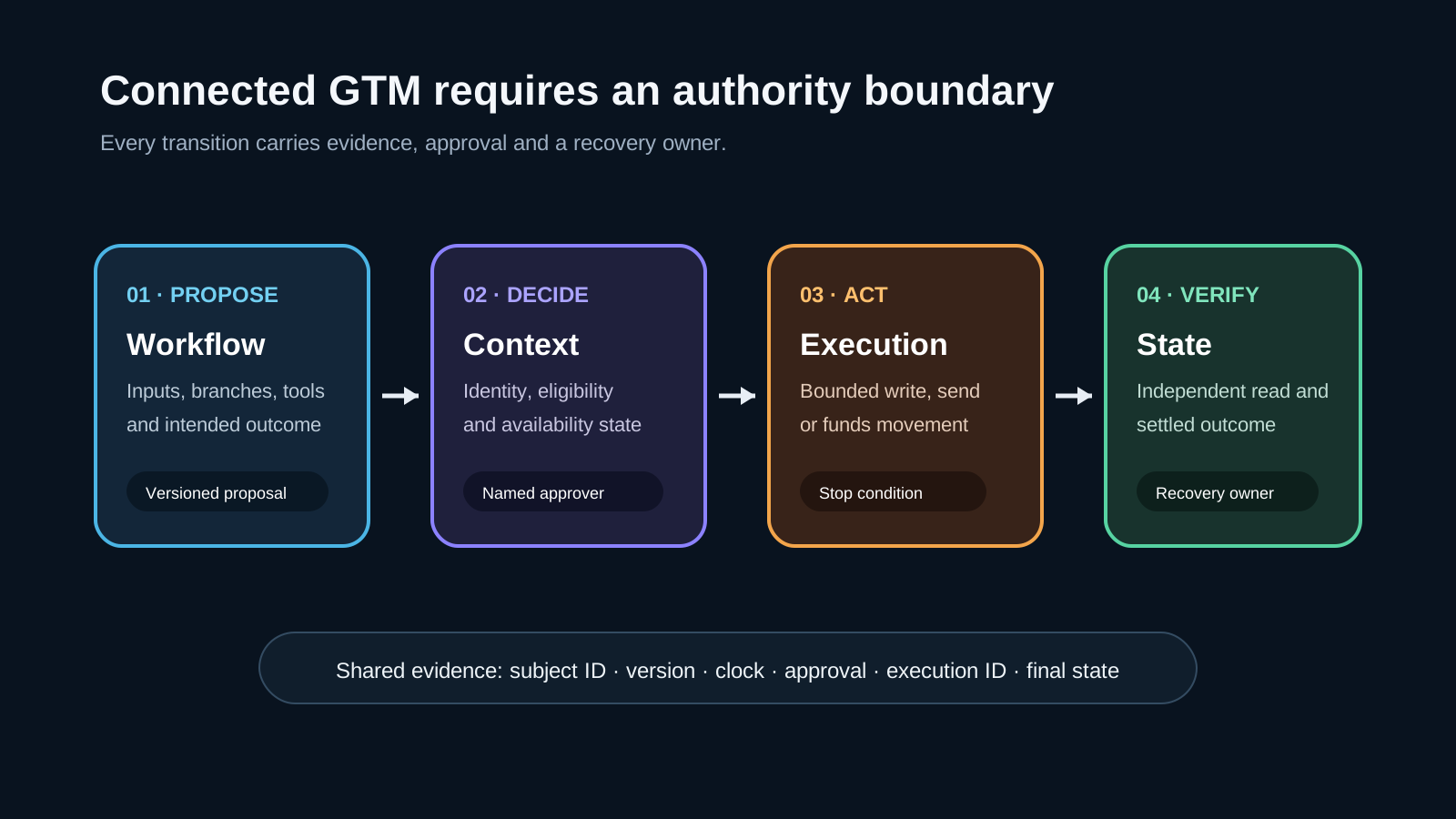
The architectural decision is therefore not centralized versus distributed software. It is where the organization places irreversible authority. Let connected tools assemble context and propose work close to the operator. Keep the decision contract outside vendor marketing language and attach it to the business consequence. Require a current-state check at execution, a terminal read after execution and a human-owned recovery path. That design preserves speed without allowing convenience to redefine customer, commercial or financial truth.
Apollo, Stripe and Salesforce each describe a larger operating surface. RevOps should take the releases seriously without treating connection as control. The mature connected GTM system is not the one that performs the most steps without intervention. It is the one that knows which steps are proposals, which actions are authorized, which records remain authoritative and how to stop, explain and repair a result when the world changes mid-run. Related reading: Revenue Operations · Sales Operations · Data Quality · Apollo
Source notes
These official sources support the workflow model and product concepts. They do not prove a specific retention outcome, benchmark, or vendor claim.
- Apollo: AI GTM System announcement: Official announcement updated September 30, 2026. It introduces Builder Studio, the Intelligence Layer and Messaging OS, and separately states that Builder Studio and Messaging OS will be available soon while the Intelligence Layer is available now.
- Stripe: OUSD is now the default stablecoin on Stripe: Official product announcement dated September 30, 2026. It describes support across Treasury, Issuing, Global Payouts, Crypto Onramp and Payments, while preserving a choice of other stablecoins and blockchains.
- Salesforce: 21 Things We Announced at Dreamforce 2026: Official roundup dated September 28, 2026. It gives distinct availability states for Coworker, long-horizon agents, Agent Optimizer, AI Skills and other Agentforce capabilities.
Last updated: 2026-10-01