Three current product changes make the same operating tension visible. Apollo's first-party Claude connector lets an eligible user find prospects, enrich records, create or update contacts, draft or send one-off emails, build sequence variants, add contacts to sequences, manage tasks and inspect team performance. Outreach's October release includes Omni in Slack and new KPI tiles. Intercom's Macro Admin Mode gives appropriately permissioned teammates a view across personal macros so they can promote useful replies into a shared library or delete outdated ones.
The products are not substitutes. Apollo connects prospecting and sales execution to an external assistant. Outreach brings selected revenue work and measurement into collaboration and reporting surfaces. Intercom governs support knowledge inside its own workspace. Their common signal is architectural: the place where a person asks for work, approves work or learns from work can differ from the system that owns the commercial record.
An interface can travel while authority stays put
A useful external workspace removes navigation cost. A seller can ask a question in Claude instead of rebuilding filters in a prospecting tool. A manager can inspect an Outreach signal in Slack rather than waiting for a separate reporting session. A support operator can turn a strong personal response into shared operating knowledge without copying text through an informal document. That proximity can shorten the distance between evidence and a decision.
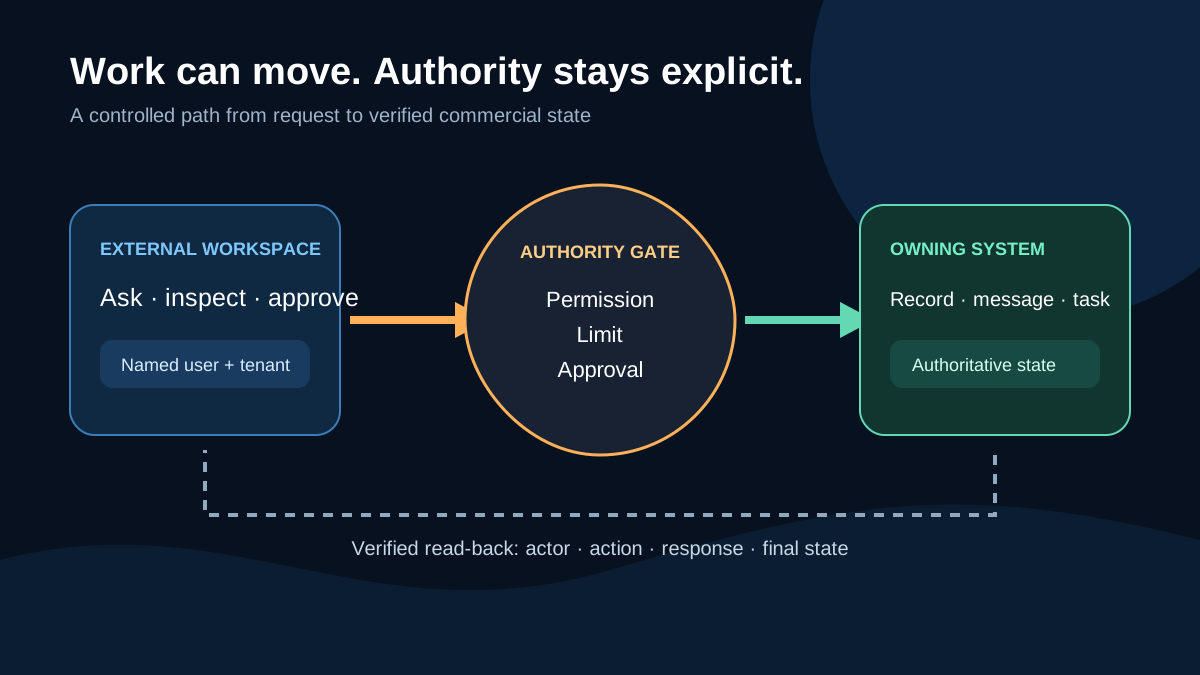
Proximity does not transfer ownership. Apollo says its Claude connector runs on the user's existing Apollo permissions, plan limits and credit balance. That boundary matters because a conversational surface may feel broader than the account behind it. The correct operating model is delegated execution: the external surface requests an action, while the source product still decides whether the user may perform it and which commercial limits apply.
RevOps should document that distinction at action level. Searching, enriching, creating a contact, sending an email and adding someone to a sequence are not one permission. They carry different customer, compliance and data-quality consequences. A connector inventory that merely says Apollo connected to Claude is too coarse to review or revoke safely.
Evidence needs to cross the same boundary as the action
A successful assistant response is not the same as a verified business outcome. The request may have been accepted while the final CRM write failed, a credit limit interrupted enrichment, a sequence membership rule rejected the contact or an asynchronous operation remained incomplete. The receiving system should be read after consequential work, and the result should be tied to the initiating user, action, source record and time.
This is where Outreach's KPI tiles are an instructive companion signal. Outreach documents ten KPIs, permission-aware visibility, 15-minute refresh behavior and automatic period comparison for supported date presets. Those qualifications are more valuable than a decorative scorecard because they tell an operator how fresh the view is, who can see it and when a comparison is or is not available. Measurement surfaces need operating contracts too.
A revenue team should retain four timestamps: source observation, request, destination acknowledgement and verified read-back. They answer different questions. Source observation says how old the evidence was. Request time shows when the operator acted. Acknowledgement shows when the platform accepted the action. Read-back shows when the intended state was actually visible in the authoritative system.
Personal workspaces create a knowledge-governance problem
Intercom's Macro Admin Mode addresses a less obvious version of the same boundary. Personal macros can accumulate high-quality language and useful diagnosis steps, but they can also preserve outdated policy, inconsistent claims or unsupported promises. Before this release, an administrator may have known that personal libraries existed without being able to assess the individual artifacts as one governed population.
The right response is not to promote every popular macro. A shared macro is an operational commitment. It needs an owner, intended audience, policy source, approval date, expiration or review date and a way to retire it. Usage volume can identify candidates, but it cannot prove that the underlying guidance is current or correct.
Macro deletion also needs care. Removing an obsolete template prevents future use, but it does not prove that prior conversations were correct or that copied variants no longer exist. Keep a decision record for promoted and retired macros, and sample recent conversations when a template changes a contractual, billing, security or service-level statement.
Build one cross-surface control model
RevOps can govern these changes with one compact model. First, name the system of record for every protected field and outcome. Second, list the external surfaces that can propose, approve or execute work. Third, map each action to the permission and commercial limit that gates it. Fourth, specify the evidence required to close the action. Fifth, assign an exception owner and a recovery route.
Do not assume a collaboration or assistant surface is low risk because it contains little data at rest. Its real risk may be delegated authority. Conversely, do not block a useful interface merely because it is outside the source application. Bounded execution with fresh read-back can be safer than manual copy-and-paste that leaves no stable action record.
The design test is whether a second operator can reconstruct what happened without relying on chat history or the memory of the person who clicked. They should be able to identify the actor, source evidence, requested action, effective permission, commercial limit, destination response and final verified state. If any part is missing, the workflow remains open.
The operating opportunity
External work surfaces can make revenue systems easier to use without weakening control. They can bring prospect research closer to a question, performance context closer to a manager and support knowledge closer to the people who refine it. The opportunity is not a wholesale replacement of CRM, engagement or support platforms. It is a cleaner separation between interaction, execution and record ownership.
That separation becomes durable when every action has a boundary and every boundary produces evidence. Treat the conversational or collaborative interface as an operating client, not a new source of truth. Let the owning system enforce permissions and limits. Then verify the resulting state where the business record actually lives.
Source notes
These official sources support the workflow model and product concepts. They do not prove a specific retention outcome, benchmark, or vendor claim.
- Apollo: Integrate Apollo with Claude: Official Apollo documentation updated October 9, 2026. The connector is described as beta and subject to existing Apollo permissions, plan limits and credit balance.
- Intercom: Macro Admin Mode: Official Intercom changelog shared October 9, 2026. It documents viewing personal macros, promoting useful ones to shared macros and deleting outdated ones for teammates with the shared-macro permission.
- Outreach product release notes — October 2026: Official Outreach release notes published October 8, 2026, with rollout windows and package or permission qualifications for the documented features.
Last updated: 2026-10-10