Problem
A programmatic content pipeline can report success while leaving an asset duplicated, attached to the wrong workflow, published without the accepted preview or blocked by consent and suppression rules that were never tested. A timeout can also trigger a blind retry after the first request already changed state.
Why it matters
Customer.io's October 6 release says its Design Studio API can manage email content from supplied HTML through review and testing, workflow linking and later publication. Those are useful control points. RevOps should turn them into explicit states with separate authority, destination read-back and recovery evidence instead of one broad publish script.
Freeze the release contract
Name one source revision, content artifact, target workspace, workflow, step and eligible audience. Record the builder, reviewer, publisher, release window and rollback target. State which changes expire approval.
Use stable identifiers wherever the platform exposes them. Display names are useful for people but weak reconciliation keys when several versions share a title.
Separate authority by stage
Use different credentials for draft creation, tests, workflow attachment and publication when the architecture permits. Restrict each identity to the required environment, object type and action.
Test one permitted and one denied action before production. A permission model is unproven until the platform refuses an action that should be refused and retains enough evidence to explain the denial.
Create and retry idempotently
Include a stable release key or idempotency mechanism. Store returned content identifiers, status and server values. If a request times out, query the destination before retrying; do not assume silence means nothing happened.
A successful creation closes only the draft step. It does not prove review, workflow attachment, publication, audience eligibility or delivery.
Run content and render checks
Check approved sender, subject, preheader, required legal language, links, tracking, accessibility, plain text, locale and personalization fallbacks. Preserve the inspected artifact, target, time and result rather than a green status alone.
A test delivery proves generation and delivery to the test target. It does not prove that the production audience, consent, suppression, frequency or workflow timing is correct.
Test audience and consent
Build a frozen cohort with an eligible person, suppressed person, opted-out person, missing personalization, ambiguous identity and cross-region case. Write the expected outcome before execution.
Use the current authoritative consent and subscription records. Customer.io's October 1 consent-record release is useful evidence about choice history; a content approval must never be treated as customer permission.
Verify the workflow association
Attach the content to the exact approved workflow and step. Read the association back and compare identifiers and versions. Record whether the workflow is draft, active or scheduled.
Document how the target configuration treats in-flight records after content changes. If the behavior is not known, test it safely instead of guessing.
Publish a bounded release
Present one packet with source revision, preview, tests, workflow association, audience evidence, open exceptions and rollback target. The approver accepts or rejects the exact bounded version.
After publication, fetch the authoritative destination. Compare version, status, association and server-generated values. Keep an asynchronous operation open until final state is visible or the exception owner accepts the unresolved result.
Observe and recover
Release first to the safest meaningful cohort where the workflow supports it. Watch disposition, fallback use, suppression, links and unexpected audience entry against stop conditions written before traffic begins.
Rollback may mean restoring a version, detaching content, pausing a workflow or narrowing an audience. Name the action for every stop condition. Preserve the failed release evidence and any recipients already affected.
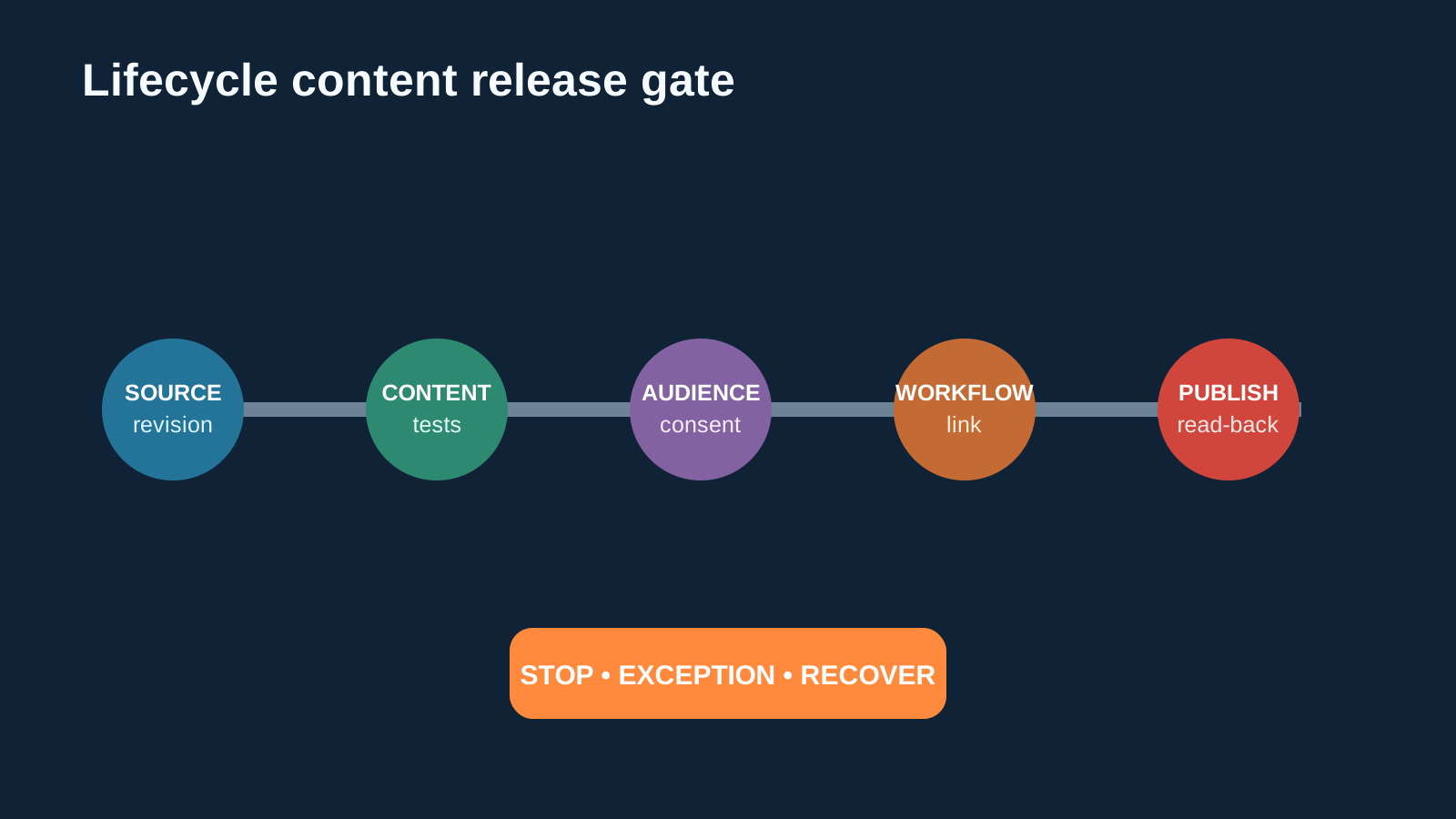
Step-by-step workflow
- RevOps freezes the source revision, destination identifiers, cohort and release window.
- The platform owner verifies least-privilege identities and captures an intended denial.
- The build identity creates or updates the draft with duplicate-safe behavior.
- The reviewer checks content, rendering, links, legal requirements and fallbacks.
- Lifecycle Operations tests consent, suppression, identity and audience edge cases.
- The workflow owner attaches the exact version and reads the association back.
- The release owner approves the bounded packet; the publisher executes only that version.
- The auditor verifies final state, opens exceptions and closes with a recovery-ready receipt.
CRM fields and signals needed
- Stable content and workflow identifiers
- Accepted preview and test evidence
- Positive and negative audience cases
- Separate publication authority
- Authoritative destination read-back
- Owned release exceptions
- Tested rollback target
Operating quality check
Use this check before adding more tooling. The goal is to prove that the workflow is owned, current, and inspectable inside the system of action.
| Area | Healthy pattern | Risk pattern |
|---|---|---|
| Identity | Stable person, content and workflow IDs | Title matching or ambiguous profile |
| Authority | Stage-specific identities and tested denial | One broad super-token |
| Content | Accepted artifact and retained test evidence | Green status without inspected output |
| Audience | Consent, suppression and edge cases verified | Approval treated as permission |
| State | Destination version and association read back | API acknowledgement treated as final |
| Recovery | Named stop condition and tested rollback | Blind mutation of live content |
Common mistakes
- Using a title as the only object identifier
- Giving one long-lived token build and publication authority
- Treating a test send as audience approval
- Retrying a timeout without querying the destination
- Changing a live version without renewing approval
- Assuming publication overrides consent or suppression
- Deleting incident evidence during rollback
Lifecycle release-control review
- Source revision
- Workspace ID
- Content ID and version
- Workflow and step IDs
- Approved sender
- Accepted previews
- Link and fallback results
- Consent and suppression source
- Frozen cohort
- Approval and publisher
- Final-state query
- Exception owner
- Rollback target
Example operating rhythm
- Per release: freeze identifiers, tests, approval, read-back and receipt.
- Daily during rollout: review wrong association, duplicate, consent and delivery exceptions.
- Weekly: sample receipts, credential use, recovery readiness and in-flight behavior.
- Monthly: recertify scopes, rotate credentials and retest intended denials.
- After any API, schema, permission or workflow change: rerun the relevant release gate.
Tooling options
- Source-control revision
- Content and workflow ID registry
- Render and link checker
- Consent and suppression preflight
- Idempotency or release key
- Destination reconciliation query
- Exception queue
- Rollback runbook
Source notes
These sources support the workflow model and product concepts. They do not prove a specific business outcome, benchmark result, or vendor claim.
- Customer.io release notes: Official October 6, 2026 release note for end-to-end Design Studio content management through the API.
- Customer.io: consent records: Official October 1, 2026 release note describing retained consent changes, scope and origin.
- NIST Secure Software Development Framework: General secure-development context; not evidence about Customer.io or its implementation.
Last updated: 2026-10-11
Decision frameworks to read next
FAQ
Does a successful create call mean the email is live?
No. Draft creation, review, testing, workflow association and publication are distinct states. Verify each state in the destination.
Should one service credential perform every stage?
Prefer stage-specific authority. If the platform forces broader access, add explicit approvals, environment restrictions, monitoring and frequent rotation.
What should happen after an API timeout?
Query the destination using the stable release key or content identifier before retrying. Resume from verified state instead of creating a duplicate.
Does approved content prove the audience is eligible?
No. Test current consent, suppression, identity, region and workflow eligibility separately with both positive and negative cases.
When is the release complete?
After the authoritative content and workflow state are read back, high-risk exceptions have owners, and the receipt and recovery path are complete.