Short verdict
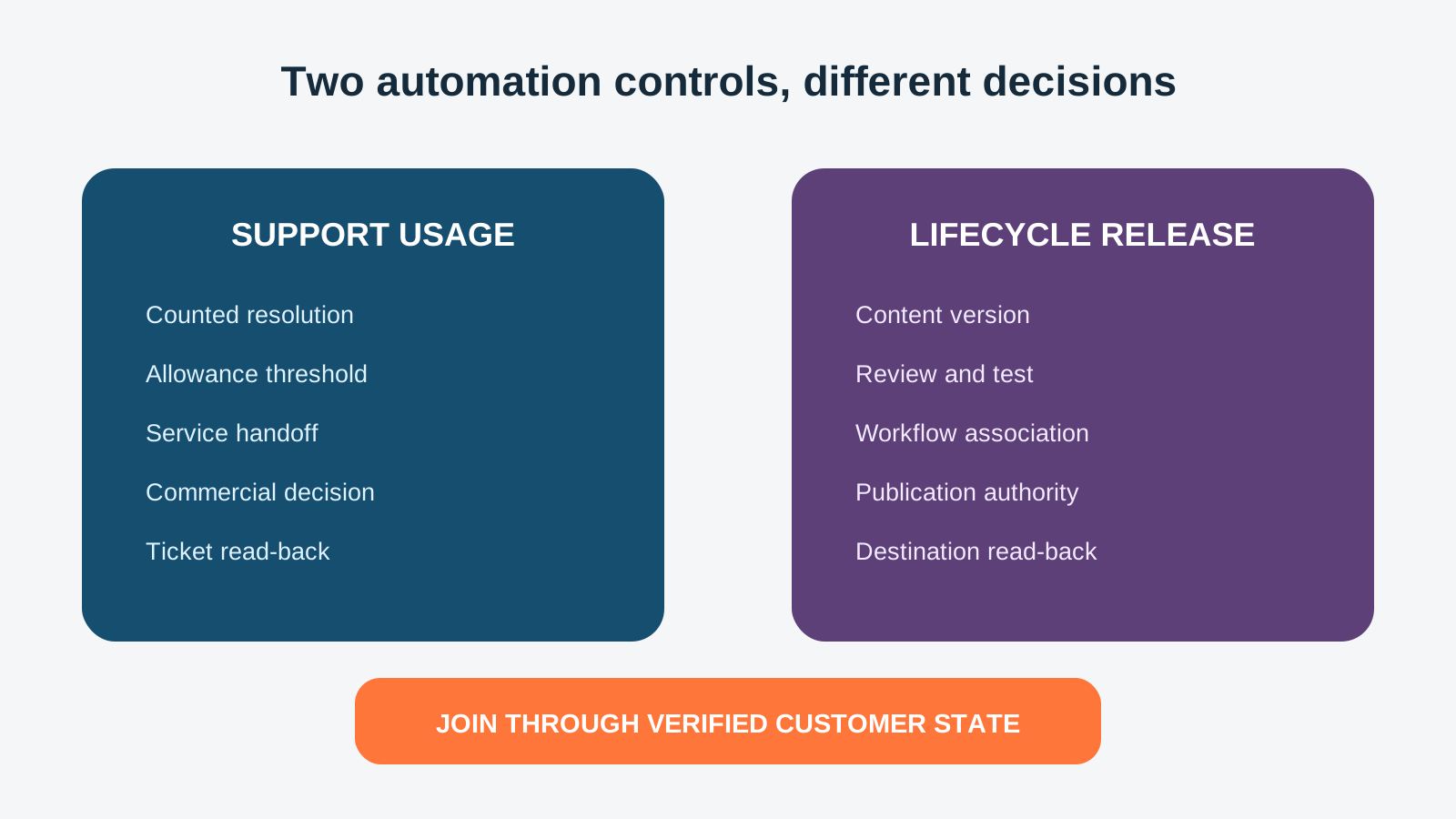
These are not substitutes. Zendesk's current control centers counted automated-support usage and allowance capacity. Customer.io's centers content and publication state. Choose the model that matches the decision, then join vendor-side state to customer-visible evidence without collapsing the two.
This comparison is written for RevOps, Sales Ops, GTM Operations, and Customer Success Ops teams that need a practical decision framework. It focuses on workflow ownership, CRM data quality, implementation effort, source-of-truth behavior, and the operating rhythm each option supports.
Who each option is best for
Zendesk when the decision concerns automated-resolution usage, service capacity and an eligible allowance model; Customer.io when the decision concerns API-managed lifecycle content, testing, workflow association and publication. A company may use both for different processes.
The right answer depends on the job the team is trying to improve. A tool that is strong for one operating model can be a poor fit when the real problem is ownership, dirty CRM data, missing renewal dates, weak handoffs, or an unclear forecast process. Use this page to map the workflow before treating either option as the default.
Operating questions before choosing
- Which recurring meeting or workflow will change if the team chooses Zendesk resolution controls or Customer.io Design Studio API?
- Which CRM records, fields, activities, or customer signals are required for the workflow to be trusted?
- Who owns the next action when the system surfaces a risk, alert, forecast change, or customer signal?
- Does the option write usable context back to the system of record, or does it create another place to inspect?
- What manual review work should decrease after implementation?
Side-by-side table
| Criterion | Zendesk resolution controls | Customer.io Design Studio API | Editorial note |
|---|---|---|---|
| Primary object | Automated-resolution usage, notification thresholds and allowance state | Email content, test evidence, workflow association and publication state | The operating grain determines the evidence and owner. |
| Current source evidence | October page documents configurable usage notifications and eligible allowance increases | October 6 release documents create, review, test, workflow-link and publish stages | Verify exact account availability and current documentation. |
| Main decision | Investigate demand, protect service and decide whether capacity needs commercial action | Approve and promote the correct content version into the correct workflow | Neither dashboard nor API response makes the business decision. |
| Authority boundary | Support admin, service owner, account owner and billing admin | Builder, reviewer, workflow admin and publisher | Separate diagnosis from consequential authority. |
| Customer-side truth | Conversation or ticket final state, reopen and human handoff | Audience eligibility, delivery disposition and content version actually used | Customer-visible outcome remains distinct from vendor state. |
| Commercial boundary | Applicable resolution-allowance terms and account eligibility | Applicable plan, API and messaging terms | Confirm current contracts rather than inferring pricing. |
| Key false conclusion | A counted resolution equals a durable customer problem solved | A successful API call equals a verified customer-facing release | Both require destination and outcome evidence. |
| Recovery | Investigate anomalies, preserve human routing and make an authorized capacity decision | Resume, pause, restore or replace without duplicate content or erased evidence | Recovery must be designed before production. |
Workflow comparison
- Name the decision and owning platform state.
- Define the customer-visible evidence required to validate it.
- Verify the account model, feature availability and named identities.
- Test allowed, denied, missing and conflicting cases.
- Execute on a frozen population or version.
- Read the authoritative destination after consequential action.
- Route unmatched states to one owned exception queue.
- Review service, commercial and recovery evidence separately.
A RevOps workflow should produce a visible action, not only a report. When comparing Zendesk resolution controls and Customer.io Design Studio API, the team should look at the handoff from signal to owner to customer action. If the output does not change a task, meeting, field, renewal follow-up, forecast inspection, or manager review, the tool may become another dashboard rather than operating leverage.
Implementation complexity
Medium to high. The visible controls are approachable, but identity, commercial definitions, consent, customer outcomes, retries, approvals and authoritative read-back require deliberate implementation.. The real complexity depends on data quality, ownership clarity, and whether the team changes its operating rhythm.
Implementation should start with source fields, permissions, integration points, and the review process. The most common failure is buying a tool before defining the workflow. A narrow pilot is usually safer than a full rollout because it reveals bad CRM fields, unclear owners, duplicate definitions, and gaps between the tool and the team operating cadence.
Data and CRM requirements
Reliable RevOps decisions need clean CRM data. Before choosing between Zendesk resolution controls and Customer.io Design Studio API, check owner fields, lifecycle stage, account and opportunity status, renewal or close dates, activity history, task ownership, and the fields that drive routing or reporting. If these fields are not trusted, the comparison should include a data cleanup step.
- Define the system of record for the workflow.
- List the fields that trigger action or reporting.
- Decide which fields can be written automatically and which need review.
- Document what evidence an operator should inspect before acting.
- Measure whether the workflow reduces missed follow-up or manual reconciliation.
Data model impact
- Keep vendor usage or content identifiers and source timestamps.
- Preserve customer, conversation or recipient identity under the applicable policy.
- Store version, workflow or allowance context separately from customer outcome.
- Link acknowledgement, final-state read-back and exception ID.
- Retain actor, approver, decision and recovery evidence.
CRM fields and signals to check
- Stable account and customer IDs
- Conversation or recipient ID
- Automation or content version
- Usage observation or publication time
- Consent and suppression state
- Workflow and step ID
- Final service or delivery disposition
- Alert, approval and recovery status
Cost and maintenance considerations
Do not infer total cost from these releases. For Zendesk, include the applicable account model, allowance definition, support administration and service review. For Customer.io, include plan and messaging terms, API implementation, content QA, workflow testing and release operations. Verify current commercial terms directly with each vendor.
Cost should include licenses, setup time, admin maintenance, integration work, enablement, governance, and the opportunity cost of manual review. A cheaper workflow can become expensive if it requires weekly spreadsheet cleanup. A larger platform can become expensive if the team only uses a narrow part of it. RevOps should compare total operating cost, not only subscription price.
Risks and limitations
- Vendor-defined state confused with customer outcome
- Shared administrator or publication identity
- Commercial action without named budget authority
- Content release without current consent or suppression check
- Wrong workflow or account context
- Blind retry after partial execution
- Unowned alert or exception
- A clean dashboard masking missing joins
The main risk in any RevOps tool comparison is overgeneralizing. No tool is universally best. The fit depends on company stage, CRM maturity, sales motion, renewal volume, customer success model, admin capacity, and how disciplined the team is about acting on signals.
Implementation risk
- Zendesk counting and contract definitions may not match internal service labels.
- Customer.io content creation can succeed while workflow association or publication remains incomplete.
- Asynchronous behavior needs later read-back.
- Retry can duplicate work without stable identifiers.
- Account-specific packaging and permissions must be verified.
Governance risk
- Support pressure can distort human-handoff policy.
- Broad API credentials increase publication blast radius.
- Consent and suppression must remain protected authorities.
- Billing and publication actions require separate approval.
- Logs must minimize customer data while preserving reconstructability.
Alternatives and complements
- Use a warehouse or BI layer for governed cross-system measurement, not to replace source-system state.
- Use a service-management queue for alert acknowledgement and exception ownership.
- Use source control and CI checks for content production, with Customer.io remaining the execution destination.
- Use finance or procurement systems to retain commercial approvals for allowance changes.
Weekly operating rhythm
- Review usage and publication exceptions by severity.
- Sample customer-visible outcomes against vendor-side state.
- Inspect alerts, approvals and owner acceptance times.
- Reconcile allowance or workflow changes with retained receipts.
- Test one designed denial or recovery path.
- Close or escalate aged mismatches.
Decision framework
- Choose Zendesk's control model for automated-support usage and allowance governance in an eligible account.
- Choose Customer.io's API model for controlled lifecycle content production and release.
- Use both only with distinct owners, identifiers and reconciliation paths.
- Do not rank them on one automation-success percentage because the units and consequences differ.
If the team cannot name the owner, source field, review cadence, and next action, pause the purchase and map the workflow first. Strong RevOps teams buy tools to close a defined operating gap. They do not use tools to discover the process after the contract is signed.
FAQ
Are Zendesk and Customer.io direct substitutes?
No. These releases govern different jobs: support usage and capacity versus lifecycle content and publication.
Which has the clearer customer outcome?
Neither vendor-side state is sufficient alone. Link Zendesk usage to ticket outcomes and Customer.io publication state to eligibility and delivery evidence.
Can the same operator own every action?
A person may cover several roles in a small team, but consequential service identities, approvals and logs should remain separable.
How should cost be compared?
Use the current applicable contracts and include operating controls. The reviewed sources do not establish a universal total-cost comparison.
What is the shared release criterion?
The team can identify the actor, authority, source state, destination read-back, customer-visible result, exception and recovery path.
Source notes
These official references support the product and workflow context. DailyRevOps uses them to bound the comparison, not to imply outcomes, rankings, or adoption claims.
- Zendesk: What's new in October 2026: Official page edited October 7, 2026; documents usage notifications and eligible allowance increases.
- Customer.io release notes: Official October 6, 2026 release note for the expanded Design Studio API lifecycle.
Last updated: 2026-10-11