Problem
Natural-language building can turn a workflow idea into executable logic quickly. The risk is that intent, eligible records, connector permissions, exception paths and destination verification remain implicit while the build itself looks complete.
Why it matters
This playbook keeps the speed of agent-assisted construction while giving RevOps a release packet another operator can review, replay and roll back. It applies whether the workflow is built in Clay, extended through Workato connectors or routes customer interactions through a platform such as Talkdesk.
Frame one operating decision
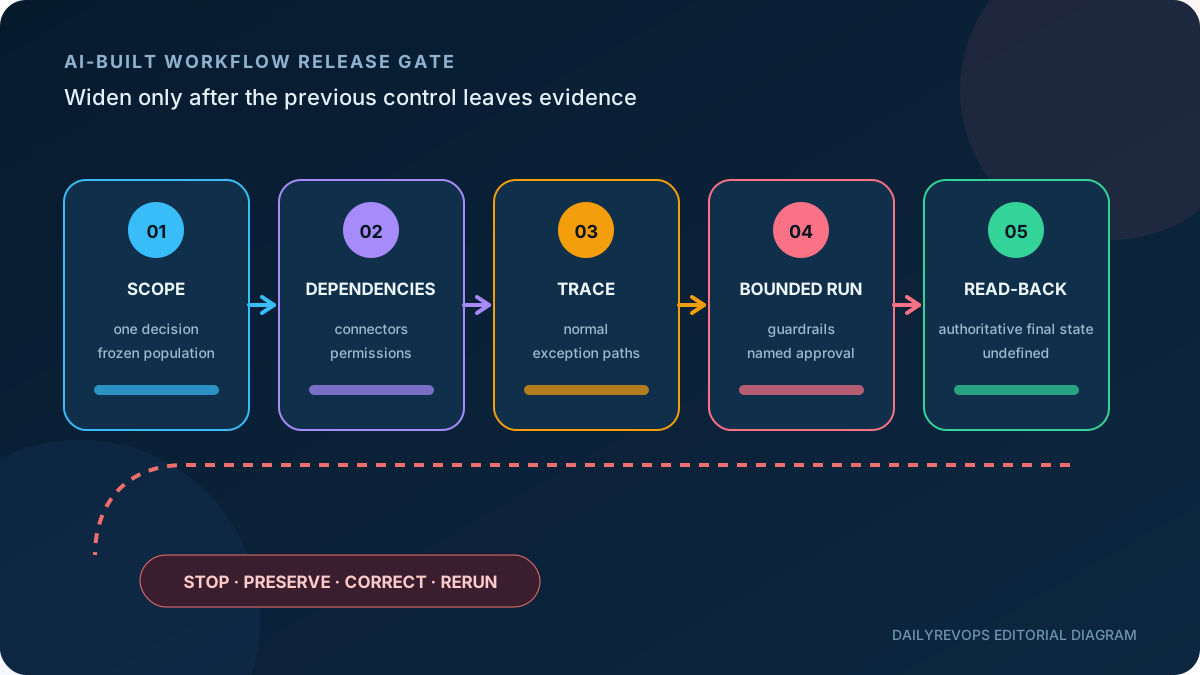
Write the workflow outcome as one record-level decision: enrich these accounts for territory review, route these inbound leads to an owner, or propose these contacts for a governed sequence. Name the source record, decision owner, destination and final state. Do not begin with a broad prompt such as improve pipeline.
Separate suggestions from actions. An agent may research or classify; a versioned rule or named reviewer should authorize protected writes, external communication, ownership, pricing or lifecycle changes. Record which step can interpret evidence and which step must remain deterministic.
Freeze the eligible population
Create a dated population extract with durable CRM or warehouse identifiers, current values, consent and suppression state, owner and observation time. State inclusions and exclusions before the workflow runs. Use a bounded sample that represents the real data shape.
Include exception cases: missing values, duplicate candidates, conflicting providers, ineligible regions, protected accounts and records that already have a destination object. A workflow that works only for clean rows has not passed the release gate.
Inventory dependencies and authority
List every source, model or prompt, connector, credential, function, destination field and scheduled trigger. For each connector action, record authentication scope, payload limit, pagination, asynchronous behavior, retry handling and current version or verification date.
Build a field-authority table. State which system owns identity, consent, lifecycle, territory, owner, product or commercial state. Give the workflow permission only to propose or write the fields approved for this release. Block blank overwrites unless they are explicitly required.
Build a traceable version
Save the natural-language instruction, generated configuration and any manual edits as one version. Record the builder and reviewer. The version should expose branch conditions, external calls, transformations, stop conditions and write behavior in a form another operator can inspect.
Run one representative record and retain the trace: source values, branch path, external request IDs, intermediate output, proposed write and response. If an AI step contributes a material fact, preserve the cited source, observation date and uncertainty or review state.
Test success and failure paths
Test a normal record, no-match record, multi-match record, connector timeout, permission failure, malformed payload and destination rejection. Confirm that retries do not create duplicates. For asynchronous jobs, test polling and terminal failure rather than stopping at request acceptance.
Classify every validation result as blocking error, accepted warning or repaired warning. Give accepted warnings an owner and reason. A platform validation panel can reveal structural issues, but business authority and customer consequence still require separate review.
Approve a bounded production run
The approver reviews the version, sample, dependency inventory, test evidence, write set and rollback trigger. Approval is specific to that package. A later prompt, model, connector, schema or permission change creates a new version and requires another decision.
Release to a limited population or time window. Use a dedicated run identifier, least-privilege credential and rate or volume guardrail. Keep high-consequence actions behind human release until the evidence shows the workflow is reliable for the current data and operating policy.
Read back the authoritative destination
After execution, query the system that owns the final state. Compare attempted, accepted, rejected, skipped and missing records. Check old and new values, destination identifiers, timestamps and downstream effects. A builder's success state is not a substitute for this read-back.
For customer communication, verify message disposition and suppression behavior. For ownership or routing, verify the current CRM owner and task. For enrichment, verify source and observation fields. For billing-adjacent data, reconcile against the commercial record before close.
Rerun without erasing the incident
If the run needs correction, stop schedules and writes, freeze the affected population, classify partial states and preserve the first attempt. Define whether the rerun will overwrite, append, skip or reverse each prior outcome. Give the corrective run a new identifier linked to the first.
Reconcile the destination again after correction. Record corrected, still failed, duplicated and manually repaired records. Keep the incident and correction evidence even when the current state is clean; it explains customer contact and reporting changes.
Move into an operating rhythm
Review production runs weekly until volume, errors and exceptions are stable. Sample traces, not only summaries. Inspect new dependencies, credential changes, unexplained warnings, missing source evidence, costly reruns and records without a verified destination state.
Expand the population only when the named owner accepts the evidence. Retire unused fields and duplicate workflows. Revalidate after a beta-to-general-availability transition, connector change, schema change, model update or significant source-data change.
Step-by-step workflow
- Define one record-level decision, owner, destination and protected-action boundary.
- Freeze a representative population with stable IDs, current values and policy state.
- Inventory models, connectors, credentials, fields, schedules and destination authority.
- Save a versioned build and retain traces for normal and exception records.
- Test permission, payload, retry, duplicate, asynchronous and destination failures.
- Approve a bounded production population with explicit volume and rollback triggers.
- Read back the authoritative destination and reconcile every attempted record.
- Link corrective reruns to the original evidence and keep unresolved exceptions owned.
CRM fields and signals needed
- Eligible, attempted, accepted, rejected, skipped and unresolved records
- Share of runs with a retained source ID, workflow version and destination ID
- Validation errors and warnings by disposition
- Connector timeouts, retries, duplicate attempts and terminal failures
- Protected-field writes proposed, approved, blocked and reversed
- Records without source provenance or observation time
- Rerun records linked to their original attempt
- Time from release to authoritative destination reconciliation
Operating quality check
Use this check before adding more tooling. The goal is to prove that the workflow is owned, current, and inspectable inside the system of action.
| Area | Healthy pattern | Risk pattern |
|---|---|---|
| Scope | One bounded record population and decision | Broad outcome without an eligible denominator |
| Authority | Named approver and field-level write policy | Generated logic decides its own permission |
| Dependencies | Versioned connectors, credentials and destinations | Hidden actions or shared administrator access |
| Evidence | Representative traces and destination read-back | Builder status or screenshot only |
| Recovery | Stop, rollback and linked rerun procedure | Bulk rerun overwrites the only incident evidence |
Common mistakes
- Treating a natural-language prompt as a complete operating specification
- Using a successful test on one clean record as production approval
- Letting connector availability imply sufficient permissions or error handling
- Allowing an agent to acquire authority because it generated the workflow
- Counting an accepted API request as a verified outcome
- Rerunning a mixed population without preserving prior states
- Expanding from beta or preview without revalidating the account and dependencies
AI-built GTM workflow release review
- Workflow ID and exact version
- Eligible population definition and extract time
- Source and destination system owners
- Connector actions and credential scopes
- Protected fields and allowed writes
- Normal and exception traces
- Approver, release window and guardrails
- Destination reconciliation and unresolved exceptions
Example operating rhythm
- Per change: capture the version, dependency inventory, trace and approval.
- Per run: reconcile attempts to destination states and own every exception.
- Weekly: sample traces, warnings, connector failures, spend and protected writes.
- Monthly: review credentials, stale workflows, unused fields and duplicated logic.
- After any material platform change: rerun representative success and failure tests.
Tooling options
- Workflow builder with exportable or retainable version evidence
- CRM or warehouse extract with durable source identifiers
- Connector and credential registry
- Sandbox or non-writing test path
- Destination read-back query and exception view
- Change record linking approval, run identifiers and rollback
- Cost and volume guardrails for agent, data and API steps
Source notes
These sources support the workflow model and product concepts. They do not prove a specific business outcome, benchmark result, or vendor claim.
- Clay: Recapping the products announced at Sculpt 2026: Official October 8, 2026 recap. Clay says Workflows is in beta for all Clay users and the Inbound SDR Agent is a pre-beta preview with a waitlist.
- Workato: Community Connectors—what's new in September 2026: Official October 7, 2026 changelog describing new community connectors plus schema, authentication, error-reporting and stability changes.
- Talkdesk Orchestration & Routing release notes: Official release notes for the progressive October 9, 2026 general-availability rollout of the revamped Studio experience.
Last updated: 2026-10-09
Decision frameworks to read next
FAQ
Does agent-built mean the workflow can release itself?
No. Agent assistance can accelerate construction and testing, but business authorization, protected writes, customer communication and production widening still need a named owner or versioned policy.
What is the minimum useful workflow trace?
A stable source ID, workflow version, observed inputs, branch path, material external calls, proposed write, destination response and fresh verification of the authoritative final state.
Can a beta workflow be used in production?
That is an organizational risk decision. Use a bounded, reversible path; record the exact availability state and account enablement; verify support and contractual requirements; and revalidate when availability changes.
When is a bulk rerun safe?
Only after the target population and prior states are frozen, overwrite and duplicate behavior are defined, the first attempt is retained, and the destination can be reconciled after the corrective run.
Why read the destination after the run?
A builder or API can report success before an asynchronous process finishes or while a duplicate or wrong record was changed. The authoritative system shows whether the intended business state exists.