Short verdict
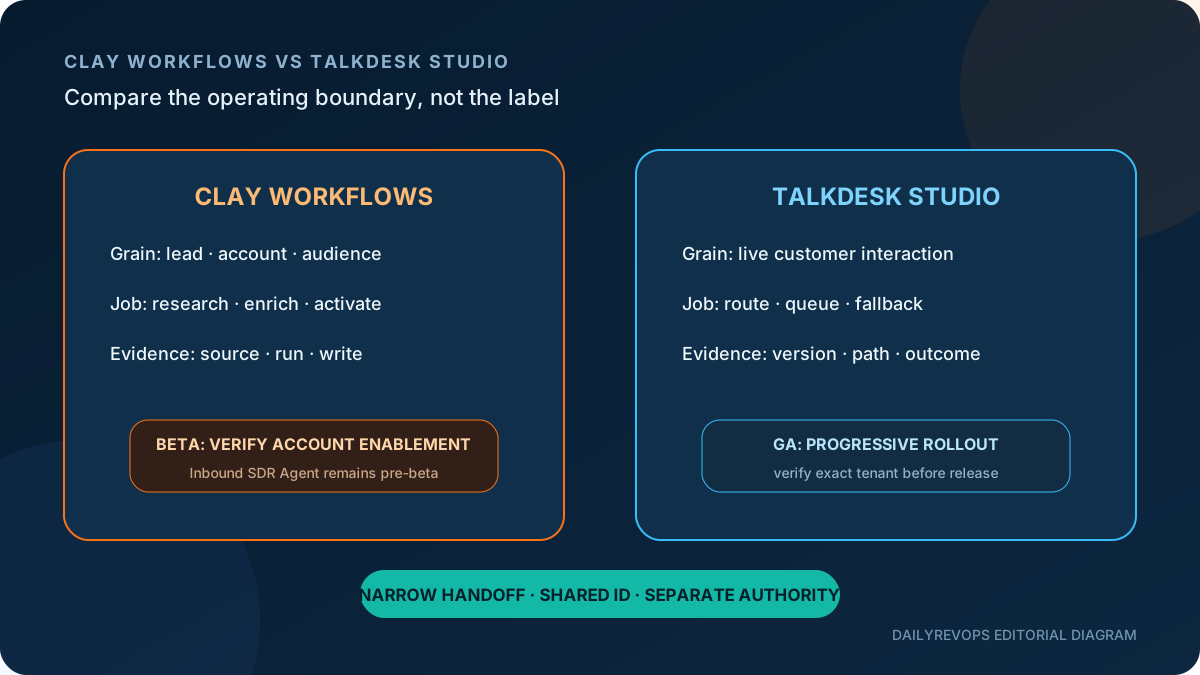
Choose Clay when the operating grain is a lead, contact, account or campaign record moving through research, enrichment and activation. Choose Talkdesk Studio when the grain is an interaction moving through contact-center routing. Connect the two only through a narrow, governed handoff with explicit identity, authority and final-state evidence.
This comparison is written for RevOps, Sales Ops, GTM Operations, and Customer Success Ops teams that need a practical decision framework. It focuses on workflow ownership, CRM data quality, implementation effort, source-of-truth behavior, and the operating rhythm each option supports.
Who each option is best for
Clay for cross-source GTM research, enrichment and activation; Talkdesk Studio for governed contact-center flow design and routing.
The right answer depends on the job the team is trying to improve. A tool that is strong for one operating model can be a poor fit when the real problem is ownership, dirty CRM data, missing renewal dates, weak handoffs, or an unclear forecast process. Use this page to map the workflow before treating either option as the default.
Operating questions before choosing
- Which recurring meeting or workflow will change if the team chooses Clay agent-led Workflows or Talkdesk Studio?
- Which CRM records, fields, activities, or customer signals are required for the workflow to be trusted?
- Who owns the next action when the system surfaces a risk, alert, forecast change, or customer signal?
- Does the option write usable context back to the system of record, or does it create another place to inspect?
- What manual review work should decrease after implementation?
Side-by-side table
| Criterion | Clay agent-led Workflows | Talkdesk Studio | Editorial note |
|---|---|---|---|
| Primary operating grain | Lead, contact, account, audience or GTM record | Customer interaction, routing context, queue or flow execution | Start with the record whose final state must be verified. |
| Current release evidence | Workflows is beta for all Clay users; the Inbound SDR Agent is pre-beta | Revamped Studio experience begins progressive general-availability rollout on October 9 | Verify exact account enablement before planning production work. |
| Build surface | Natural-language or CLI-assisted construction with visual run tracing | Redesigned flow editor with search, validation, context and node operations | Builder convenience does not replace business authorization. |
| Typical dependencies | CRM, warehouse, providers, agents, functions and activation systems | Contact-center components, variables, queues, routing rules and agent experience | Keep a bill of materials for every production version. |
| Core operator evidence | Source record, run trace, research provenance, write response and destination state | Flow version, variable state, validation findings, branch path and interaction outcome | Preserve path evidence beyond the editor. |
| High-risk failure | Wrong identity, unsupported research, broad rerun or unauthorized CRM write | Misdirected interaction, invalid branch, uninitialized context or unsafe publish | Design named exception and rollback paths before release. |
| Best handoff | Produce reviewed context or an approved record action | Consume only the context needed to route or serve the interaction | Do not let one system silently become authority for the other. |
Workflow comparison
- Define whether the unit of work is a GTM record or a live customer interaction.
- Keep source-system identifiers and observation time through any cross-platform handoff.
- Use Clay to prepare only the approved context required by the downstream workflow.
- Use Talkdesk Studio to route from declared interaction and context variables.
- Prevent either platform from changing protected CRM, consent or commercial fields without authority.
- Retain separate run and flow versions, then link them with a shared correlation identifier.
- Verify both the customer interaction outcome and any resulting CRM or task state.
A RevOps workflow should produce a visible action, not only a report. When comparing Clay agent-led Workflows and Talkdesk Studio, the team should look at the handoff from signal to owner to customer action. If the output does not change a task, meeting, field, renewal follow-up, forecast inspection, or manager review, the tool may become another dashboard rather than operating leverage.
Implementation complexity
High in both cases, driven by data and connector governance for Clay and customer-routing consequence and flow governance for Talkdesk.. The real complexity depends on data quality, ownership clarity, and whether the team changes its operating rhythm.
Implementation should start with source fields, permissions, integration points, and the review process. The most common failure is buying a tool before defining the workflow. A narrow pilot is usually safer than a full rollout because it reveals bad CRM fields, unclear owners, duplicate definitions, and gaps between the tool and the team operating cadence.
Data and CRM requirements
Reliable RevOps decisions need clean CRM data. Before choosing between Clay agent-led Workflows and Talkdesk Studio, check owner fields, lifecycle stage, account and opportunity status, renewal or close dates, activity history, task ownership, and the fields that drive routing or reporting. If these fields are not trusted, the comparison should include a data cleanup step.
- Define the system of record for the workflow.
- List the fields that trigger action or reporting.
- Decide which fields can be written automatically and which need review.
- Document what evidence an operator should inspect before acting.
- Measure whether the workflow reduces missed follow-up or manual reconciliation.
Data model impact
- Preserve CRM account, contact and lead IDs before Clay processing.
- Create a minimal handoff contract with correlation ID, source timestamp, approved context and expiry.
- Keep Talkdesk flow and interaction identifiers separate from CRM lifecycle and ownership authority.
- Store source provenance and review state for any agent-produced attribute used in routing.
- Record final CRM or task updates through an explicit, independently verified write path.
CRM fields and signals to check
- Durable account, contact, lead and opportunity identifiers
- Consent, suppression and channel eligibility
- Lifecycle, owner, territory and protected-field authority
- Source and observation time for enriched or researched context
- Workflow version, flow version, run ID and interaction correlation ID
- Destination response, final owner action and verified outcome
Cost and maintenance considerations
Do not compare headline plan prices alone. Model Clay data, agent, action and rerun usage; Talkdesk licensing, contact-center capacity, implementation and administrative effort; connector and warehouse costs; testing; exception review; and ongoing ownership. Obtain current quotes and verify beta or rollout terms directly.
Cost should include licenses, setup time, admin maintenance, integration work, enablement, governance, and the opportunity cost of manual review. A cheaper workflow can become expensive if it requires weekly spreadsheet cleanup. A larger platform can become expensive if the team only uses a narrow part of it. RevOps should compare total operating cost, not only subscription price.
Risks and limitations
- Comparing two different operating layers as though they were substitutes
- Building a critical process on an availability label that has not been verified for the account
- Passing more customer or prospect data between systems than the route requires
- Allowing research or inferred context to overwrite an authoritative CRM field
- Publishing a valid flow without a business owner for its routing consequences
- Losing correlation between the upstream GTM record and downstream interaction
- Treating a completed run or flow as proof of customer outcome
The main risk in any RevOps tool comparison is overgeneralizing. No tool is universally best. The fit depends on company stage, CRM maturity, sales motion, renewal volume, customer success model, admin capacity, and how disciplined the team is about acting on signals.
Implementation risk
- Natural-language workflow output may need manual correction and version control.
- Connector schemas, permissions and asynchronous behavior can change the effective path.
- Contact routing exceptions can affect live service even when the flow publishes successfully.
- Bulk reruns and copied nodes can multiply an error unless the target set and variables are reviewed.
- Progressive rollout can produce different account capabilities during implementation.
Governance risk
- An inferred account attribute is mistaken for verified customer context.
- The integration credential can write more than the workflow requires.
- A warning is accepted without a named disposition.
- A rerun or republish overwrites the only evidence of the previous outcome.
- No owner reconciles the interaction outcome to the CRM or customer record.
Alternatives and complements
- CRM-native workflows for simple deterministic record routing
- Warehouse transformations plus Reverse ETL for governed historical data preparation
- Workato or another integration platform for explicit system-to-system orchestration
- Manual specialist review for low-volume, high-consequence exceptions
- A queue or rules engine when the decision is fully deterministic and does not require agent interpretation
Weekly operating rhythm
- Review changed workflow and flow versions.
- Sample upstream traces and downstream interaction outcomes.
- Inspect accepted warnings, failed connectors and unresolved route exceptions.
- Reconcile protected-field writes and customer-facing consequences.
- Retire stale handoff fields and over-broad credentials.
Decision framework
- Choose Clay when research, enrichment, segmentation or multi-system GTM activation is the central job.
- Choose Talkdesk Studio when contact routing, queue behavior, context variables and interaction flow are the central job.
- Use both when a reviewed GTM context genuinely improves interaction handling and the handoff can be minimized and audited.
- Keep the CRM, consent system, commercial system and contact-center record authoritative for their own facts.
- Require separate release tests and destination reconciliation on each side of an integration.
- Pilot with a bounded population and explicit stop conditions before widening.
If the team cannot name the owner, source field, review cadence, and next action, pause the purchase and map the workflow first. Strong RevOps teams buy tools to close a defined operating gap. They do not use tools to discover the process after the contract is signed.
FAQ
Are Clay Workflows and Talkdesk Studio direct competitors?
No. Clay focuses here on GTM data and workflow orchestration, while Talkdesk Studio designs contact-center routing. They can participate in one operating chain, but they govern different records and consequences.
Is Clay's Inbound SDR Agent generally available?
No. Clay's October 8 recap describes it as a preview and invites pre-beta partners to a waitlist. Clay Workflows is separately described as beta for all Clay users.
What became generally available in Talkdesk?
Talkdesk says the revamped Studio experience begins a progressive general-availability rollout on October 9, including the revamped toolbar and header, search, Flow Validation Panel, manual positioning, copy and paste, Context Manager and Add New Node.
Where should the platforms connect?
At a minimal, versioned handoff: stable identity, approved context, source time, expiry, correlation ID and a named destination owner. Avoid passing an entire profile when the route needs one reviewed attribute.
Which platform should own CRM fields?
Neither should gain ownership by convenience. RevOps should define the authoritative system and allowed writer for each field, then verify every protected write in the CRM.
Source notes
These official references support the product and workflow context. DailyRevOps uses them to bound the comparison, not to imply outcomes, rankings, or adoption claims.
- Clay: Recapping the products announced at Sculpt 2026: Official October 8, 2026 recap. Clay says Workflows is in beta for all Clay users and the Inbound SDR Agent is a pre-beta preview with a waitlist.
- Talkdesk Orchestration & Routing release notes: Official release notes for the progressive October 9, 2026 general-availability rollout of the revamped Studio experience.
- Workato: Community Connectors—what's new in September 2026: Official October 7, 2026 changelog describing new community connectors plus schema, authentication, error-reporting and stability changes.
Last updated: 2026-10-09