Problem
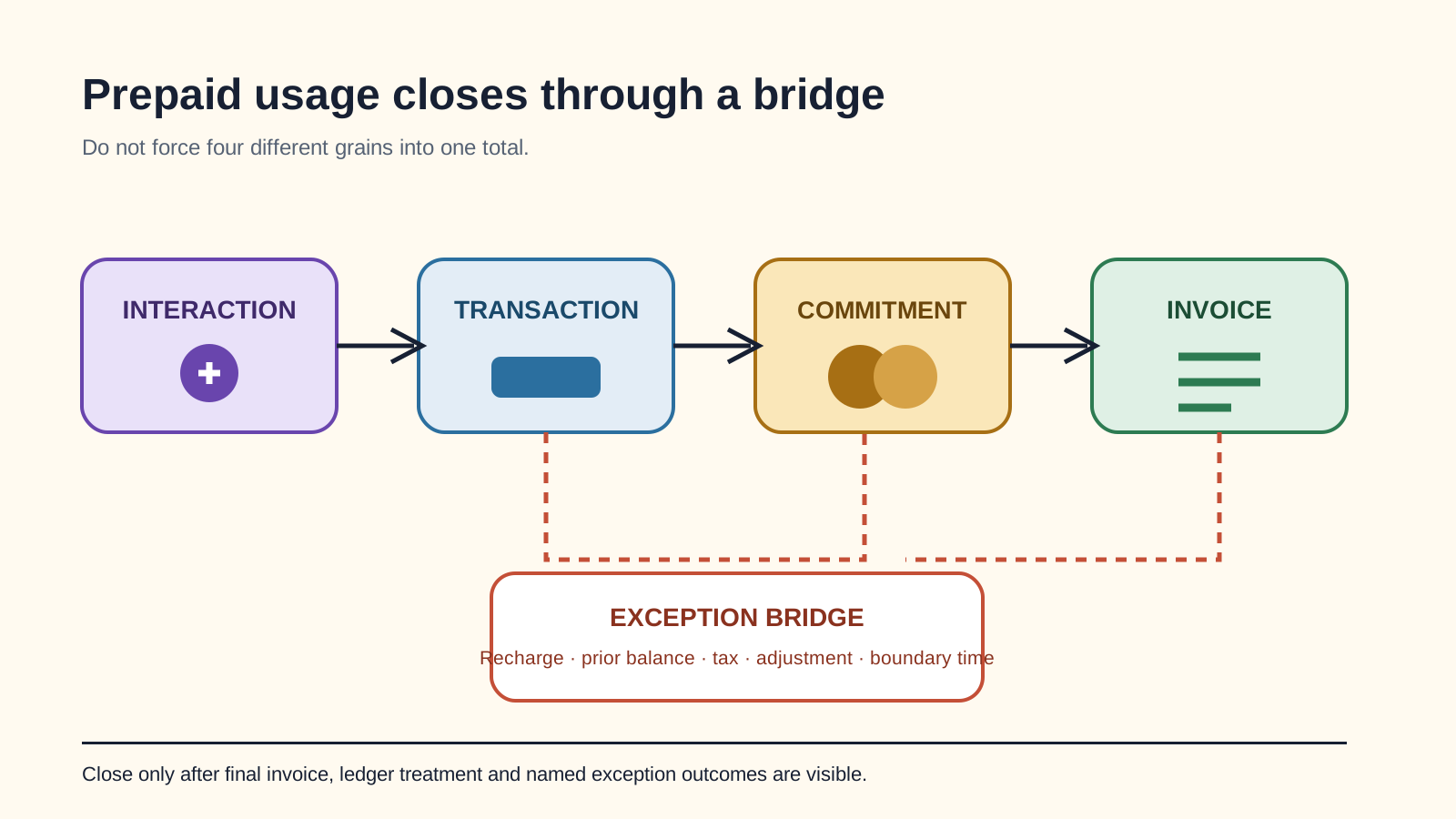
Usage transactions can look complete while the invoice still depends on prepaid commitments, recharges, prior balances and contract rules. Talkdesk's new commitment fields improve traceability, but a report row still needs identity, period, contract and invoice reconciliation before RevOps treats spend or remaining balance as settled.
Why it matters
The workflow protects renewal, procurement, support and finance decisions from an incomplete usage interpretation. It creates one evidence path from customer interaction through charged transaction and commitment consumption to the final billed result, with named owners for exceptions.
Trigger: start before the billing period closes
Use this playbook when an account has usage-priced Talkdesk services, prepaid credit commitments, free units or recharge activity. Run it during the close window, after a material usage anomaly, before a commitment renewal, or when an operator is asked to explain remaining committed credit.
Do not wait for an invoice dispute. The trigger should create a dated reconciliation work item tied to the account, contract, billing period and report extraction. A refreshed report should create a new extraction record rather than silently replacing the one under review.
Owners: separate source, commercial and ledger responsibility
The Talkdesk administrator or contact-center owner provides the source reports and explains configured products. RevOps maps the customer and commercial identifiers, maintains the exception workflow and checks CRM implications. Finance or Accounts Payable owns invoice and ledger treatment. Procurement or the contract owner interprets commitment terms. One named close owner coordinates the final decision.
The close owner should not rewrite source data to make totals match. When the transaction report, commitment balance and invoice disagree, preserve all three, identify the missing bridge and route the case to the owner of that bridge.
Prerequisites: define the data and contract grain
Confirm the account identifier, contract, commitment identifier, product or usage category, currency, billing timezone, period start and end, invoice identifier and recharge treatment. Record whether taxes, adjustments, prior balances or credits sit outside the usage-transactions report.
Talkdesk documents that one interaction can create multiple transactions and that the transactions report does not necessarily equal the final invoiced amount. Keep interaction, transaction, commitment and invoice as separate objects. Do not join on date and amount alone when stable identifiers are available.
Build a four-part evidence packet
Part one is the frozen usage extract with extraction time, filters and row count. Part two is the commitment view with Credit Commit ID, balance and any recharge or carryover evidence. Part three is the contract interpretation that names included units, rates, term and approved amendments. Part four is the invoice or pre-invoice statement with line-level totals and adjustments.
Store the packet in an approved finance location and link it from the CRM or operating queue. Avoid putting sensitive invoice detail into broadly visible CRM notes. The link should identify the period and remain accessible to the next authorized reviewer.
Reconcile through bridges, not forced equality
First group transactions by commitment and usage category, then compare consumed amounts with the commitment movement. Next bridge the commitment result to invoice lines, explicitly separating prior balance, recharge, manual adjustment, tax and non-usage charges. Explain every difference with a named source and owner.
A zero difference is not sufficient if identifiers are missing. Two wrong aggregates can cancel. Sample individual interactions from high-value, unusual and boundary-period cohorts. Verify that the interaction produced the expected transactions, used the intended commitment and appeared in the correct billing period.
Route exceptions without changing customer state prematurely
Use exception states such as identity mismatch, missing commitment, unexpected category, duplicate transaction, boundary timing, recharge not reflected, invoice adjustment pending and source unavailable. Assign an owner, due date, evidence link and close condition.
Do not change renewal risk, entitlement, account health or customer messaging solely because remaining credit looks low. Confirm the contract and forecasted usage, then let the responsible owner decide the customer action. Usage evidence informs the decision; it does not grant commercial authority.
Close on final-state evidence
Close only when the final invoice or approved statement is available, all material bridges are explained, exceptions are resolved or formally carried, and the accounting treatment is recorded. Preserve the extraction and calculation version used for sign-off.
After close, update only the CRM fields needed for owned work: review result, renewal or procurement action, next commitment checkpoint, owner and evidence link. Keep the detailed billing calculation in the authorized finance system.
Step-by-step workflow
- Create one reconciliation record for the account, contract, commitment and billing period.
- Freeze the Talkdesk usage-transactions extract with filters, extraction timestamp and row count.
- Capture Credit Commit ID and Credit Commit Balance plus recharge, carryover and prior-balance evidence.
- Map interactions to transactions and transactions to the correct commitment without collapsing their grains.
- Bridge commitment movement to invoice lines, separating taxes, adjustments, recharges and non-usage charges.
- Sample high-value, unusual and period-boundary interactions and verify their end-to-end treatment.
- Route every unexplained difference to a named exception owner with source evidence and a close condition.
- Approve customer or procurement action only after contract authority and forecasted usage are reviewed.
- Close when the final invoice, ledger treatment and material exception outcomes are visible and versioned.
CRM fields and signals needed
- Talkdesk account, customer or tenant identifier and mapped CRM account ID
- Interaction ID, transaction ID, transaction type, usage category, timestamp and amount
- Credit Commit ID, Credit Commit Balance, recharge, carryover and free-unit application
- Contract version, included units, committed amount, pricing term, currency and amendment
- Billing period, timezone, extraction time, invoice ID, invoice line and ledger entry
- Prior balance, tax, credit note, manual adjustment and non-usage charge
- Exception type, owner, opened-at, source link, due date, outcome and closed-at
- Procurement, renewal or customer-action decision with authority and next checkpoint
Operating quality check
Use this check before adding more tooling. The goal is to prove that the workflow is owned, current, and inspectable inside the system of action.
| Area | Healthy pattern | Risk pattern |
|---|---|---|
| Grain | Interaction, transaction, commitment and invoice remain separately identifiable. | One aggregate is treated as the complete billing truth. |
| Contract | The reviewed commitment and pricing version is linked to the period. | Operators infer terms from a balance or prior invoice. |
| Bridge | Recharges, prior balance, adjustments, taxes and non-usage charges explain the movement. | The team forces report and invoice totals to match without a source-backed bridge. |
| Authority | Finance, Procurement, RevOps and the contact-center owner have bounded decisions. | Report access silently becomes authority to change commercial or customer state. |
| Closure | Final invoice, ledger treatment and exception outcomes are versioned. | The queue closes when the source extract is produced. |
Common mistakes
- Treating the usage-transactions report as identical to the final invoice despite the vendor's explicit boundary.
- Summing interactions when one interaction can create several transactions.
- Joining records only on date and amount while stable interaction, transaction and commitment IDs exist.
- Overwriting the original extract after a refresh instead of preserving the reviewed version.
- Letting a low displayed balance automatically change health, entitlement or renewal status.
- Repairing source rows manually to force equality and losing the original evidence.
- Ignoring timezone and period-boundary transactions that settle after the interaction occurred.
- Closing on an aggregate match without sampling individual interactions and final invoice lines.
Weekly handoff checklist
- Confirm the account, contract, commitment and billing period identifiers.
- Attach the frozen usage extract and commitment evidence with extraction time.
- List every bridge item between usage, commitment movement and invoice.
- Assign unresolved exceptions to the source owner and state the close condition.
- Record Finance sign-off, posted invoice evidence and the next renewal or procurement checkpoint.
Example operating rhythm
- Daily during close: inspect missing extracts, unresolved high-value exceptions and source-access failures.
- Twice weekly during the billing period: review commitment consumption and unusual usage with the contact-center owner.
- At period close: freeze extracts, complete bridges and obtain Finance sign-off on final invoice treatment.
- Monthly: group exceptions by cause, product, account and source system; repair repeated mapping or ownership failures.
- Before commitment renewal: compare remaining balance, forecasted usage, contract options and customer operating plans without presenting a universal utilization target.
Tooling options
- Talkdesk Explore and its Billing Usage Transactions Report provide source transaction, commitment and balance evidence; confirm current workspace availability.
- A finance warehouse or controlled spreadsheet can perform the bridge when it preserves row-level IDs, versions and reviewer ownership.
- The CRM should hold only the account mapping, review state, owner, next action and approved evidence link—not unrestricted invoice detail.
- Accounting or ERP records remain authoritative for posted invoice and ledger treatment.
- A ticket or work queue should manage exceptions with status, due date, source and close evidence.
Source notes
These sources support the workflow model and product concepts. They do not prove a specific business outcome, benchmark result, or vendor claim.
- Talkdesk Admin release notes, October 7, 2026: Official release note for Credit Commit ID and Credit Commit Balance in the Billing Usage Transactions Report.
- Talkdesk Billing Usage Transactions data dictionary: Official documentation for report grain and the boundary between transactions and final invoiced amount.
Last updated: 2026-10-07
Decision frameworks to read next
FAQ
Should the transaction report equal the invoice?
Not necessarily. Talkdesk says final invoicing also considers commitment, recharge and prior-balance information. Build a documented bridge instead of forcing equality.
What is the minimum unit for sampling?
Sample a transaction and preserve its interaction, commitment and invoice relationships. One interaction can generate multiple transactions.
Where should detailed evidence live?
Keep detailed billing and invoice evidence in an authorized finance location. Put only the review state, owner, next action and evidence link in the CRM.
When is the reconciliation complete?
After the final invoice and ledger treatment are visible, material differences are explained, and every carried exception has an owner and close condition.