Short verdict
Start with Talkdesk for vendor-source evidence. Add a warehouse bridge when the question crosses contracts, recharges, invoices, currencies or accounting. Keep the posted invoice and ledger authoritative.
This comparison is written for RevOps, Sales Ops, GTM Operations, and Customer Success Ops teams that need a practical decision framework. It focuses on workflow ownership, CRM data quality, implementation effort, source-of-truth behavior, and the operating rhythm each option supports.
Who each option is best for
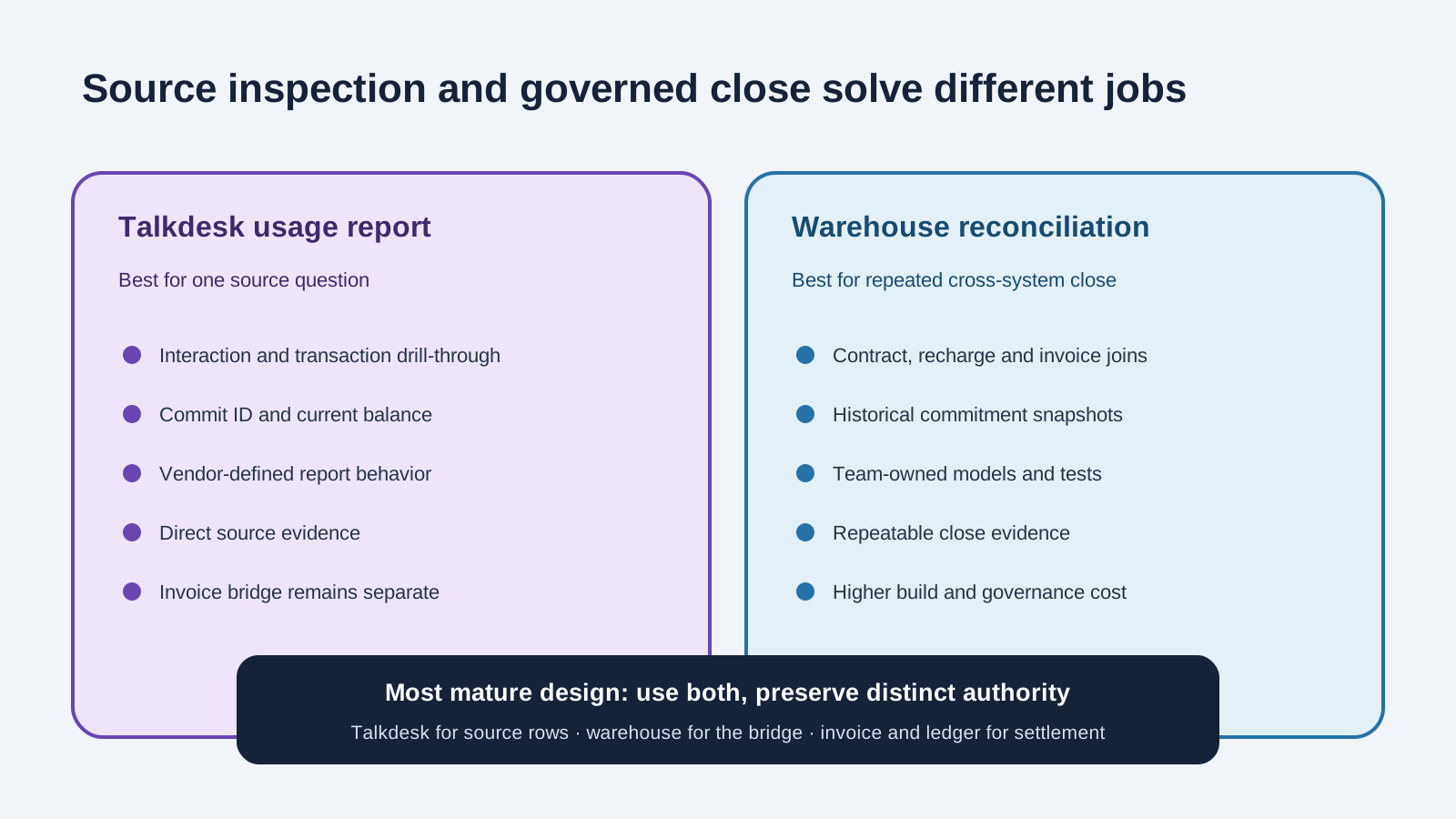
Use Talkdesk for source transaction and commitment inspection; use a governed warehouse model when Finance must join contract, invoice, CRM and accounting evidence across periods.
The right answer depends on the job the team is trying to improve. A tool that is strong for one operating model can be a poor fit when the real problem is ownership, dirty CRM data, missing renewal dates, weak handoffs, or an unclear forecast process. Use this page to map the workflow before treating either option as the default.
Operating questions before choosing
- Which recurring meeting or workflow will change if the team chooses Talkdesk usage reporting or Warehouse reconciliation model?
- Which CRM records, fields, activities, or customer signals are required for the workflow to be trusted?
- Who owns the next action when the system surfaces a risk, alert, forecast change, or customer signal?
- Does the option write usable context back to the system of record, or does it create another place to inspect?
- What manual review work should decrease after implementation?
Side-by-side table
| Criterion | Talkdesk usage reporting | Warehouse reconciliation model | Editorial note |
|---|---|---|---|
| Primary grain | Interactions and their usage transactions; one interaction may have multiple transactions. | A modeled set of interaction, transaction, commitment, contract, invoice and ledger tables. | Do not flatten the grains before defining the decision. |
| Commitment visibility | October 7 release adds Credit Commit ID and Credit Commit Balance to the transaction report. | Can retain commitment snapshots, contract versions, recharge events and historical balances if modeled. | Current balance and historical movement answer different questions. |
| Invoice boundary | Official documentation says transaction data does not necessarily match the final invoice. | Can build an explicit bridge to invoice lines, taxes, credits and posted accounting entries. | The warehouse improves explanation but does not become authority by default. |
| Freshness | Depends on Talkdesk report availability and extraction timing. | Depends on connector schedules, late-arriving data and model runs. | Store source time, extraction time and model time separately. |
| Operator access | Useful to authorized Talkdesk administrators and analysts inspecting source activity. | Useful to Finance, RevOps and analytics teams with governed warehouse and BI access. | Access scope should follow the decision and data sensitivity. |
| Change control | Vendor-defined fields and report behavior. | Team-defined transformations, tests, versioning and deployment controls. | Flexibility creates ownership and maintenance obligations. |
| Audit evidence | Direct vendor-source rows and commitment identifiers. | Versioned joins, reconciliation results and repeatable period snapshots. | Preserve both the original extract and transformation version. |
| Best first step | Investigate a specific usage or commitment question. | Reconcile repeated cross-system close and renewal questions at scale. | Do not build a warehouse model before naming the recurring decision. |
Workflow comparison
- Name the question: source usage inspection, commitment consumption, invoice close, renewal planning or accounting explanation.
- Freeze the Talkdesk extract with filters, extraction time, row count and commitment identifiers.
- If the question ends inside Talkdesk, sample source transactions and document the result there or in the controlled work queue.
- If the question crosses contracts or Finance, ingest source rows without changing their grain and retain the original extraction ID.
- Model commitments, contract versions, recharges, prior balances, invoice lines and ledger entries as separate linked objects.
- Test duplicate interactions, several transactions per interaction, late data, currency, boundary dates and missing IDs.
- Reconcile a sample back to Talkdesk and forward to the posted invoice before using the model for an operating decision.
- Publish ownership, refresh, exception and rollback rules alongside the model.
A RevOps workflow should produce a visible action, not only a report. When comparing Talkdesk usage reporting and Warehouse reconciliation model, the team should look at the handoff from signal to owner to customer action. If the output does not change a task, meeting, field, renewal follow-up, forecast inspection, or manager review, the tool may become another dashboard rather than operating leverage.
Implementation complexity
Medium to high because the two approaches operate at different grains and neither should silently replace the ledger or contract.. The real complexity depends on data quality, ownership clarity, and whether the team changes its operating rhythm.
Implementation should start with source fields, permissions, integration points, and the review process. The most common failure is buying a tool before defining the workflow. A narrow pilot is usually safer than a full rollout because it reveals bad CRM fields, unclear owners, duplicate definitions, and gaps between the tool and the team operating cadence.
Data and CRM requirements
Reliable RevOps decisions need clean CRM data. Before choosing between Talkdesk usage reporting and Warehouse reconciliation model, check owner fields, lifecycle stage, account and opportunity status, renewal or close dates, activity history, task ownership, and the fields that drive routing or reporting. If these fields are not trusted, the comparison should include a data cleanup step.
- Define the system of record for the workflow.
- List the fields that trigger action or reporting.
- Decide which fields can be written automatically and which need review.
- Document what evidence an operator should inspect before acting.
- Measure whether the workflow reduces missed follow-up or manual reconciliation.
Data model impact
- Preserve interaction, transaction, commitment, contract, invoice and ledger IDs as separate keys.
- Store business time, source extraction time, warehouse load time and model run time separately.
- Snapshot commitment balance when historical reconstruction is required.
- Represent adjustments, recharges, taxes and prior balance as explicit bridge components.
CRM fields and signals to check
- Billing review status, period and owner
- Commitment review due date and procurement owner
- Evidence packet link and extraction ID
- Material exception count and highest-severity reason
- Approved customer or renewal action and next checkpoint
Cost and maintenance considerations
Talkdesk reporting uses existing product access but still requires analyst and close-review time. A warehouse adds ingestion, storage, transformation, testing, BI and ownership costs. Compare the repeated decision burden and exception volume rather than assuming centralization is automatically cheaper.
Cost should include licenses, setup time, admin maintenance, integration work, enablement, governance, and the opportunity cost of manual review. A cheaper workflow can become expensive if it requires weekly spreadsheet cleanup. A larger platform can become expensive if the team only uses a narrow part of it. RevOps should compare total operating cost, not only subscription price.
Risks and limitations
- Treating the Talkdesk transaction report as the invoice despite the documented boundary.
- Flattening several transactions into one interaction and losing credit application detail.
- Allowing warehouse transformations to overwrite source meaning or hide late-arriving rows.
- Using current Credit Commit Balance as a historical balance without a dated snapshot.
- Exposing invoice or customer data too broadly through BI access.
- Building a sophisticated model without a named Finance or RevOps decision owner.
The main risk in any RevOps tool comparison is overgeneralizing. No tool is universally best. The fit depends on company stage, CRM maturity, sales motion, renewal volume, customer success model, admin capacity, and how disciplined the team is about acting on signals.
Implementation risk
- Incomplete history or missing stable IDs can make backfills appear reconciled while individual rows remain ambiguous.
- Late-arriving or corrected usage needs deterministic restatement rules.
- Currency and timezone assumptions can move transactions across period boundaries.
- Warehouse access and report retention must match finance and customer-data policy.
Governance risk
- A modeled number may gain false authority because it appears in a central dashboard.
- Unversioned transformations can change prior close results without an explicit restatement.
- Broad admin access can blur source investigation, commercial approval and ledger ownership.
- CRM automation may act on a balance before Finance or Procurement approves the interpretation.
Alternatives and complements
- A controlled close spreadsheet can be sufficient for a low-volume process if it preserves row IDs, versions, reviewers and exceptions.
- An ERP reconciliation module may own the invoice-to-ledger bridge while the warehouse supplies usage detail.
- A ticketing workflow can manage disputes and source-access failures without becoming the financial system of record.
- Contract-management tooling can complement both approaches by preserving the approved commitment version.
Weekly operating rhythm
- Review report freshness and unresolved source exceptions.
- Reconcile one high-value and one boundary-period sample end to end.
- Check model changes, failed tests and access changes before widening use.
- Route commercial or customer decisions to the named owner rather than encoding them in the reconciliation job.
Decision framework
- Choose Talkdesk-first when the question is about one source interaction, transaction or commitment and authorized operators can resolve it directly.
- Choose a warehouse bridge when the same reconciliation repeatedly crosses contract, CRM, invoice, currency, recharge and ledger data.
- Use both when Finance needs repeatable close evidence while source operators still need drill-through to the original transaction.
- Do not let either approach change commercial terms, entitlement or customer state without the responsible owner and source evidence.
- Keep the posted invoice and accounting ledger authoritative for settled financial treatment.
If the team cannot name the owner, source field, review cadence, and next action, pause the purchase and map the workflow first. Strong RevOps teams buy tools to close a defined operating gap. They do not use tools to discover the process after the contract is signed.
FAQ
Does the Talkdesk report replace warehouse reconciliation?
No. It improves source detail. A warehouse becomes useful when the operating question repeatedly joins contracts, recharges, invoices, CRM and accounting evidence.
Can the warehouse be the billing source of truth?
Only if the organization formally assigns that authority and controls its transformations. In most designs the contract, posted invoice and ledger retain distinct authority.
When is Talkdesk-only sufficient?
When an authorized operator can answer a bounded source-usage or commitment question directly and the decision does not require cross-system settlement.
What should stay in CRM?
Keep the review state, owner, next action and approved evidence link. Avoid copying unrestricted invoice and transaction detail into broadly visible fields.
Source notes
These official references support the product and workflow context. DailyRevOps uses them to bound the comparison, not to imply outcomes, rankings, or adoption claims.
- Talkdesk Admin release notes, October 7, 2026: Official release note for the two new commitment-detail columns.
- Talkdesk Billing Usage Transactions data dictionary: Official documentation for report grain and invoice limitations.
Last updated: 2026-10-07