Stripe's September 30 announcement says OUSD on Tempo is now its default stablecoin configuration while businesses can still choose other stablecoins and blockchains. The word default is operationally important. Defaults help teams start, make documentation coherent and reduce the number of early choices. My view is that a vendor default should remain a proposed configuration until the organization has checked its own customers, geographies, contracts, ledger design, recovery paths and reporting rules. Convenience is not authority.
The same principle applies beyond payments. Salesforce publishes different availability states across Coworker, long-horizon agents, Optimizer and AI Skills. Apollo separates an available Intelligence Layer from Builder Studio and Messaging OS that it says will be available soon. Product pages naturally present a connected direction. Operators need a smaller decision: which capability exists in this account today, what is enabled, what consequence can it create and who has approved that consequence? The answer should live in a versioned release record, not in the product's default settings.
Defaults are often treated as neutral. They are not. A default stablecoin and network affect treasury, settlement, counterparties, support, reconciliation and customer explanation. A default agent scope affects which records it can read, which tools it can call and how much changed state it can accumulate. A default audience, model or message affects who receives contact. Even when the vendor provides a sensible general choice, the organization remains accountable for applying it to a specific workflow.
The first review question is availability. Is the feature generally available, in beta, in pilot, announced for a later month or simply described as coming soon? Does the status apply to the relevant region, plan, product and account? A platform may expose controls in one surface while a connected action remains preview-only. Teams should record the official source date and the date they verified their tenant. This prevents an announcement from being copied into architecture as if it were a tested entitlement.
The second question is substitution. What will the default replace? OUSD can be offered alongside other stablecoins, according to Stripe, and existing balances are not required to convert. That distinction matters. A new default for new configuration does not necessarily justify migrating existing balances, invoices, payout instructions or customer expectations. Likewise, a new agent workspace should not automatically replace deterministic workflows that already have reliable ownership, test coverage and recovery.
The third question is reversibility. A configuration switch may be easy to undo while the effects it produced are not. Changing a stablecoin setting does not reverse funds already sent. Disabling an outreach system does not retract delivered messages. Stopping a long-running agent does not automatically close tasks, repair records or withdraw external requests it already emitted. Before accepting a default, list each downstream terminal state and the separate correction or compensating action it requires.
The fourth question is evidence. Operators should be able to show the previous configuration, new configuration, approval, effective time, affected cohort, first successful execution and independent final-state check. A successful API response is not enough. Finance may need ledger and settlement reconciliation; RevOps may need a destination CRM read; Marketing Operations may need message disposition and current preference. The evidence should match the consequence rather than whatever log happens to be easiest to export.
The fifth question is who benefits from the default. Sometimes a default reduces integration work and improves reliability. Sometimes it makes a vendor's broader stack easier to adopt. Those outcomes can coincide, but procurement should separate them. Model the operating cost of monitoring, exception handling, training, support and migration alongside technical convenience. Do not turn a platform's architecture preference into a claim about customer value without local evidence.
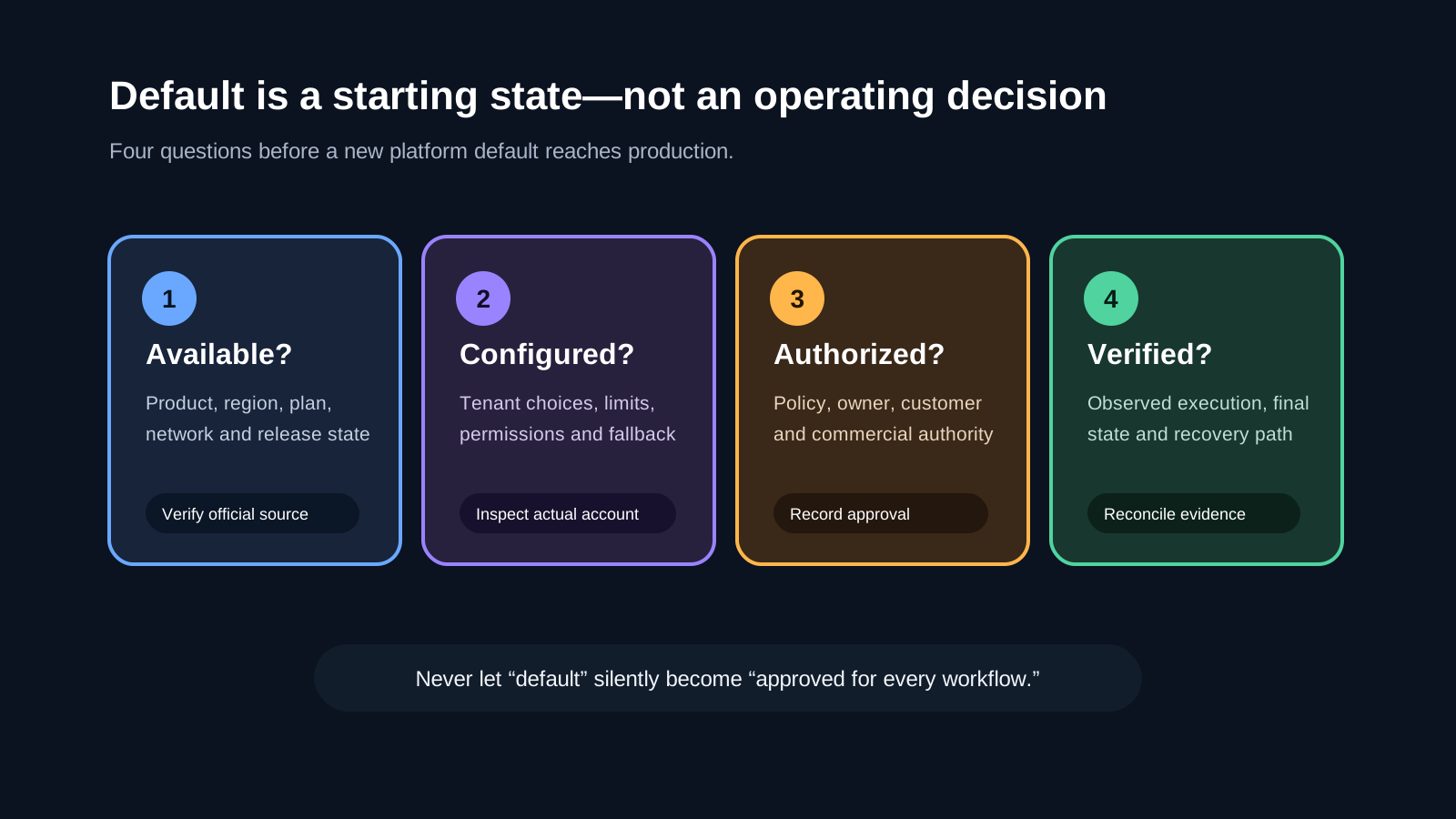
A useful acceptance process has four states: available, configured, authorized and verified. Available means the capability exists under stated conditions. Configured means the tenant choices, permissions, limits and fallback are known. Authorized means a named owner has approved the business use. Verified means a bounded live or production-like case completed, the final state reconciled and recovery was tested. Skipping a state makes the next state hard to defend.
This structure also protects product teams from unnecessary bureaucracy. Low-risk descriptive features can move through the states quickly. High-impact customer contact, ownership, entitlement or funds movement gets deeper review. The point is proportional control, not a committee for every setting. Classification should be made before release so the team does not invent a process only after an incident.
Defaults should expire from memory. Review them when the vendor changes availability, network support, pricing, permissions or behavior; when the company enters a new region; when the workflow adds a new consequence; or when incident evidence shows the assumptions were wrong. Preserve the prior decision so reviewers can understand why a configuration was reasonable at the time rather than judging history by today's interface.
Leaders should also resist using default adoption as a maturity metric. A team is not advanced because it enabled the newest connected capability. It is mature when it can state the purpose, authority, release state, evidence and recovery for the workflow and can remove the capability without losing business truth. Adoption volume may be interesting. It does not establish operational quality.
Stripe's OUSD announcement is useful precisely because it states both the default and the retained choice. RevOps and finance should preserve that distinction in implementation. Salesforce's availability labels and Apollo's available-soon separation deserve the same discipline. Read the announcement as product evidence, then make the operating decision locally.
The practical standard is simple: no platform default should become a customer, commercial or financial policy through silence. Name the owner, scope, alternative, effective date, expected terminal state and recovery. Verify the first real outcome. A default can still be the right answer. It becomes the organization's answer only after someone accountable has made and evidenced the choice. Related reading: GTM Operations · Billing Operations · Data Quality
Source notes
These official sources support the workflow model and product concepts. They do not prove a specific retention outcome, benchmark, or vendor claim.
- Stripe: OUSD is now the default stablecoin on Stripe: Official product announcement dated September 30, 2026. It describes support across Treasury, Issuing, Global Payouts, Crypto Onramp and Payments, while preserving a choice of other stablecoins and blockchains.
- Apollo: AI GTM System announcement: Official announcement updated September 30, 2026. It introduces Builder Studio, the Intelligence Layer and Messaging OS, and separately states that Builder Studio and Messaging OS will be available soon while the Intelligence Layer is available now.
- Salesforce: 21 Things We Announced at Dreamforce 2026: Official roundup dated September 28, 2026. It gives distinct availability states for Coworker, long-horizon agents, Agent Optimizer, AI Skills and other Agentforce capabilities.
Last updated: 2026-10-01