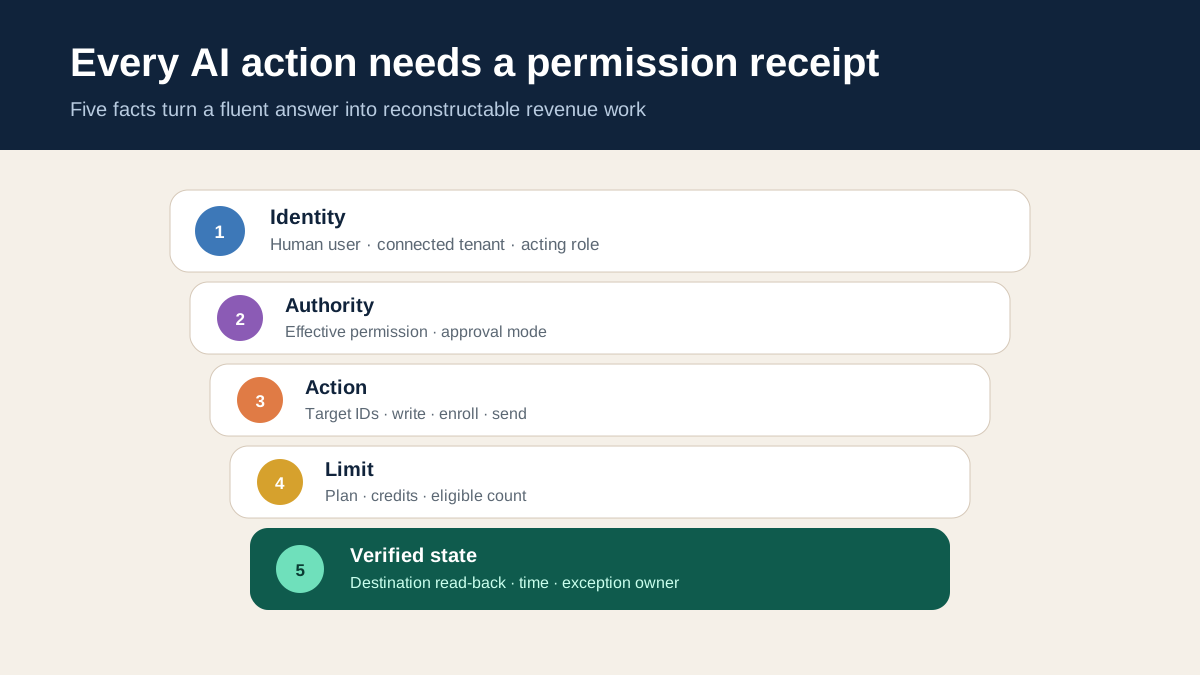
A revenue assistant should not merely say that an action succeeded. It should produce a permission receipt: a compact record of who requested the action, which connected account acted, which permission allowed it, which limit applied and which final state was verified. Apollo's October 9 documentation for its Claude connector makes the need concrete because the beta can move from research into contact creation, sequence work and outbound email while using existing Apollo permissions, plan limits and credits.
That is a promising model. Users can work in a familiar assistant without receiving an invisible parallel identity. The remaining opportunity is to make the inherited boundary obvious at the moment of action. A conversational interface can collapse several steps into one sentence; it should not collapse the evidence that distinguishes those steps.
The confident answer is the wrong completion signal
Human users naturally treat a fluent confirmation as proof. In revenue operations, the meaningful result sits elsewhere: the contact exists with the intended values, the sequence accepted the correct person, the email was sent from the approved mailbox, or the task has the assigned owner and due date. The assistant response is an explanation of an attempt, not the authoritative record.
A permission receipt should therefore contain both request and verification. At minimum: user identity, connected tenant, action type, target record IDs, effective permission, applicable credit or plan boundary, request time, platform response, destination read-back time and exception state. The receipt can be concise for the user while retaining structured detail for audit and recovery.
This is not a demand for a giant compliance screen before every lookup. Risk should determine friction. Read-only prospect search may need a simple identity and freshness note. Creating a contact needs duplicate and field-authority checks. Adding a person to a sequence needs consent, suppression and owner validation. Sending an email needs the strongest confirmation because the customer-facing consequence cannot be recalled by correcting a database row.
Inherited permissions need visible context
Existing permissions are a strong foundation only when the user understands which account and role are active. People commonly belong to sandboxes, production tenants, regional teams or acquired-company workspaces. A connector that silently chooses one context can obey every platform permission and still act in the wrong business environment.
Show the acting tenant and role before protected work. For bulk or customer-facing actions, include the eligible count and a summary of exclusions. If a plan or credit limit changes the result, disclose the partial state rather than presenting the batch as complete. A receipt should distinguish requested, attempted, accepted, verified and unresolved records.
Apollo's documentation also makes credits relevant. Credits are not only a commercial detail when an automated workflow can consume them. They are a production dependency. RevOps should set budget ownership, alert thresholds and behavior at exhaustion. A flow that enriches half its list and quietly continues with missing attributes creates a data-quality incident, not merely a billing surprise.
Measurement surfaces need receipts too
Outreach's documented KPI tiles illustrate the read side of the same principle. A metric deserves a small evidence contract: definition, eligible population, permission context, refresh cadence, current period and comparison period. Outreach notes a 15-minute refresh, permission-aware visibility and automatic comparisons for supported presets, while custom date ranges do not receive the same comparison. Those are useful operating facts because they prevent a viewer from treating every tile as equally current and comparable.
RevOps should carry that discipline into assistant answers. When an AI reports pipeline, engagement or sequence performance, the response should expose the definition and observation time. A cited number without population, permission context and freshness may be precise but not decision-ready.
Knowledge actions need ownership evidence
Intercom's Macro Admin Mode extends the argument beyond CRM writes. Promoting a personal macro into a shared library changes who can use the language and how widely an outdated statement can travel. The permission to manage shared macros should therefore produce a decision receipt: candidate owner, policy source, approver, intended audience, effective date and next review date.
Deleting an old macro should record why it was retired and whether a replacement exists. The goal is not surveillance of individual support agents. It is accountable publishing for reusable operational language. Personal experimentation can remain lightweight; shared distribution deserves explicit ownership.
Make receipts usable, not ceremonial
A receipt that nobody can find is ceremony. Put the short form next to the assistant result and write the structured form to a searchable log. Link it from the changed CRM, sequence, task or knowledge artifact when possible. Give every exception a stable ID and owner. Retain enough input context to reproduce the decision without storing unnecessary customer data.
Receipts should also support recovery. For reversible database writes, retain prior values and an approved rollback path. For sequence enrollment, capture removal and suppression steps. For messages already sent, recovery means escalation, correction and learning rather than pretending rollback is possible. Label irreversible actions before execution.
The standard should be simple: if an external AI workspace can cause a meaningful business change, it must be able to show the authority used and the state produced. That makes assistants easier to trust because operators do not have to choose between speed and evidence. A good receipt preserves both.
Source notes
These official sources support the workflow model and product concepts. They do not prove a specific retention outcome, benchmark, or vendor claim.
- Apollo: Integrate Apollo with Claude: Official Apollo documentation updated October 9, 2026. The connector is described as beta and subject to existing Apollo permissions, plan limits and credit balance.
- Intercom: Macro Admin Mode: Official Intercom changelog shared October 9, 2026. It documents viewing personal macros, promoting useful ones to shared macros and deleting outdated ones for teammates with the shared-macro permission.
- Outreach product release notes — October 2026: Official Outreach release notes published October 8, 2026, with rollout windows and package or permission qualifications for the documented features.
Last updated: 2026-10-10