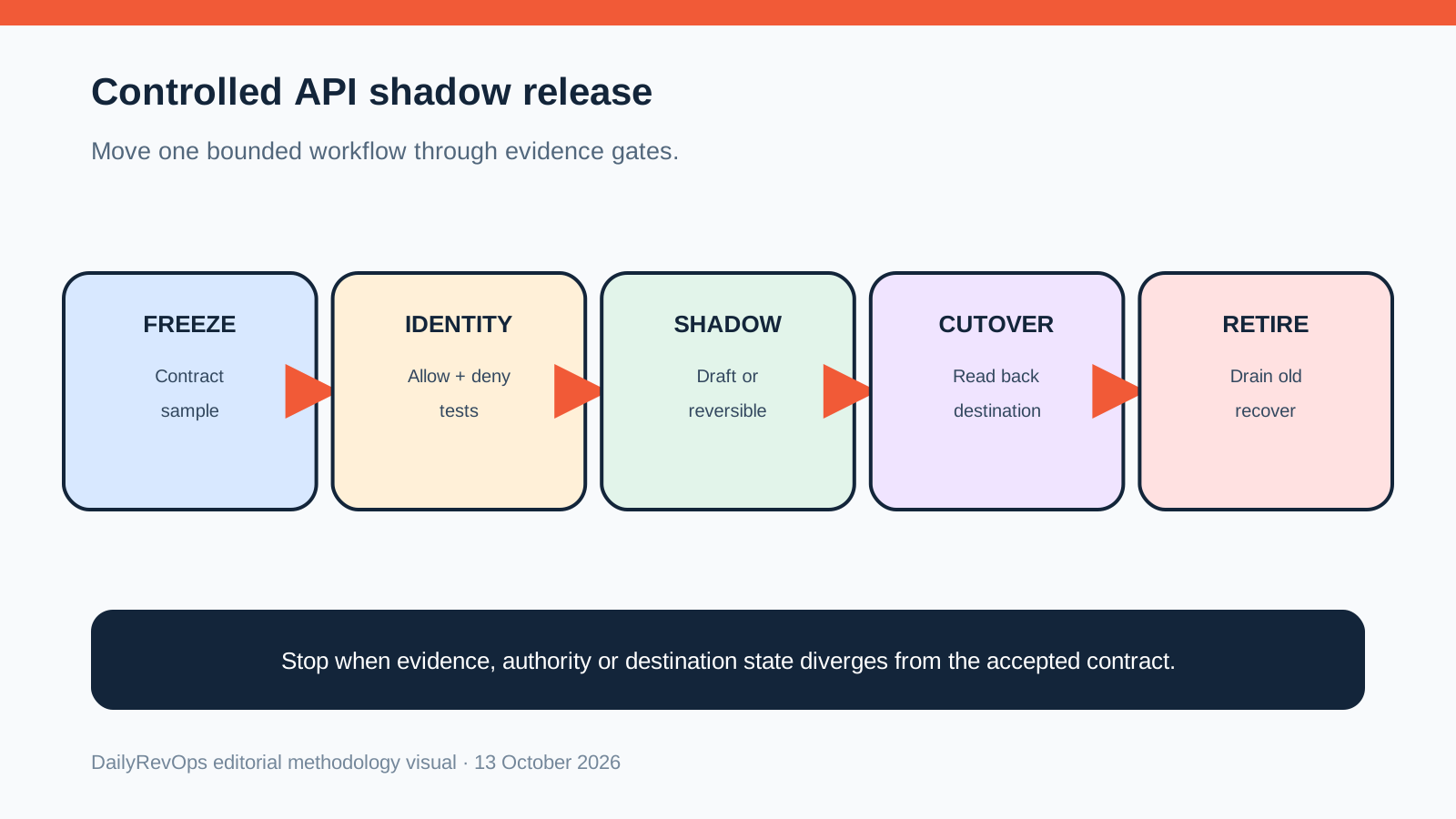
Problem
An API version or connector upgrade can appear successful because requests return accepted responses while permissions, defaults, object shape, audience rules or destination behavior changed. Customer-facing knowledge and commercial data make that ambiguity consequential.
Why it matters
Intercom API 2.17 adds drafts, article history and Data Connector lifecycle operations. Snowflake adds named workload identities. Maxio's prepayment correction shows why current success cannot prove historical completeness. Together they support a migration pattern that tests identity, release and reconciliation before cutover.
Declare the migration contract
Record current and target API version, affected objects, environments, authentication identities, scopes, owners, production consequence and rollback deadline. Name which source and destination are authoritative for each state.
Define success as observed behavior, not a 2xx response. Include eligible inputs, expected mutations, denied actions, destination read-back and owned exceptions.
Freeze the baseline population
Select representative clean, stale, missing, ambiguous, unauthorized and high-consequence records. Preserve stable IDs, source versions and current destination state before any target-version run.
Include recent and older records. A recency-limited lookup can pass on the newest objects while hiding historical gaps, as Maxio's prepayment note illustrates.
Separate the target identity
Use a distinct test or named workload identity for the target path where the platform permits it. Record provider, role, scopes, network boundary, owner and expiry.
Run one permitted and one denied case. Verify the identity is visible in the evidence operators will use during an incident, not only in an administration screen.
Run a no-write compatibility pass
Replay reads, searches and list operations against the frozen sample. Compare object identity, pagination, nulls, enums, timestamps, audience filters and error behavior.
Treat missing or differently typed fields as explicit findings. Do not coerce unknown into empty or successful state merely to make downstream code pass.
Shadow consequential writes
Where drafts or sandbox objects exist, create target-version changes without replacing the current live state. Compare the proposed object, defaults, permissions and validation results with the accepted contract.
If the platform lacks a safe shadow object, use the smallest reversible production case with named approval and a stop condition. Never use a customer-wide publication as the first write test.
Publish one bounded release
Approve one low-risk item or connector configuration. Preserve previous version, proposed version, approver, acting identity, request, response and release time.
Read the authoritative destination after release. For knowledge, inspect the current article and retrieval. For a connector, inspect execution history and sampled outputs. For a financial object, reconcile stable source and destination IDs.
Compare old and target paths
During a time-boxed shadow window, compare eligible counts, results, denied behavior, latency, exceptions and destination outcomes. Explain every difference instead of averaging it away.
Do not double-write consequential destinations. When dual reads or draft writes are used, label them so they cannot be mistaken for live customer or financial state.
Cut over and drain the old path
Move the production trigger only after the target path satisfies the release contract. Observe a full operating cycle and retain the old recovery route for the stated window.
Stop new work on the old version, drain or classify pending runs, then revoke the old identity and archive configuration evidence. Indefinite overlap creates duplicate behavior and unclear attribution.
Reconcile history and close
Audit the migration window from the complete eligible source population. Classify each item as verified, missing, duplicate, denied, stale, mismatched or unresolved.
Give every non-verified result an owner, containment and due date. Close only when the business owner accepts the verified population and explicit carryovers.
Install the durable control
Monitor supported API version, identity age, permission denials, oldest unresolved eligible item, destination mismatch and rollback readiness. Segment by object and consequence.
Repeat the shadow-release drill after material schema, authentication, audience, connector or publication changes. Keep the runbook linked to the alert.
Step-by-step workflow
- Platform owner records the current and target contract, scope, owners and rollback deadline.
- RevOps freezes a representative eligible population and current destination state.
- Security or data operations provisions a bounded target identity and tests denial.
- Engineering runs no-write compatibility checks and classifies every difference.
- Content or integration owner creates shadow drafts or equivalent reversible changes.
- Named approver releases one low-risk production case.
- Operations reads back the authoritative destination and samples downstream behavior.
- The team compares paths for one full cycle without double-writing.
- Platform owner cuts over, drains pending work and retires the old identity.
- Business owner accepts the reconciled population and explicit exceptions.
CRM fields and signals needed
- Current and target API versions
- Frozen eligible population
- Stable object IDs
- Target workload identity
- Positive and negative tests
- Previous and proposed versions
- Release approval
- Authoritative destination read-back
- Oldest unresolved exception
- Rollback deadline
Operating quality check
Use this check before adding more tooling. The goal is to prove that the workflow is owned, current, and inspectable inside the system of action.
| Area | Healthy pattern | Risk pattern |
|---|---|---|
| Contract | Versioned request, response and state semantics | Endpoint list without behavior |
| Identity | Bounded target identity with tested denial | Shared broad credential |
| Sample | Clean and failure cases across time | Newest successful records only |
| Release | Shadow or reversible bounded change | Customer-wide first write |
| Outcome | Authoritative destination read-back | Accepted request treated as complete |
| Recovery | Timed overlap, drain and rollback | Indefinite dual paths |
Common mistakes
- Treating a 2xx response as the outcome
- Testing only recent clean records
- Sharing the old identity with the target path
- Coercing unknown fields into defaults
- Double-writing live destinations
- Leaving both versions active indefinitely
- Building the denominator from successful target runs
- Revoking the old route before pending work drains
Customer-operations API migration gate
- Current version
- Target version
- Affected objects
- Business consequence
- Source authority
- Destination authority
- Eligible sample
- Target identity
- Allowed test
- Denied test
- Shadow result
- Named approver
- Read-back evidence
- Pending old runs
- Exception owner
- Rollback deadline
- Retirement evidence
Example operating rhythm
- Before migration: freeze contract, sample and destination baseline.
- Per shadow run: compare result, denial and evidence.
- At cutover: release one bounded case and read back.
- Daily during overlap: review differences and oldest exception.
- At closure: reconcile the full eligible window and retire old access.
- Quarterly: rehearse a rollback on a low-risk workflow.
Tooling options
- API contract diff
- Frozen fixture set
- Named workload identity
- Draft or sandbox object
- Execution-history export
- Destination reconciliation query
- Exception queue
- Release receipt
- Rollback runbook
Source notes
These sources support the workflow model and product concepts. They do not prove a specific business outcome, benchmark result, or vendor claim.
- Intercom API 2.17 changelog: Official October 12 release for article drafts, history and Data Connectors.
- Snowflake new features: Official October 12 release for named workload identities.
- Maxio October 2026 product release: Official October 12 note separating future correction from historical reconciliation.
Last updated: 2026-10-13
Decision frameworks to read next
FAQ
How long should the shadow window run?
Long enough to cover one representative operating cycle and the highest-risk schedule, with a fixed end date and no duplicate live writes.
Can a successful draft replace destination verification?
No. A draft verifies proposal storage. Publish and post-publication read-back verify the live state.
Why test an intentional denial?
It proves the target authority boundary, while a successful request proves only that some access works.
Should the old credential remain for safety?
Only through the defined drain and rollback window. Indefinite overlap creates ambiguity and credential sprawl.
What closes the migration?
Verified destination outcomes for the eligible window, explicit owned exceptions, retired old access and a tested recovery path.