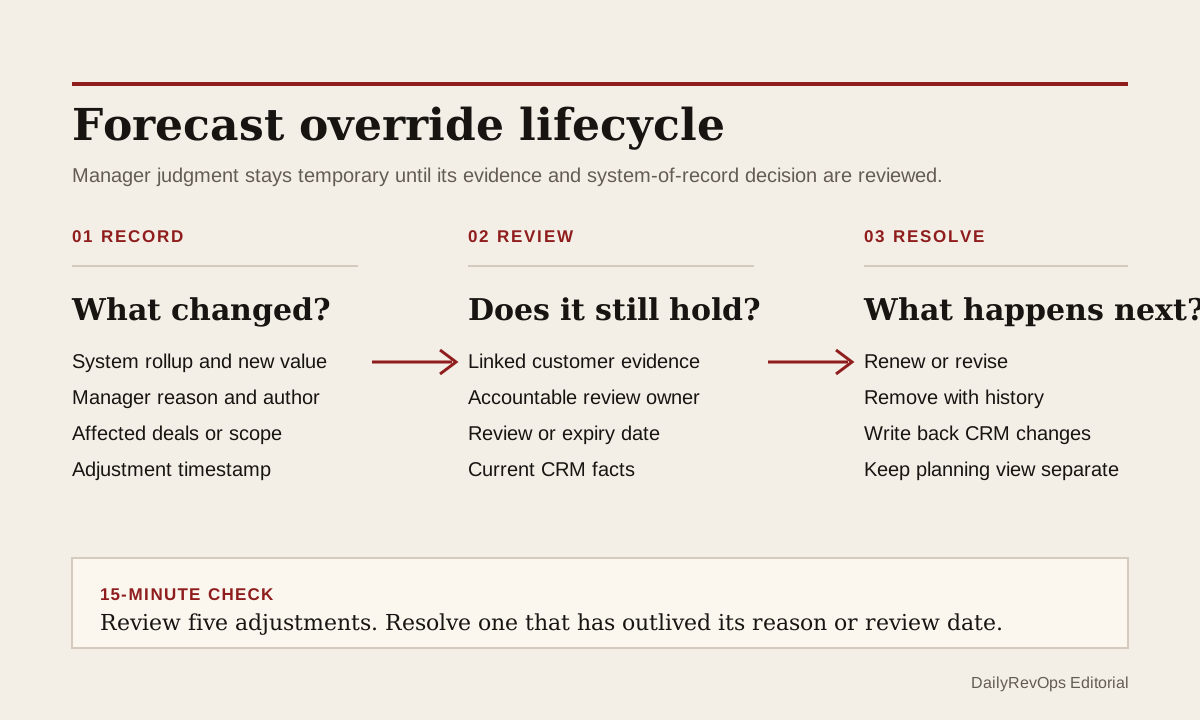
A manager forecast override can be useful when deal-level CRM data does not yet express the full commercial judgment. The risk begins when the override becomes a permanent number with no reason, source evidence, accountable owner, or review date. The next forecast call then inherits yesterday's judgment even though the pipeline, customer evidence, and close-date assumptions have changed.
This is narrower than checking whether every commit deal has enough CRM evidence. The operating question here is what happens after a leader deliberately changes a submitted or rolled-up forecast. RevOps should keep that decision temporary and inspectable until the underlying opportunities support it, the override is revised, or the team writes the final decision back to the system of record.
What to watch today
Watch for team, segment, region, or leadership forecast values that differ from the visible deal rollup but have no current explanation. A manager may have reduced a call because procurement is slipping across several deals. Another may have increased it because a late opportunity is expected to close. Both can be reasonable judgments. Neither should survive unchanged into later reviews without a dated reason and evidence check.
Also watch for copied notes such as conservatism, leadership view, upside expected, or commit remains. These phrases describe a position, not the evidence behind it. If the submission history shows the same adjustment week after week while the linked opportunities, amount, close date, forecast category, or next step have changed, the override needs review rather than another copy-forward.
Why RevOps should care
An unexplained override creates two competing forecasts: the CRM rollup and the manager number. Finance and leadership may plan from the adjusted value while Sales Ops inspects opportunity records that cannot reconcile to it. When the quarter ends, the team can see that the number changed but may not be able to explain which customer evidence, portfolio assumption, or management action supported the change.
HubSpot documents custom forecast submissions with an amount, note, associated deals, schedule, and submission history. Salesforce provides adjustment controls in Collaborative Forecasts and separate field-history capabilities for selected CRM fields. Clari presents a forecast workflow for rollups and management review. These sources show that forecast submissions, adjustments, history, and manager workflows can be structured. They do not establish that an override is accurate or define the right expiry rule for a specific team.
CRM and workflow signals to inspect
- Forecast period, pipeline, team, region, segment, currency, and management hierarchy
- System rollup, seller submission, manager submission, leadership override, and modeled forecast where used
- Previous adjusted value, new adjusted value, adjustment amount, direction, and timestamp
- Controlled reason such as named deal judgment, portfolio risk, timing shift, data gap, scope change, or finance alignment
- Source opportunities or portfolio assumption linked to the override
- Customer evidence, close-date movement, amount change, forecast-category change, blocker, and next step behind the decision
- Override author, accountable review owner, approver where needed, and affected rollup level
- Review date, expiry date, current status, replacement decision, and final CRM write-back state
- Resolution: renewed, revised, removed, converted into deal-level updates, or retained as a documented planning adjustment
15-minute operator action
Open the five largest or most recent manual adjustments in the current forecast period. For each one, compare the system rollup with the adjusted value and identify the first review where the difference appeared. Then check whether the record still shows the original reason, author, affected deals or portfolio assumption, and a date when another person must review it.
Mark each sample as evidence current, reason too broad, source deals missing, owner missing, expired, copied forward, CRM correction pending, or valid planning adjustment. For one expired item, do not silently delete the number. Ask the accountable manager to renew it with current evidence, revise it, remove it, or convert the judgment into the deal-level CRM changes that now support the call.
The output is five classified overrides and one resolved decision. It is not a new forecast model. If all five require detective work, add a small adjustment register or required submission fields before the next call rather than asking managers to remember the history verbally.
Give every override a lifecycle
A useful override record starts with a baseline: which rollup or submission was changed, what its value was, and when the change happened. It then adds a reason and evidence. The evidence may be one named opportunity, a group of deals sharing the same timing risk, a known data-quality gap, or a planning decision outside the opportunity rollup. Keep those categories separate so portfolio judgment does not masquerade as customer-confirmed pipeline.
Next, name the owner and review date. The owner is responsible for deciding whether the adjustment still applies, not necessarily for changing every opportunity. A review date can align with the next forecast call or the expected resolution of a blocker. An expiry date is a control against silent persistence. It should reopen the decision, not automatically force the number up or down.
Finally, close the lifecycle with an explicit resolution. If the underlying deals now reflect the manager judgment, record that the override was converted into CRM updates and remove the parallel adjustment. If the difference remains a legitimate top-down planning view, keep it labeled as such with its own evidence and review rhythm. If the judgment was wrong or no longer applies, remove it without rewriting the historical submission.
Keep write-back decisions explicit
Not every override should write directly into opportunity amounts, close dates, or forecast categories. A manager may be expressing portfolio risk that belongs above the deal level. Forcing that view into individual records can create fake precision and distort seller accountability. RevOps should first decide whether the judgment belongs to a specific deal, a group of deals, or a separate planning layer.
When the evidence belongs to a deal, assign a named owner to review the relevant CRM fields and source activity. When it belongs to a portfolio assumption, preserve the top-down adjustment and keep the CRM rollup unchanged. In either case, record the decision so the next user knows whether a write-back is pending, completed, rejected, or not appropriate.
Risks and limits
Do not ban manager judgment. CRM data can lag a real commercial conversation, and a leader may see correlated risk across several opportunities. The control should make judgment explainable, not pretend that a formula is always more accurate. A temporary override with current evidence can be more honest than a clean rollup built from stale records.
Do not treat expiry as automatic deletion. Removing an adjustment without review can restore a rollup that is still misleading. Expiry should create a decision point with an accountable owner. Do not require long notes for every small change either. Set a materiality rule by amount, percentage, rollup level, or planning impact so the strongest controls apply where the adjustment can change a real decision.
Field history and submission history are evidence, not a complete explanation. They may show who changed a value and when without proving why it was right. Review the linked customer evidence, affected opportunities, and final owner action before using override counts as a quality metric. The goal is not fewer overrides. It is fewer forecast numbers that outlive their reason.
Related reading
Forecast commit needs CRM evidence · Revenue forecasting workflows · Weekly forecast review with CRM evidence · Reopened pipeline needs a re-entry gate · Gong vs Clari for revenue intelligence · Clari profile · Salesforce profile · HubSpot profile
Source notes
These official sources support the workflow model and product concepts. They do not prove a specific retention outcome, benchmark, or vendor claim.
- HubSpot forecast tool: Official reference for forecast categories, custom forecast submissions, notes, associated deals, submission schedules, and submission history.
- Salesforce adjust forecasts: Official reference for forecast adjustments in Salesforce Collaborative Forecasts.
- Salesforce field history tracking: Official reference for retaining the history of selected Salesforce field changes.
- Clari Forecast: Official product context for forecast rollups and manager forecast workflows; vendor outcome claims are not treated as independent evidence.
Last updated: 2026-07-21