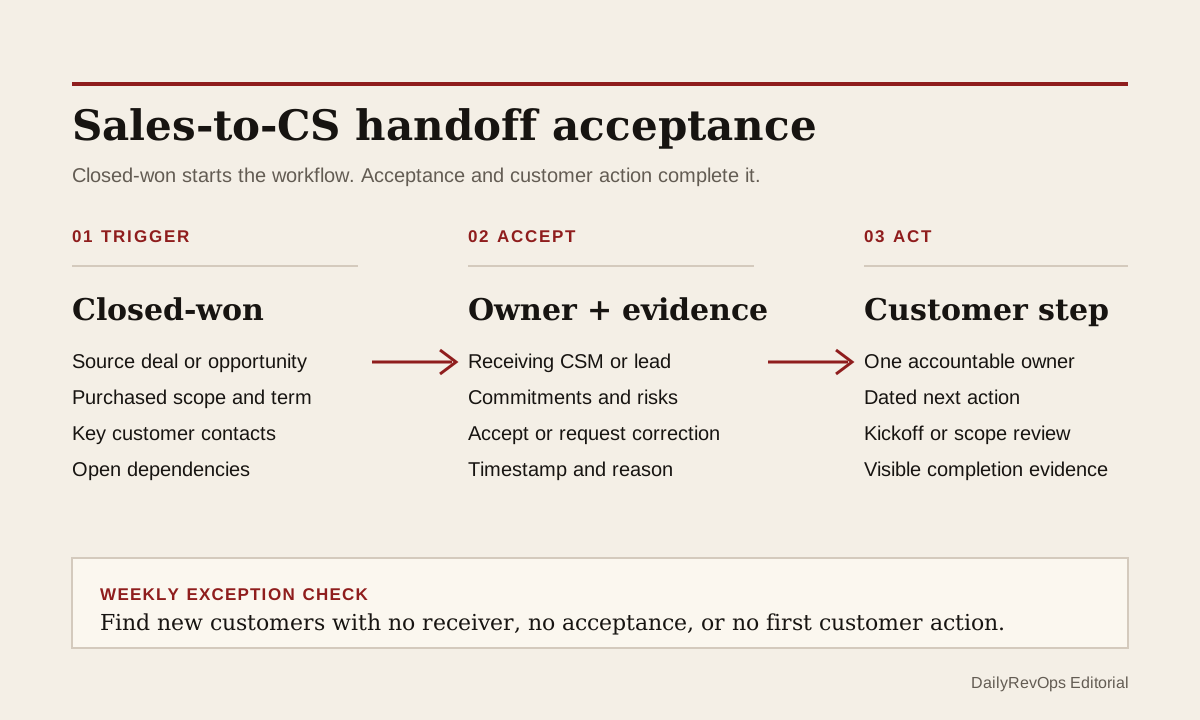
Problem
A sales-to-customer success handoff can look complete because a deal changed to closed-won, an owner field changed, or an internal message was posted. The customer workflow is still at risk when the receiving CSM cannot see the commercial promise, product scope, stakeholders, open blockers, implementation timing, and the first customer action that now belongs to them.
Why it matters
The handoff is the point where new-business context must become an owned post-sale workflow. RevOps should make that transfer inspectable inside the CRM so Sales, Customer Success, implementation, Support, and Finance can see which record triggered the handoff, who accepted it, what evidence moved with it, and whether the customer received the next action on time.
Trigger: start when closed-won creates a new operating obligation
Use this playbook when a closed-won deal should create onboarding, implementation, account ownership, or a first customer-success action. It also applies when an existing customer changes product scope, segment, region, commercial owner, or delivery model and the receiving team needs a fresh acceptance check.
Do not use a stage change as proof that the handoff worked. The stage change is only the trigger. A complete handoff must create an accountable receiving owner, a dated customer action, an evidence packet, and an acceptance state. If any of those are missing, the record belongs in a handoff exception queue rather than being treated as complete.
Owner: separate the commercial owner, handoff owner, and receiving owner
The sales owner remains responsible for accurate commercial context and promises made before close. RevOps owns the field definitions, trigger logic, exception view, and audit rhythm. The receiving CSM or implementation owner accepts the post-sale work and owns the next customer action. A manager owns escalation when the handoff is rejected, unassigned, or overdue.
These roles should not collapse into one generic account owner field. One field can describe the current commercial owner while another identifies the receiving CSM or implementation lead. A separate handoff status and accepted-at timestamp show whether responsibility actually moved. This makes owner changes understandable when territories, teams, or customer segments change later.
Prerequisites: define the entry contract before automating the handoff
Before enabling a workflow, define the records and fields that must be trustworthy at closed-won. The minimum set usually includes the account or company, primary contacts, opportunity or deal, products or line items, amount and term, expected start date, onboarding or implementation need, commercial owner, receiving owner rule, and the first customer milestone.
Write an entry contract that says which missing values block automatic acceptance and which can enter an exception queue. A missing billing contact may require Finance follow-up without blocking the CSM assignment. A missing product scope, implementation date, or primary customer contact may be serious enough to stop the handoff. The rule should follow customer consequence, not field completeness for its own sake.
Build a handoff evidence packet, not a free-text summary
The receiving owner needs structured evidence close to the customer record. Include the source deal, purchased product or service, contract dates, customer objectives stated during the sale, key stakeholders, decision criteria, promised deliverables, known risks, open legal or security items, implementation dependencies, and the latest meaningful customer conversation. Link the source call, email, quote, contract, or note when the context depends on it.
A summary can help the owner read quickly, but it should not replace the underlying records. If an AI assistant prepares the summary, keep it draft-only until the sales owner confirms that the scope, commitments, dates, and stakeholder roles match the source evidence. Customer-facing promises and high-impact CRM fields should not change from an unreviewed summary.
Add acceptance, rejection, and escalation states
A one-way notification is not a handoff control. The receiving owner should accept the handoff, reject it with a reason, or request missing evidence. Acceptance means the owner can see the customer scope, understands the next action, and has a due date. Rejection should route back to the person who can fix the record rather than leaving the item in a shared queue.
Use a small status model such as pending, accepted, needs correction, escalated, and complete. Keep a timestamp and actor for each state change. Complete should mean the first customer-facing post-sale action happened or the onboarding milestone was confirmed, not only that an internal task was checked off.
Measurement: prove that ownership created customer action
Measure the workflow by handoff quality and follow-through. Useful measures include handoffs created, percentage with a receiving owner, percentage accepted within the agreed operating window, percentage with complete source evidence, time from closed-won to first customer action, rejection reasons, overdue first actions, repeated owner reassignment, and records that required manual repair.
Do not publish a universal target without a comparable source and operating definition. Establish an internal baseline from recent handoffs, then inspect why exceptions occur. If most rejections come from missing product scope, improve the close process. If accepted handoffs still have no customer action, ownership or workload is the problem. If owner rules fail after territory changes, the assignment logic needs governance.
Step-by-step workflow
- Name the handoff trigger, usually closed-won, and identify the exact source deal or opportunity that creates the post-sale obligation.
- Define the commercial owner, handoff owner, receiving CSM or implementation owner, and escalation owner as separate roles.
- Create the entry contract for required customer, commercial, product, contact, timing, and implementation evidence.
- Build the handoff evidence packet from structured CRM associations and links to source calls, emails, quotes, contracts, or approved notes.
- Assign the receiving owner and create one dated first customer action, such as kickoff scheduling, onboarding confirmation, or scope review.
- Require the receiver to accept, request correction, or reject with a reason. Route corrections to a named owner with a due date.
- Keep high-impact field changes and AI-prepared summaries in a reviewed lane until the responsible owner confirms the source evidence.
- Close the handoff only when acceptance, source evidence, and the first customer-facing action are visible in the CRM.
- Review weekly exceptions and update the entry contract, owner rules, or source fields when the same failure repeats.
CRM fields and signals needed
- Account or company ID, primary contacts, opportunity or deal ID, pipeline, stage, closed-won timestamp, amount, currency, and commercial owner
- Product, line item, package, service scope, contract or subscription term, start date, renewal date, and implementation requirement
- Receiving CSM, implementation owner, support owner, renewal owner, manager, assignment reason, and owner-change history
- Handoff status, created-at, accepted-at, rejected-at, correction reason, escalation owner, and completion timestamp
- Customer objective, promised outcome, key stakeholders, champion, executive sponsor, decision criteria, and known risk
- Latest meaningful customer conversation, source call or email, approved summary, open task, next customer action, and due date
- Open legal, security, procurement, billing, support, product, or implementation dependency linked to the customer record
- Source confidence and record association checks when deal, account, contact, contract, and onboarding records disagree
Operating quality check
Use this check before adding more tooling. The goal is to prove that the workflow is owned, current, and inspectable inside the system of action.
| Area | Healthy pattern | Risk pattern |
|---|---|---|
| Trigger | One source deal or opportunity creates the handoff at a defined customer moment. | Several stage, owner, or lifecycle changes can create duplicate or conflicting handoffs. |
| Ownership | Commercial, receiving, workflow, and escalation owners are visible as separate roles. | A generic account owner field hides who accepted the next customer obligation. |
| Evidence | Scope, dates, stakeholders, commitments, risks, and source records travel with the handoff. | The receiver gets a summary without enough evidence to trust it. |
| Acceptance | The receiver can accept, request correction, reject, or escalate with a reason and timestamp. | A one-way notification is counted as completion. |
| Customer action | The handoff closes after a dated first customer action or confirmed onboarding milestone. | An internal task closes while the customer remains untouched. |
| Measurement | RevOps reviews acceptance, evidence, time to customer action, corrections, and reassignments. | The team measures only how many handoffs were created. |
Common mistakes
- Treating closed-won, an owner change, or a posted Slack message as proof that the handoff is complete.
- Using one generic owner field for the sales owner, CSM, implementation lead, support owner, and renewal owner.
- Passing a free-text summary without the source records that support product scope, dates, promises, and stakeholder roles.
- Requiring every possible field instead of blocking only on values that change the customer workflow.
- Creating a receiving task without an acceptance, rejection, correction, or escalation path.
- Closing the handoff when an internal task is completed rather than when the first customer action is visible.
- Allowing AI summaries or workflow automation to overwrite high-impact fields without source review.
- Measuring handoff volume while ignoring overdue customer actions, repeated reassignments, and correction reasons.
Weekly handoff checklist
- Confirm the source deal or opportunity and the exact reason the handoff exists.
- Confirm the receiving owner, escalation owner, and accepted-at timestamp.
- Confirm product scope, term, start date, key contacts, commitments, and open dependencies from source records.
- Confirm one dated first customer action and the person responsible for it.
- Return incomplete handoffs for correction with a reason and due date instead of repairing them silently.
- Close the handoff only after the receiving owner accepts and customer action is visible.
Example operating rhythm
- Daily: inspect new closed-won handoffs that have no receiving owner, no evidence packet, no first customer action, or no acceptance state.
- Twice weekly: Sales and Customer Success managers review rejected, corrected, escalated, and overdue handoffs with the named owner.
- Friday: RevOps samples completed handoffs and confirms that the first customer action and source evidence are present, not only a closed task.
- Monthly: group correction and rejection reasons by team, segment, product, and source field to find repeated process failures.
- Quarterly: revalidate owner rules, product mappings, lifecycle definitions, permissions, integrations, and escalation paths after team or process changes.
Tooling options
- HubSpot workflows, record associations, teams, tasks, and custom properties can support a CRM-native handoff when the object and owner rules are clear.
- Salesforce opportunities, accounts, contacts, account teams, tasks, Flow, and handoff controls can support more complex ownership and role models.
- Vitally or another customer success platform can become the receiving workspace when the post-sale motion needs health, lifecycle, onboarding, and portfolio management beyond the CRM.
- Gong or another conversation platform can supply source context, but the receiving owner and next action should still be explicit in the system of action.
- Sighub is relevant later in the HubSpot customer lifecycle when missed renewal conversations need evidence-backed owner tasks. It does not replace the initial sales-to-CS handoff design.
Source notes
These sources support the workflow model and product concepts. They do not prove a specific business outcome, benchmark result, or vendor claim.
- HubSpot associate records documentation: Official reference for associating records so companies, contacts, deals, tickets, and other context can remain connected during a handoff.
- Salesforce handoff customization documentation: Official reference for Salesforce handoff configuration concepts. Validate current edition, permissions, and object behavior before implementation.
- Salesforce Account Teams documentation: Official context for defining account-team roles and access around customer records.
Last updated: 2026-07-17
Decision frameworks to read next
- HubSpot vs Salesforce for RevOps workflows
- Vitally vs generic CRM health tracking
- CS platforms vs CRM-native renewal alerts
FAQ
When is a sales-to-customer success handoff complete?
It is complete when the receiving owner has accepted the work, the source evidence is visible, and the first dated customer-facing action or onboarding milestone is recorded.
Which CRM fields should block a handoff?
Block only on missing values that prevent safe customer action, such as receiving owner, primary customer contact, purchased scope, start date, critical dependency, or first next step. Other gaps can enter a correction queue.
Can AI create the handoff summary?
AI can draft a summary, but the sales owner should confirm product scope, commitments, dates, stakeholders, and risks against source records before the summary guides customer work.
What should RevOps measure after rollout?
Track acceptance, source-evidence completeness, time to first customer action, correction and rejection reasons, overdue actions, repeated owner changes, and manual repairs.