Problem
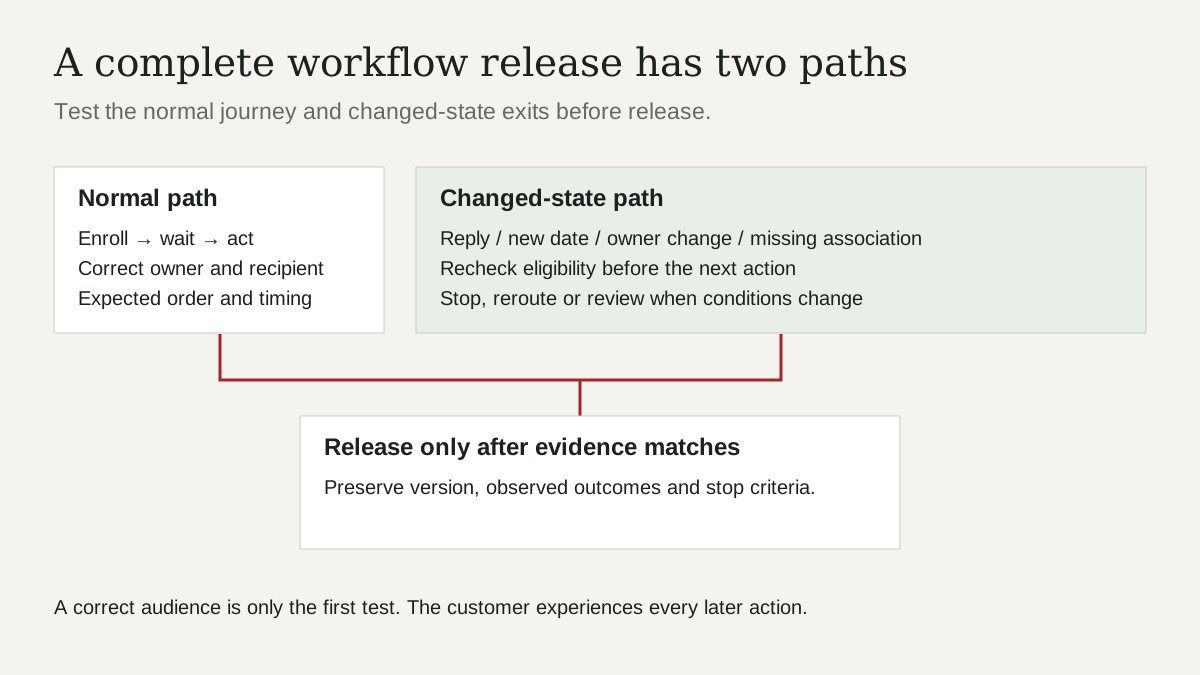
A correctly selected audience can still receive the wrong sequence of actions when timing, exit rules or re-enrollment behave differently from the team's assumptions.
Why it matters
The customer experiences the complete journey. Testing only the first enrollment condition leaves later messages, repeated actions and changed records outside the evidence for release.
Trigger and accountable owner
Use this playbook before enabling a new renewal journey, changing its delays or branches, importing records into an active flow, or widening its eligible audience. Also repeat the relevant checks when another integration starts writing a field used by the journey. The release owner should be a named operator with authority to pause the workflow. The customer-facing owner should approve the intended communication and escalation behavior.
Define the outcome in customer terms. For example: a renewal owner receives one preparation task, the customer receives an approved message only when appropriate, and later actions stop when the accepted exit condition is reached. Avoid describing success only as the workflow ran. A technically successful run can still be an inappropriate customer experience.
Prerequisites and a written journey map
List every action from enrollment to completion, including waits, branches, record edits, tasks, internal alerts and customer messages. Record the intended timing between actions in plain language. Identify which conditions are checked only at enrollment and which are checked again before an action. If the platform cannot provide the desired second check, redesign the flow before enabling it.
Preserve the current version, audience query, owner rules, message versions and rollback instructions. Prepare a small set of clearly marked internal test records and destinations. Keep real customer addresses out of the first functional test. Verify that the test path cannot accidentally inherit a live list, broad association or fallback recipient. The presence of a test label alone is not a containment boundary.
CRM and data model contract
Write down the object that enrolls, its stable identifier and its associations to the customer, commercial record and communication recipient. Identify the authoritative renewal date and the property used for timing. State what happens when the date is missing, changes during a delay or points to a different commercial term. Decide whether the workflow follows a company, a contract or a specific renewal event.
Separate eligibility from permission to communicate. A record can be commercially eligible while lacking an appropriate contact, a valid address, consent where required or a suitable message context. Assign an owner to each rule. Do not let an unresolved association silently choose the first available contact or let an empty owner field produce a task nobody sees.
Test the entire sequence
Start with the normal path and observe every step through completion. Record the planned and actual times, branch outcomes, recipient, associated records and resulting tasks. For long waits, use a safely isolated test version with short delays to inspect transitions, then separately verify the production delay configuration. A shortened test is evidence about sequence behavior, not evidence that the production clock is correct.
Next test changed-state cases. Add a customer reply during a wait. Change the renewal date. Reassign the owner. Cancel a scheduled meeting. Mark the commercial event complete. Remove the contact association. Each case should have an expected outcome written before execution. Where the flow should stop, confirm that every later action is suppressed, including actions already queued.
Prove duplicate and re-entry behavior
Enroll the same eligible record again and observe what actually happens. Test an import or integration update that rewrites an unchanged property. Test a record that leaves the criteria and later re-enters. Define whether the new run represents the same renewal event or a future one. The distinction should be based on stable commercial identity and period, not simply the time of the latest update.
Inspect every task writer that can act on the same account. A native workflow and a connected application can both be operating correctly while producing duplicate work together. Decide which system owns the action, how existing work is recognized and what happens when a task is completed or deleted. Keep a route for uncertain cases instead of retrying indefinitely.
Quality assurance and stop conditions
Have a second person inspect the message order and the visible customer experience where staffing allows. Review the actual destination and rendered content, including personalization fallbacks. Confirm that the message does not imply a renewal date, product entitlement or commercial commitment that the underlying records cannot support. A test should verify the content the recipient would see, not only the action label on the canvas.
Define release blockers: unexpected recipient, skipped delay, repeated message, missing suppression, wrong company association, unowned task or unexplained branch result. A blocker remains a blocker even if most records behaved correctly. Correct the cause and rerun the affected path plus a normal path. Keep the evidence with the workflow version so the next operator can understand what was tested.
Release in a bounded cohort
Enable a small appropriate cohort first and watch the complete journey. Choose the cohort for low operational complexity and representative behavior, not because it will produce flattering results. Set a clear observation window and a named person to inspect exceptions. Keep expansion separate from the initial release decision so a clean first action does not automatically expose the entire customer base.
If something goes wrong, pause the relevant action path, inspect what has already been sent or written and decide the customer response from the actual impact. Do not automatically restart the same audience after a fix. Determine which records have already received each action, reconcile their state and resume only the remaining justified work. Preserve the incident evidence rather than clearing it to make the dashboard look normal.
Rhythm and measurement
Review active journeys whenever a dependency changes and inspect a sample during the regular customer-operations review. Track unexpected transitions, duplicate actions, suppressed actions, owner acceptance and the time required to resolve exceptions. These are operating measures. They do not independently prove customer retention, and they should not be presented as a benchmark across companies with different journeys.
Retire a workflow only after identifying its queued records, dependent fields, related task writers and reporting uses. A paused flow can still leave open customer work behind. Transfer that work to a named owner and verify the resulting queue. The release standard and retirement standard share the same principle: every customer action should have an explainable path, an accountable owner and evidence that the system behaved as intended.
Step-by-step workflow
- Map every action and delay through the final exit.
- Verify test recipients and contain the audience.
- Test normal, changed-state, duplicate and re-entry cases.
- Record observed actions against expected outcomes.
- Release a bounded cohort and inspect the whole journey.
CRM fields and signals needed
- Renewal event ID and authoritative date
- Company and contact associations
- Owner and fallback owner
- Current plan and suppression state
- Workflow version and action timestamps
Common mistakes
- Testing enrollment alone
- Assuming a completed task confirms customer progress
- Restarting a partially executed audience without reconciliation
Example operating rhythm
- Review after every material change
- Inspect exceptions during the weekly customer-operations review
Tooling options
- Use the CRM's execution history and a controlled internal cohort.
- Keep evidence links with the reviewed version.
Source notes
These sources support the workflow model and product concepts. They do not prove a specific business outcome, benchmark result, or vendor claim.
- HubSpot: Workflow enrollment history: Official reference for inspecting record paths and workflow execution history.
- HubSpot: Choose workflow actions: Action reference; this playbook supplies an independent release procedure.
Last updated: 2026-09-08
FAQ
Does a correct audience mean the workflow is safe?
No. Later delays, branches, queued actions and re-enrollment still need end-to-end testing.