Problem
A lifecycle automation can pass a builder preview and still fail operationally because the source event is ambiguous, identity crosses the wrong account, the deployed version differs from approval, a downstream write is overwritten or a message is sent after customer state changes.
Why it matters
Attio, Customer.io and Braze now expose useful evidence at workflow, trigger and delivery layers. RevOps needs one gate that connects those surfaces, proves the normal and changed-state paths and assigns recovery before a live cohort can be released.
Define the consequential unit
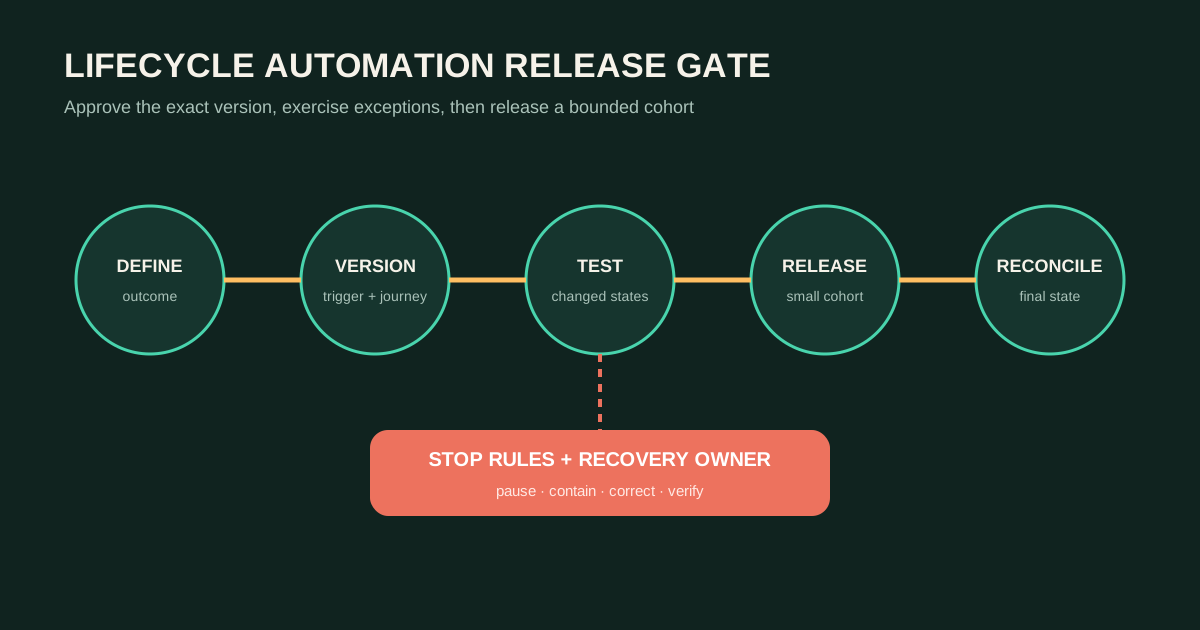
Write the customer or commercial outcome in one sentence: for example, an iOS entry event may enroll an eligible person in a venue journey, or an approved CRM change may assign a follow-up owner. Name the subject grain, account relationship, authoritative eligibility sources and customer-facing consequence.
Classify the run before choosing controls. Descriptive enrichment, CRM ownership, consent-sensitive contact and entitlement changes need different approval, evidence and retention. The classification determines the sample size, release authority and recovery requirement.
Version trigger, identity and decision
Preserve the event schema, geofence or source-definition version, workflow version, deployed-at time and stable subject identifiers. For Customer.io polygon geofences, record the boundary version and SDK version that produced the entry or exit event.
Save the approved configuration, not only a prompt or builder draft. Assisted construction can accelerate setup, but the deployed audience, branches, timing, fields and channels must be reviewable as an exact version.
Test normal, delayed and changed-state paths
Create named test subjects for normal entry, boundary jitter, delayed device delivery, missing identity, conflicting account association, current suppression, changed owner, destination rejection, retry and manual pause. Confirm both expected action and expected non-action.
Inspect the platform history and the destination independently. Attio's workflow and agent logs can show steps and changes; Braze observability can explain a message disposition. A second read verifies the final CRM, audience or communication state.
Release a bounded cohort
Choose a small, representative cohort with a documented time window, maximum volume and stop authority. Keep high-impact downstream actions behind a manual release until the first sample reconciles.
Monitor threshold, failure, hold, drop, duplicate and destination mismatch signals. A volume anomaly can indicate missing source events or broken eligibility; it is not proof of cause. Follow the correlation IDs back through the chain.
Close with evidence and recovery
For each sampled run, store trigger, identity, approved version, branch, writes, delivery disposition, destination read and reviewer. Record held and rejected actions because successful controls are part of the release evidence.
Exercise the recovery path before expansion. Pause the journey, identify unprocessed subjects, restore reversible values or issue a compensating customer action, then verify the corrected state. Name the owner who can approve each step.
Step-by-step workflow
- Name the business outcome, subject grain, account relation and consequence class.
- Inventory trigger, identity, eligibility, CRM, messaging and destination authorities.
- Assign stable event, subject, account, workflow-version and correlation identifiers.
- Freeze the approved audience, branches, timing, writes, channels, thresholds and stop rules.
- Build normal, delayed, duplicate, stale, suppressed, changed-owner, rejected and retry test cases.
- Run the cases and inspect workflow history, agent calls, message disposition and destination state.
- Approve a bounded cohort with a volume ceiling, time window, monitoring owner and recovery owner.
- Monitor source volume, entry or exit balance, branch counts, holds, drops, rejects and final-state mismatches.
- Sample normal and exceptional runs for reconstructability before widening the cohort.
- Close the release only after evidence is stored, corrections are complete and the next review is scheduled.
CRM fields and signals needed
- Stable event and correlation ID
- Trigger or geofence version
- Observed, received, evaluated and confirmed times
- Person and account identity mapping
- Workflow and approval version
- Agent tool calls and changed records
- Destination request and independent read
- Sent, held or dropped reason
- Threshold breach and cohort size
- Pause, rollback or compensating-action owner
Operating quality check
Use this check before adding more tooling. The goal is to prove that the workflow is owned, current, and inspectable inside the system of action.
| Area | Healthy pattern | Risk pattern |
|---|---|---|
| Trigger | Stable event ID, version and clocks are present | Only a current flag or screenshot exists |
| Identity | Person and account keys resolve without conflict | Email or domain is the only link |
| Decision | Exact approved version and reason are stored | Prompt or mutable draft is treated as approval |
| Action | Request, result and destination read reconcile | HTTP or platform success is the only proof |
| Recovery | Pause, affected cohort and correction owner are tested | The team plans recovery after an incident |
Common mistakes
- Treating a successful step as proof of a correct customer outcome
- Keeping only the builder prompt instead of the deployed configuration
- Using mutable email or domain as the only cross-system key
- Discarding held, rejected and dropped actions from review
- Ordering delayed events by ingestion time alone
- Expanding volume before changed-state cases pass
- Assuming platform logs preserve previous destination values
- Letting the builder approve the same high-impact release without an authority boundary
Lifecycle automation evidence review
- Provide the release ID, approved version and cohort.
- List source, identity and destination owners.
- Link the live monitoring and exception views.
- Name who may pause, restart, reverse or communicate a correction.
- Record the first review time and evidence-retention location.
Example operating rhythm
- Before release: approve purpose, versions, tests, cohort, limits and recovery.
- First live hour: reconcile trigger volume, branches, writes, holds, drops and destination reads.
- Next business day: sample normal, exceptional and delayed runs and resolve every unexplained difference.
- Weekly: review overrides, corrections, identity gaps, stale versions and evidence-retention failures.
- Monthly: retest pause and recovery, permissions, source authority and cross-system correlation.
Tooling options
- Use Attio workflow history and agent logs for step, tool-call, record-change and credit evidence where applicable.
- Use Customer.io release and SDK evidence to version location-trigger behavior and test entry or exit semantics.
- Use Braze threshold alerts and messaging observability to investigate volume and message disposition where applicable.
- Use the CRM, data warehouse or billing system for independent final-state verification when it owns the business field.
- Use a governed release register for approvals, correlation IDs, samples, exceptions and recovery results.
Source notes
These sources support the workflow model and product concepts. They do not prove a specific business outcome, benchmark result, or vendor claim.
- Attio: Workflow history and agent log: Official changelog dated September 23, 2026; describes step-level workflow history and agent logs covering tool calls, record changes and credits.
- Customer.io: iOS SDK 4.9.0 polygon geofences: Official stable iOS SDK changelog dated September 25, 2026; states that polygon geofences follow the drawn venue shape while existing circular geofences continue to work.
- Braze: Forge 2026 product announcements: Official product announcement published and last edited September 28, 2026; describes journey building, Content Optimizer, threshold alerts, messaging observability, data ingestion and account objects.
Last updated: 2026-09-30
Decision frameworks to read next
FAQ
Does a platform success status complete the gate?
No. It proves a configured execution state. The gate also requires source, identity, approved version, final destination state and consequence checks.
How large should the first cohort be?
Use the smallest representative cohort that exercises the real trigger, identities, branches and destination behavior while remaining easy to pause and reconcile.
Should every automation keep the same evidence?
No. Scale retention and approval to consequence, but every material run should remain reconstructable for its required review window.