Short verdict
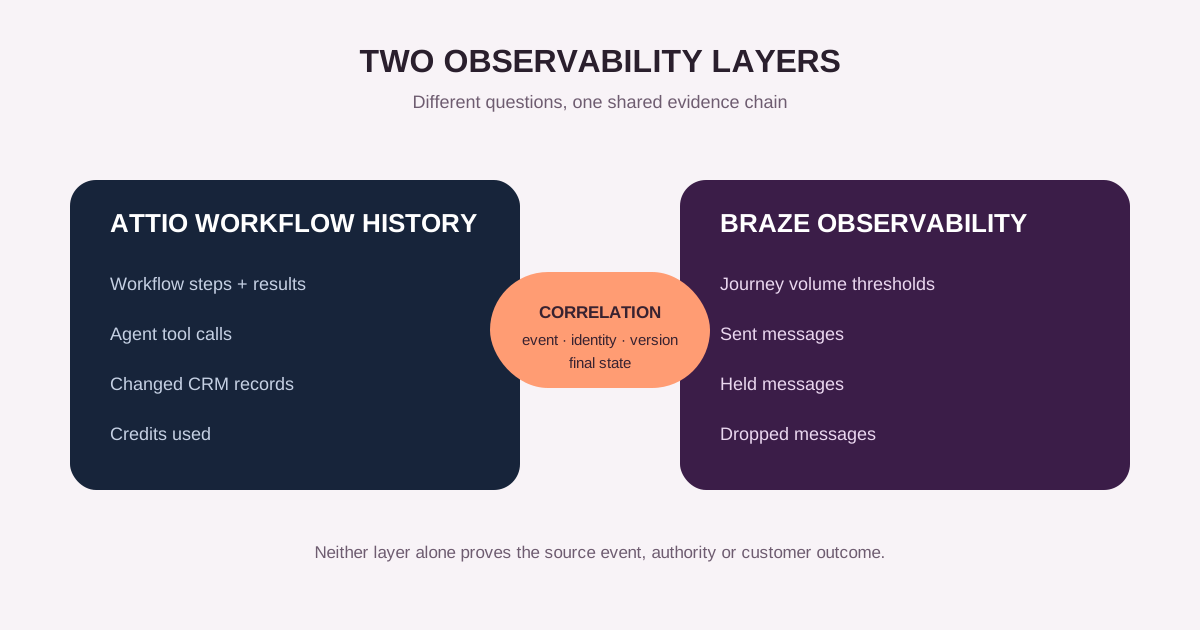
These products are not substitutes. Attio's September 23 update describes run history plus an agent log. Braze's September 28 announcement describes available threshold alerts and a Messaging Observability Dashboard. Choose the surface that matches the failing layer, and require stable correlation to the trigger and final business state.
This comparison is written for RevOps, Sales Ops, GTM Operations, and Customer Success Ops teams that need a practical decision framework. It focuses on workflow ownership, CRM data quality, implementation effort, source-of-truth behavior, and the operating rhythm each option supports.
Who each option is best for
Attio fits teams tracing workflow steps, agent tool calls and record changes inside CRM operations. Braze fits teams diagnosing journey volume and why customer messages were sent, held or dropped. Many stacks need both layers plus source and destination evidence.
The right answer depends on the job the team is trying to improve. A tool that is strong for one operating model can be a poor fit when the real problem is ownership, dirty CRM data, missing renewal dates, weak handoffs, or an unclear forecast process. Use this page to map the workflow before treating either option as the default.
Operating questions before choosing
- Which recurring meeting or workflow will change if the team chooses Attio workflow history or Braze messaging observability?
- Which CRM records, fields, activities, or customer signals are required for the workflow to be trusted?
- Who owns the next action when the system surfaces a risk, alert, forecast change, or customer signal?
- Does the option write usable context back to the system of record, or does it create another place to inspect?
- What manual review work should decrease after implementation?
Side-by-side table
| Criterion | Attio workflow history | Braze messaging observability | Editorial note |
|---|---|---|---|
| Primary layer | CRM workflow and agent execution | Lifecycle journey and message delivery | Start with the layer where the symptom appears |
| Run detail | Steps, changes and results | Journey volume and message disposition | Neither alone proves the full customer outcome |
| Agent evidence | Tool calls, changed records and credits | Operator-assisted journey construction is separately described | Proposal and approval still need organization rules |
| Customer contact | May prepare or change CRM work | Directly investigates sent, held and dropped messages | Contact consequence raises approval requirements |
| Trigger context | Needs source event and record identity | Needs audience entry and event lineage | Carry stable IDs into both |
| Destination proof | Read the final CRM record independently | Read current profile, journey and downstream state | Vendor status is execution evidence, not full verification |
| Volume control | Review run counts and exceptions | Canvas Threshold Alerts are listed as available | Thresholds detect anomalies but not root cause |
| Best operator | RevOps, CRM admin and automation owner | Lifecycle, marketing operations and deliverability owner | Cross-functional incidents need a named lead |
| Recovery | Pause workflow and correct records | Pause journey, suppress future actions and assess communication | Sent communication may require compensation, not reversal |
| Evidence join | Workflow, record and agent run IDs | Campaign, journey, profile and message IDs | Use a shared correlation record across layers |
Workflow comparison
- Classify the incident as trigger, identity, workflow, destination, journey-volume or message-disposition failure.
- Open the relevant vendor evidence and capture stable run, record, journey and message identifiers.
- Trace backward to the initiating event and approved version, then forward to the independent destination or customer outcome.
- Pause the smallest affected scope, reconcile a sample and assign correction plus customer communication where needed.
- Record the root layer and improve the correlation or stop rule before restart.
A RevOps workflow should produce a visible action, not only a report. When comparing Attio workflow history and Braze messaging observability, the team should look at the handoff from signal to owner to customer action. If the output does not change a task, meeting, field, renewal follow-up, forecast inspection, or manager review, the tool may become another dashboard rather than operating leverage.
Implementation complexity
Medium. The real complexity depends on data quality, ownership clarity, and whether the team changes its operating rhythm.
Implementation should start with source fields, permissions, integration points, and the review process. The most common failure is buying a tool before defining the workflow. A narrow pilot is usually safer than a full rollout because it reveals bad CRM fields, unclear owners, duplicate definitions, and gaps between the tool and the team operating cadence.
Data and CRM requirements
Reliable RevOps decisions need clean CRM data. Before choosing between Attio workflow history and Braze messaging observability, check owner fields, lifecycle stage, account and opportunity status, renewal or close dates, activity history, task ownership, and the fields that drive routing or reporting. If these fields are not trusted, the comparison should include a data cleanup step.
- Define the system of record for the workflow.
- List the fields that trigger action or reporting.
- Decide which fields can be written automatically and which need review.
- Document what evidence an operator should inspect before acting.
- Measure whether the workflow reduces missed follow-up or manual reconciliation.
Data model impact
- Define shared person, account and correlation identifiers before connecting CRM workflow evidence to lifecycle delivery evidence.
- Preserve event, workflow, journey and message versions with observed, evaluated and confirmed times.
- Keep field authority explicit: a workflow log records change, while the CRM, billing or preference system may own the current truth.
- Model holds, drops, rejects and manual overrides as first-class outcomes rather than missing success.
CRM fields and signals to check
- Correlation ID, workflow run ID, agent run ID, CRM record ID and prior/current values.
- Person ID, account ID, audience or journey ID, campaign ID, message ID and channel.
- Trigger event ID, schema or geofence version, observed time, received time and evaluated time.
- Approval version, suppression state, hold or drop reason, destination read, correction owner and reviewed-at time.
Cost and maintenance considerations
Both products are commercially packaged platforms; observability value depends on the modules, plans and limits in the target account. Include implementation, identity mapping, evidence retention, monitoring and recovery ownership in total operating cost. Verify current pricing and availability directly rather than inferring them from the announcement pages.
Cost should include licenses, setup time, admin maintenance, integration work, enablement, governance, and the opportunity cost of manual review. A cheaper workflow can become expensive if it requires weekly spreadsheet cleanup. A larger platform can become expensive if the team only uses a narrow part of it. RevOps should compare total operating cost, not only subscription price.
Risks and limitations
- Selecting a tool by dashboard appeal instead of the layer the team must control.
- Treating an execution trace as proof that the trigger and business authority were correct.
- Failing to join person-level activity to the intended account or commercial record.
- Keeping different clocks and versions without a correlation key.
- Assuming a sent communication can be rolled back like a CRM field.
The main risk in any RevOps tool comparison is overgeneralizing. No tool is universally best. The fit depends on company stage, CRM maturity, sales motion, renewal volume, customer success model, admin capacity, and how disciplined the team is about acting on signals.
Implementation risk
- A technically connected stack can remain operationally fragmented when run IDs are not carried across events and writes.
- Test delayed triggers, duplicate events, changed owners, suppression, destination rejection and retry behavior before live volume.
- Confirm actual account packaging, retention, exports and permissions; the official announcements do not define every tenant's configuration.
- Run independent reads after writes and delivery checks instead of relying on one vendor response.
Governance risk
- Separate builder, approver and recovery authority for customer-impacting automation.
- Apply least privilege to raw payloads, customer records, tool calls and messaging evidence.
- Document retention by consequence and avoid copying unnecessary personal data into a central log.
- Review version changes, threshold edits, overrides and agent permissions as production changes.
Alternatives and complements
- Customer.io or another lifecycle platform can provide different trigger and message surfaces; evaluate the same correlation and recovery requirements.
- A warehouse can join vendor evidence for investigation, but it should not silently become the authority for consent or contracts.
- Native CRM audit history can complement Attio when a connected object or external system owns the record.
- Deliverability and channel-provider logs can complement Braze when transport-level evidence is needed.
Weekly operating rhythm
- Monday: review new failures, holds, drops, destination mismatches and missing correlation links.
- Midweek: sample normal Attio runs and Braze message paths against source and final state.
- Friday: close corrections, record root layers and retest changed stop rules.
- Monthly: review permissions, retention, versions, threshold quality and recovery readiness.
Decision framework
- Use Attio history when the question is which workflow or agent step ran, what record changed and what result or credit use was recorded.
- Use Braze observability when the question is why journey volume shifted or why a message was sent, held or dropped.
- Use both when a CRM workflow supplies or changes lifecycle context and customer communication follows downstream.
- Keep source-event, identity, consent, billing and contractual evidence in their authoritative systems.
- Approve the stack only after a sample can be reconstructed end to end without searching by mutable labels.
If the team cannot name the owner, source field, review cadence, and next action, pause the purchase and map the workflow first. Strong RevOps teams buy tools to close a defined operating gap. They do not use tools to discover the process after the contract is signed.
FAQ
Are Attio workflow history and Braze messaging observability direct alternatives?
No. They cover different operational layers and can complement each other in one revenue stack.
Which surface should RevOps open first?
Start where the symptom appears, then trace backward to trigger and approval and forward to final state.
Do these logs replace a central evidence model?
No. The organization still needs stable identifiers, authority, retention and recovery across systems.
Source notes
These official references support the product and workflow context. DailyRevOps uses them to bound the comparison, not to imply outcomes, rankings, or adoption claims.
- Attio: Workflow history and agent log: Official changelog dated September 23, 2026; describes step-level workflow history and agent logs covering tool calls, record changes and credits.
- Braze: Forge 2026 product announcements: Official product announcement published and last edited September 28, 2026; describes journey building, Content Optimizer, threshold alerts, messaging observability, data ingestion and account objects.
Last updated: 2026-09-30