Problem
An API version change can expose mismatches between a portal's configured rules and the assumptions in its connected writers.
Why it matters
A normal successful request is not enough evidence for a migration. The release must also handle incomplete facts, restricted actions and changes made while a failed operation waits.
Trigger, scope and accountable owner
Use this playbook when a writer is scheduled to adopt HubSpot's 2026-09 API version or when the portal's requirements change. HubSpot's announcement says the new enforcement depends on configured rules. Inventory the actual version used by each writer first; do not assume every connected application migrated on the release date. Identify the object types and operations in scope and leave unrelated integrations unchanged.
Name an integration release owner who can pause the affected writer, a CRM administrator who can explain the rules and a business owner who can validate the customer facts. Record the planned change window and the person receiving exceptions afterward. If a vendor controls the API version, ask for its migration boundary and test evidence instead of pretending the portal administrator controls the vendor's release.
Capture the current contract
Record the source event, target record type, stable record identifier, mapped properties, association targets and authentication model. Preserve the deployed mapping and a known-good configuration reference. List which values come from authoritative records, which are derived and which need human confirmation. Define the evidence required for each commercially consequential change.
Inspect the portal's configured requirements with the responsible administrator. HubSpot identifies conditional requirements, create-record requirements and a user-level OAuth association-permission boundary; it says that association restriction does not affect portal-level app tokens. Test the model actually used by the integration. Do not expand permissions simply to make a test pass.
Prepare isolated records and expected outcomes
Use a permitted test environment or a tightly isolated set of internal records. Confirm that their creation or update cannot trigger customer messages, billing changes or live routing. A name containing test is not sufficient isolation if another workflow enrolls every new record. Review the full downstream path before sending the first request.
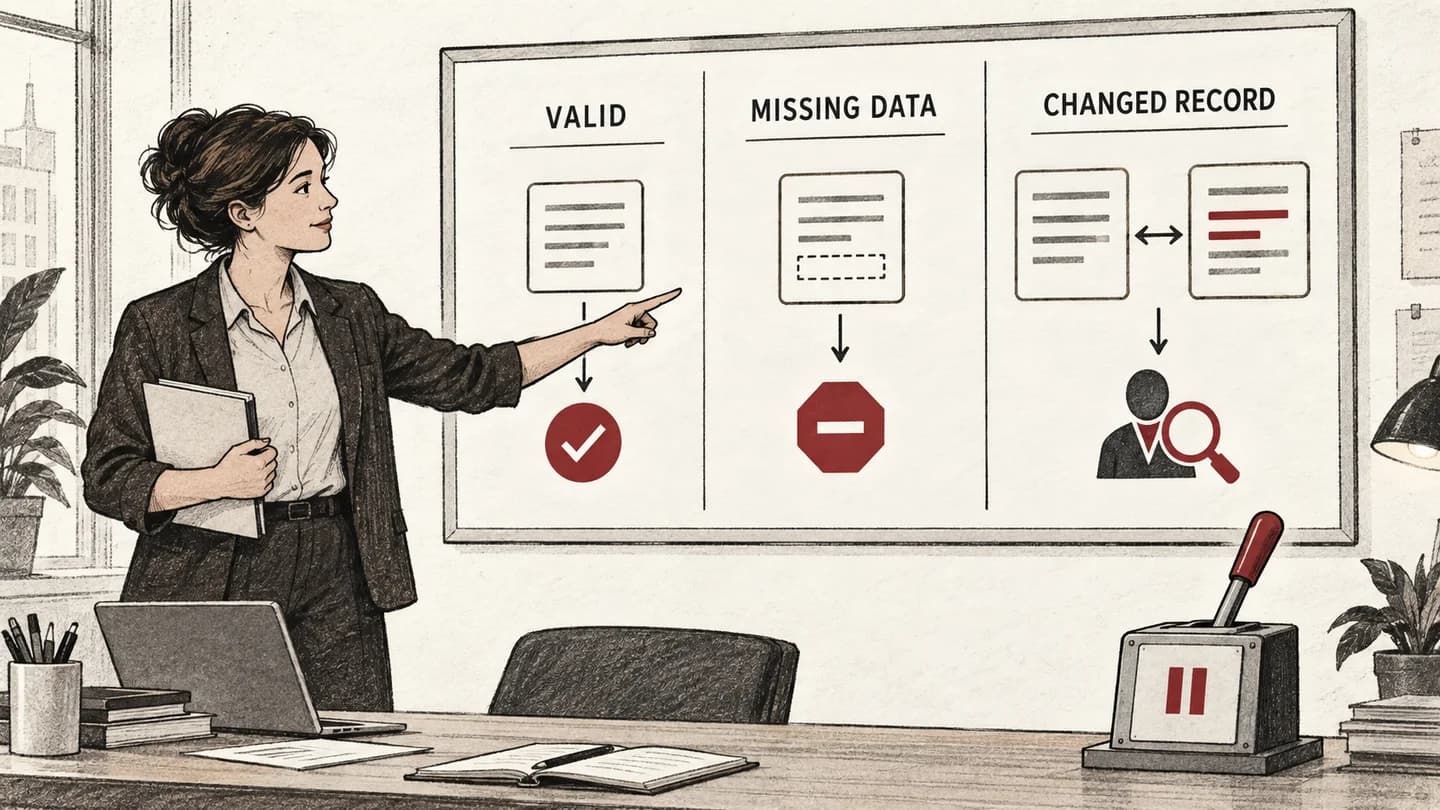
Write the expected result before execution. Include a complete valid create, a create missing a required fact, a normal update, a conditional change without its supporting value and an association operation with the relevant authority boundary. Add a case where no applicable rule is configured. Keep the test matrix tied to the actual portal settings rather than a universal list of assumptions.
Inspect the record, response and downstream effect
For each case, retain a redacted request, response category, correlation identifier where available, configuration version and observation time. Check the resulting CRM record, not only the response code. Verify the property values and associations that matter to the business. If the request should be rejected, confirm that the intended prohibited change did not occur.
Inspect any downstream task, notification or workflow enrollment associated with the test. An API check can pass while another system acts on an earlier source event. Compare what the customer-facing process would believe with what the CRM actually committed. Keep technical success and business completion as separate observations in the evidence record.
Test repair without manufacturing evidence
When a required fact is absent, route the case to the person who can establish it. Never fill a commercial date, amount or status with an arbitrary value solely to satisfy validation. A legitimate resolution can be to abandon the proposed change because the original event did not support it. Preserve that decision and its owner.
For a mapping problem, repair the encoding or target field and repeat the affected test. For a disputed rule, have the process owner decide whether the rule accurately represents the business requirement. Do not weaken a portal-wide requirement as an undocumented workaround for one writer. Any rule change should receive its own impact review because other interfaces may rely on it.
Prove replay behavior after the record changes
Prepare a failed operation, then make an authorized later change to its test record. Attempt the controlled replay using the intended production logic. The expected behavior should protect the newer legitimate value or route the conflict for review. A repaired old request is not automatically the most current truth.
Test a timeout after a write may already have committed, and a repeated source event representing the same business action. Confirm that the system recognizes existing work before repeating it. Track one operation identity across attempts and retain the final outcome. Stop the release if a retry can create duplicate records, duplicate outreach or an unexplained overwrite.
Release blockers and bounded rollout
Block release for a wrong record association, unauthorized write, invented required value, lost exception, uncontrolled repeat or unexplained downstream action. Fix the cause and rerun both the affected path and a normal path. A majority of passing cases does not override a failure involving a consequential customer action.
Once the evidence is accepted, enable a bounded cohort appropriate to the business risk. Record which writers and operations are included. Keep the previous configuration available where a supported rollback is possible, but remember that restoring configuration does not undo writes already made. Reconcile the records affected during the test and release window separately.
Daily review, measurement and handover
During the initial observation window, review unique rejected operations, missing business evidence, mapping defects, permission issues and conflicts with newer data. Give each unresolved case an owner and a next review time. Inspect accepted writes as well as failures, because required-field completeness does not establish factual correctness.
After stability is demonstrated, move the checks into the normal weekly operating review and repeat relevant tests after rule, mapping, token or writer changes. Handover is complete when another operator can locate the evidence, pause the affected path and explain how unresolved cases reach their owners. Keep this test pack alongside the workflow configuration rather than in a disconnected presentation.
Step-by-step workflow
- Inventory writers and API versions.
- Capture portal rules, mappings and authority.
- Test valid, invalid and changed-state cases.
- Repair evidence or mapping without bypassing rules.
- Release a bounded cohort and reconcile actual CRM outcomes.
CRM fields and signals needed
- Unique rejected operations and their age
- Cases awaiting customer evidence
- Wrong associations and repeat actions
- Verified writes that survive the next sync
Common mistakes
- Treating every older integration as migrated automatically
- Retrying an unchanged invalid request
- Inventing required business values
- Assuming a configuration rollback reverses past writes
Example operating rhythm
- Daily during rollout: inspect owned exceptions and accepted-write samples.
- Weekly after stabilization: review the error mix and repeat tests for changed dependencies.
Tooling options
- CRM configuration history and a redacted request log
- Integration execution history and a named business exception queue
Source notes
These sources support the workflow model and product concepts. They do not prove a specific business outcome, benchmark result, or vendor claim.
- HubSpot CRM API write validation enforcement: August 11 announcement for the 2026-09 version; configured rules and token type determine the relevant test cases.
- Attention workflow execution inspection: Example of inspecting triggers, branches, step results and version restoration in a connected workflow tool.
Last updated: 2026-09-09
Decision frameworks to read next
FAQ
Should we disable required fields to get the integration running?
Not as an undocumented workaround. Determine whether the request lacks evidence, the mapping is wrong or the business rule needs an approved change.
Does a successful retry finish the work?
Only after the intended record is verified and any affected downstream action is reconciled. A retry can succeed against a record that has changed since the first attempt.