Automation rate is an attractive number because it is easy to explain: how much work ran without a person touching it? It is also a weak first benchmark. A workflow can automate one hundred percent of a process while using an ambiguous metric definition, stale source data, generic retry logic or an unverified destination write. The rate tells you how often the machine acted. It does not tell you whether an operator can reconstruct the decision or whether the resulting business state is correct.
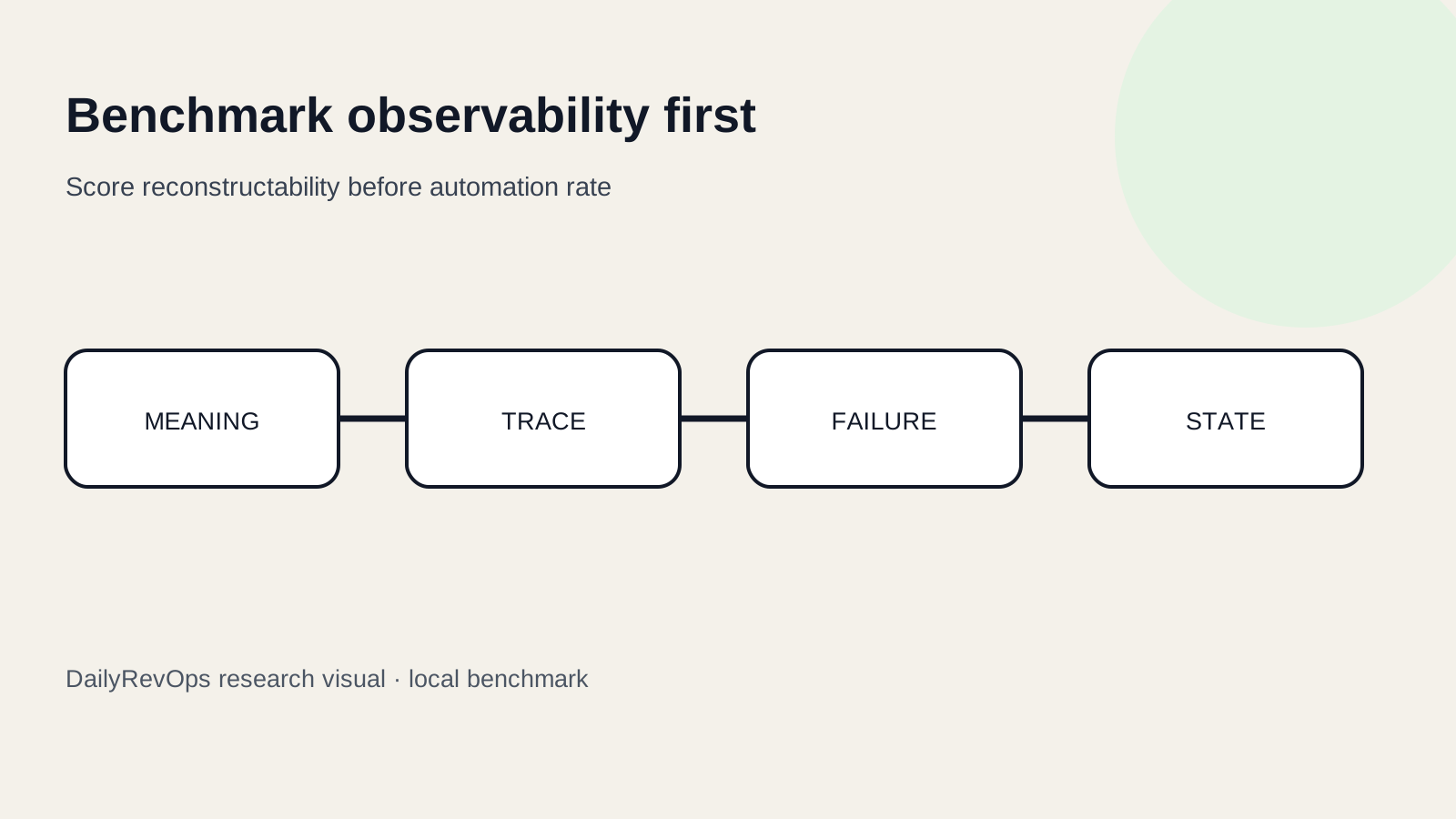
This DailyRevOps benchmark is a local evaluation method, not a universal industry standard. It is designed for teams testing their own CRM, support, billing, lifecycle, enrichment and agent-assisted workflows. The method scores observability before throughput: business-definition clarity, source traceability, failure classification, write verification and correction readiness. Only after those controls are measurable should the team compare automation rate, latency or labor saved.
Unit of analysis: one production decision path
Choose one workflow that produces a durable business outcome. Examples include assigning an account, calculating a support KPI, enriching a contact, creating a renewal task, updating a lifecycle stage, exporting subscription pricing or writing a billing adjustment. Define the start and end points. Do not benchmark an entire platform at once. A platform may be well controlled for read-only reporting and poorly controlled for writes, or vice versa.
For the selected path, capture a stable workflow version and a fixed evaluation cohort. Include ordinary records and deliberately difficult ones: missing source values, a duplicate identity, a stale record, a different currency, an unsupported pricing shape, a permission failure, malformed input, a transient failure and a write whose result is uncertain. The benchmark becomes useful when the same cases can be rerun after a vendor, schema, prompt or workflow change.
Dimension 1: business-definition observability
Score whether the workflow makes its business meaning reconstructable. For a metric, can another operator identify the numerator, denominator, filters, exclusions and time basis? For a renewal price, can they identify the source currency, pricing model and effective period? For an account status, can they identify the rule or evidence that produced the label? A field name alone does not count as a definition.
Use a simple local scale: 0 when the meaning exists only in tribal knowledge or UI labels; 1 when there is partial documentation but important filters or authority are implicit; 2 when the definition, owner, effective date and source authority are explicit and versioned. Record the evidence URL, file or configuration ID used to award the score. The number matters less than the requirement that another operator can reproduce the reasoning.
Dimension 2: source and identity traceability
A result should be traceable to the business object it describes. Capture stable IDs for the customer, contact, opportunity, subscription, conversation, cohort or other unit of work. Then capture the source records and observed-at times for material inputs. If several systems contribute evidence, mark which one is authoritative for each fact and which ones provide context only.
Score 0 when a result survives without source IDs; 1 when the main entity is known but some material claims cannot be traced; 2 when every material input can be tied to a current source record and time. Add an explicit ambiguity state. A workflow that refuses to choose between two plausible customer identities can score better than one that always produces an answer by selecting the first match.
Dimension 3: failure classification
Apollo's structured error update provides a useful model: stable machine-readable codes separate error classes from display text. Your workflow does not need a vendor-provided taxonomy to apply the principle. Distinguish authentication, authorization, invalid input, missing dependency, stale state, rate or capacity conditions, transient transport failure, unknown provider failure and uncertain write outcome where relevant.
Score 0 when all failures collapse into success/fail or generic retry; 1 when some important classes are separated but unknowns still flow into a catch-all action; 2 when each consequential class has an explicit retry, repair, hold or stop policy and unknown errors surface visibly. Keep the provider code and internal policy code together so a future provider change does not silently inherit the wrong retry behavior.
Dimension 4: destination verification
A transport response is not the final business result. After a write, verify the destination object or state when consequence justifies the cost. For task creation, store the created task ID and read or query it. For a CRM field update, capture prior and resulting values. For an export, reconcile a sample against the source. For billing and money-related fields, use stronger invariants than for low-impact internal notes.
Score 0 when the workflow treats request acceptance as completion; 1 when destination state is checked only for selected paths; 2 when high-consequence writes and exports are verified against explicit invariants and uncertain outcomes enter reconciliation instead of blind retry. Idempotency should be evaluated here too: rerun the same action key and confirm that the business result does not duplicate.
Dimension 5: correction readiness
Maxio's September corrections show why teams need a path for already-processed history. When a source vendor fixes field semantics or pricing behavior, can you identify which internal records depended on the old behavior? Can you decide whether to restate history, preserve the original observation or store both? Can you locate customer-facing actions derived from the affected data? These questions measure correction readiness.
Score 0 when affected history cannot be located; 1 when dependencies are partially known but remediation is manual and uncertain; 2 when source version or effective time, downstream lineage and a backfill or reconciliation procedure are documented for consequential fields. This does not require a sophisticated lineage platform. A versioned export job, destination table, source record ID and release note can be enough for a bounded workflow.
Calculate an observability baseline
Add the five dimension scores for a maximum local score of 10. Do not publish the score as an industry benchmark or compare unrelated workflows as though ten points means the same risk everywhere. Use it to compare the same workflow over time and to expose which control is missing. A low-impact internal task may ship safely at a lower score than a billing write; consequence determines the release threshold.
Alongside the score, record exception counts from the fixed evaluation cohort: unresolved identities, stale sources, unknown failure codes, mismatched destination values, duplicate-prevention events and records requiring correction. Those counts are more diagnostic than a single composite number. If the total score improves while unknown-error frequency rises, the team still has a concrete problem to investigate.
Add automation rate only after observability
Once the workflow has a stable local observability baseline, measure automation rate as an outcome of bounded execution: eligible cases completed without manual intervention divided by eligible cases attempted. Keep held-back cases visible. A workflow that routes ten percent of ambiguous records to review may be healthier than one that forces one hundred percent through. Human review is not automatically waste; it can be the correct terminal state for insufficient evidence.
Also track correction-after-automation. Sample completed cases and count how many require a later human repair to the material result. Separate stylistic edits from business-state corrections. A high automation rate with frequent owner, amount, date, identity or permission corrections is not mature automation. It is deferred manual work with a larger investigation cost.
A 45-minute benchmark run
Take ten representative records from one current production workflow. Write the business definition and source authority. Run the records under a fixed workflow version. Force at least one invalid input and one transient or simulated uncertain result. Capture source IDs, error classes, action IDs and destination values. Then score the five dimensions and log every case where the evidence could not be reconstructed without opening several unrelated tools or asking the original builder.
Repeat after the next material vendor or workflow change. The goal is not to maximize a vanity score. It is to make improvements visible: stable metric definitions, fewer untraceable claims, fewer unknown failures, verified writes and faster reconciliation after corrections. When those controls are strong, automation rate becomes more meaningful because the team knows what the automated path actually did.
Source notes
These official sources support the workflow model and product concepts. They do not prove a specific retention outcome, benchmark, or vendor claim.
- Intercom custom metrics: Current product evidence for locally defined, reusable reporting semantics.
- Maxio September 2026 release: Current product evidence showing why technically successful exports and renewals still require semantic validation.
- Apollo structured API errors: Current product evidence for stable machine-readable failure classification.
- Common Room CLI: Official documentation updated September 23 describing JSON-first headless access, typed filters, agent context and dry-run support for mutations.
Last updated: 2026-09-24