Agentic GTM platforms increasingly describe a connected path from context to action. Apollo's September 30 announcement combines data, an Intelligence Layer and execution products. Salesforce's September 28 roundup includes generally available, pilot, beta and planned capabilities for building, running, testing and monitoring agents. Stripe's OUSD launch provides a useful financial endpoint where a completed action must reconcile beyond an agent log. This research design measures whether a local workflow is controllable. It does not claim a universal vendor score or external benchmark.
Define the unit as one consequential run. A run starts with an observation or request and ends only when the authoritative destination is read and any customer, commercial or financial result is settled. Do not end the unit at a model answer, tool call or platform success status. Include the workflow version, availability state, subject and account grain, approval, every material action, terminal result and open exception under one correlation record.
Build the sample frame from consequences. Include prospect outreach, CRM writes, customer contact, account prioritization, task creation, payment acceptance, payout initiation and funds conversion when they exist in scope. Stratify by workflow version, channel, release state and result. Include normal, held, rejected, retried, cancelled and manually corrected runs. A sample of only successful executions will overstate evidence and conceal whether safeguards work.
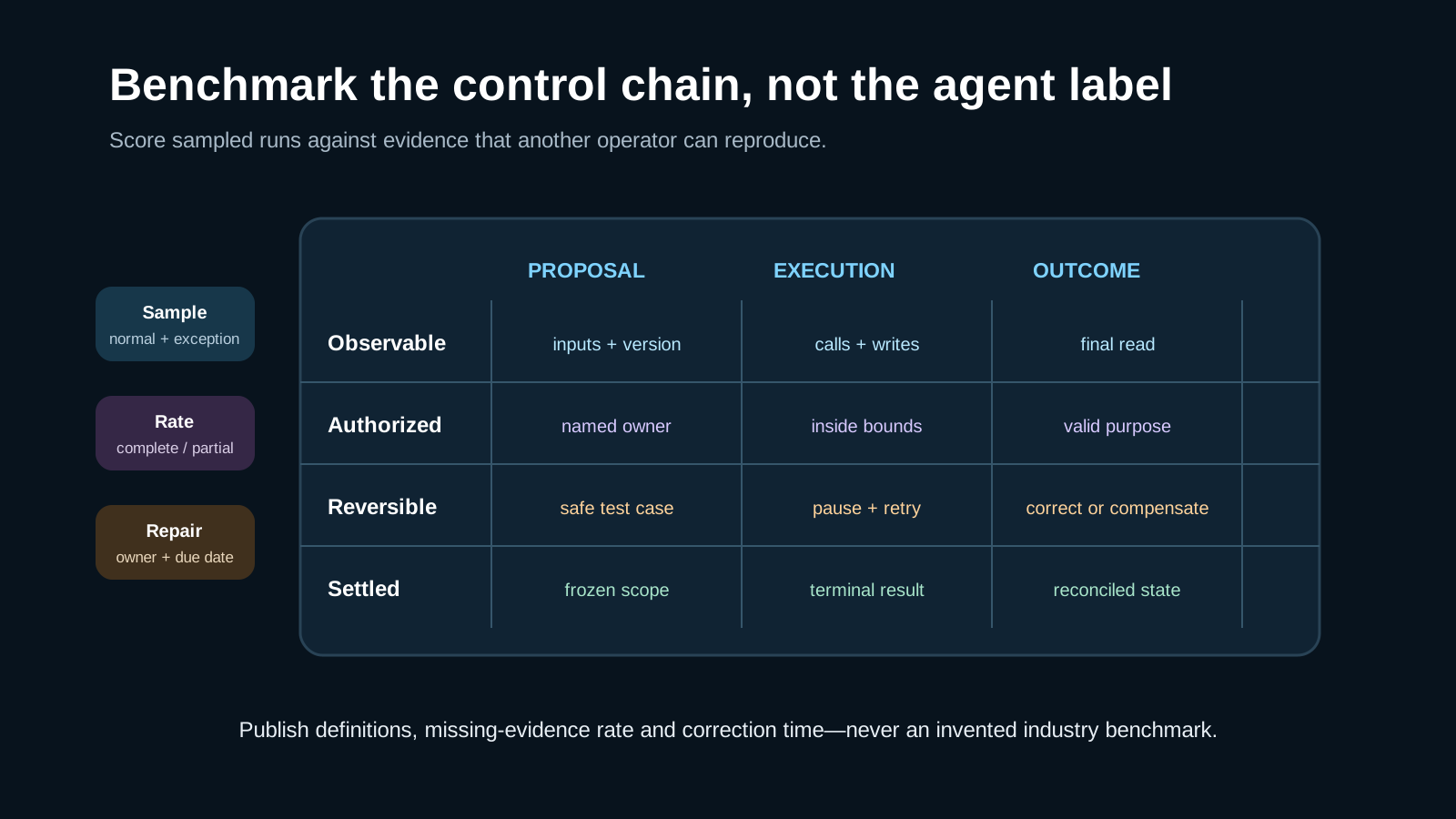
Score observability first. A fully observable proposal retains input references, source time, identity mapping, model or rule version, retrieved context, proposed steps and intended consequence. A fully observable execution retains tool calls, parameters or bounded summaries, responses, writes, external IDs and timestamps. A fully observable outcome includes an independent destination read, message disposition or ledger and settlement evidence. Missing raw secrets or unnecessary personal data should not reduce the score when stable references preserve reviewability.
Score authorization separately. The proposal layer passes when the decision owner and allowed scope are explicit. Execution passes when the actual actions stay within field, channel, amount, geography, cohort and timing limits. Outcome passes when the business purpose remains valid at completion. A run can be technically correct and unauthorized. Keep that distinction visible instead of folding it into a generic accuracy percentage.
Score reversibility with consequence-specific language. A proposal is reversible when it can be discarded without downstream work. An execution is reversible when the team can pause remaining steps, locate emitted work and restore or supersede reversible records. An outcome is recoverable when a named path exists for correction, return, cancellation or compensating communication. Funds already transferred and messages already delivered should not receive rollback credit merely because the initiating workflow can be switched off.
Score settlement last. Settlement means the result has reached the authoritative operating state and connected systems no longer disagree under the defined window. For a CRM write, read the destination after competing automations have run. For outreach, record sent, held or dropped plus current suppression and any reply handoff. For a stablecoin payment or payout, reconcile requested asset and amount, network or provider status, internal ledger, fees, conversion and the commercial record that reporting uses.
Use an ordinal scale with explicit evidence. Score each cell zero for absent, one for partial or ambiguous and two for complete under the local definition. There are four dimensions across proposal, execution and outcome, producing twelve cells. Publish the denominator and missing cells. Do not collapse everything into one maturity label unless the audience can still inspect which control failed. A high total with zero authorization at execution should not appear healthy.
Add two time measures. Review latency is the time from terminal execution status to an independent operator's completed reconstruction. Correction latency is the time from a confirmed material mismatch to verified repair or compensation. Report median and a high percentile only when the sample supports it; otherwise publish the individual intervals. Separate waiting on external settlement from unowned internal delay so remediation is actionable.
Add freshness without hiding incompleteness. Record the age of identity, preference, ownership, commercial and financial evidence when each consequential action ran. Mark whether the age met a predefined contract. A packet can contain every required field and still use obsolete state. Freshness failures should remain separate from missing evidence because they require different repairs: source cadence, current-state checks, expiry or manual review.
Test availability claims inside the sample. For Apollo, the announcement distinguishes an available Intelligence Layer from Builder Studio and Messaging OS expected soon. For Salesforce, preserve whether a run used GA, beta or pilot capabilities. For Stripe, record product, region, asset, network and account configuration. An architecture score should not award a planned feature the same evidence as a tested production path.
Run the benchmark before expansion and monthly afterward. Start with at least one normal and one exception per material branch, then sample production by consequence and version. Publish coverage, missing-evidence rate, unauthorized-action count, unresolved final-state mismatch, recovery-test pass rate, review latency and correction latency. These are internally comparable only while definitions and sampling remain stable. When they change, preserve both versions.
Use the results to narrow or widen scope. Missing observability may justify adding correlation IDs or retaining a destination read. Weak authorization may require smaller cohorts or human release. Poor reversibility may move actions back to proposal-only mode. Unsettled outcomes may require a ledger, message or CRM reconciliation job. The benchmark should produce an owner and repair date for every failed cell rather than a decorative scorecard.
The objective is not to prove that agents are safe in general. It is to determine whether this organization can explain and control a specific connected workflow under normal and changed state. Apollo, Salesforce and Stripe provide current examples of increasingly powerful surfaces and distinct terminal outcomes. A trustworthy benchmark keeps the vendor facts separate from local performance, preserves failures and makes the next operating decision reproducible. Related reading: Research & Benchmarks · Revenue Operations · Data Quality
Source notes
These official sources support the workflow model and product concepts. They do not prove a specific retention outcome, benchmark, or vendor claim.
- Apollo: AI GTM System announcement: Official announcement updated September 30, 2026. It introduces Builder Studio, the Intelligence Layer and Messaging OS, and separately states that Builder Studio and Messaging OS will be available soon while the Intelligence Layer is available now.
- Salesforce: 21 Things We Announced at Dreamforce 2026: Official roundup dated September 28, 2026. It gives distinct availability states for Coworker, long-horizon agents, Agent Optimizer, AI Skills and other Agentforce capabilities.
- Stripe: OUSD is now the default stablecoin on Stripe: Official product announcement dated September 30, 2026. It describes support across Treasury, Issuing, Global Payouts, Crypto Onramp and Payments, while preserving a choice of other stablecoins and blockchains.
Last updated: 2026-10-01