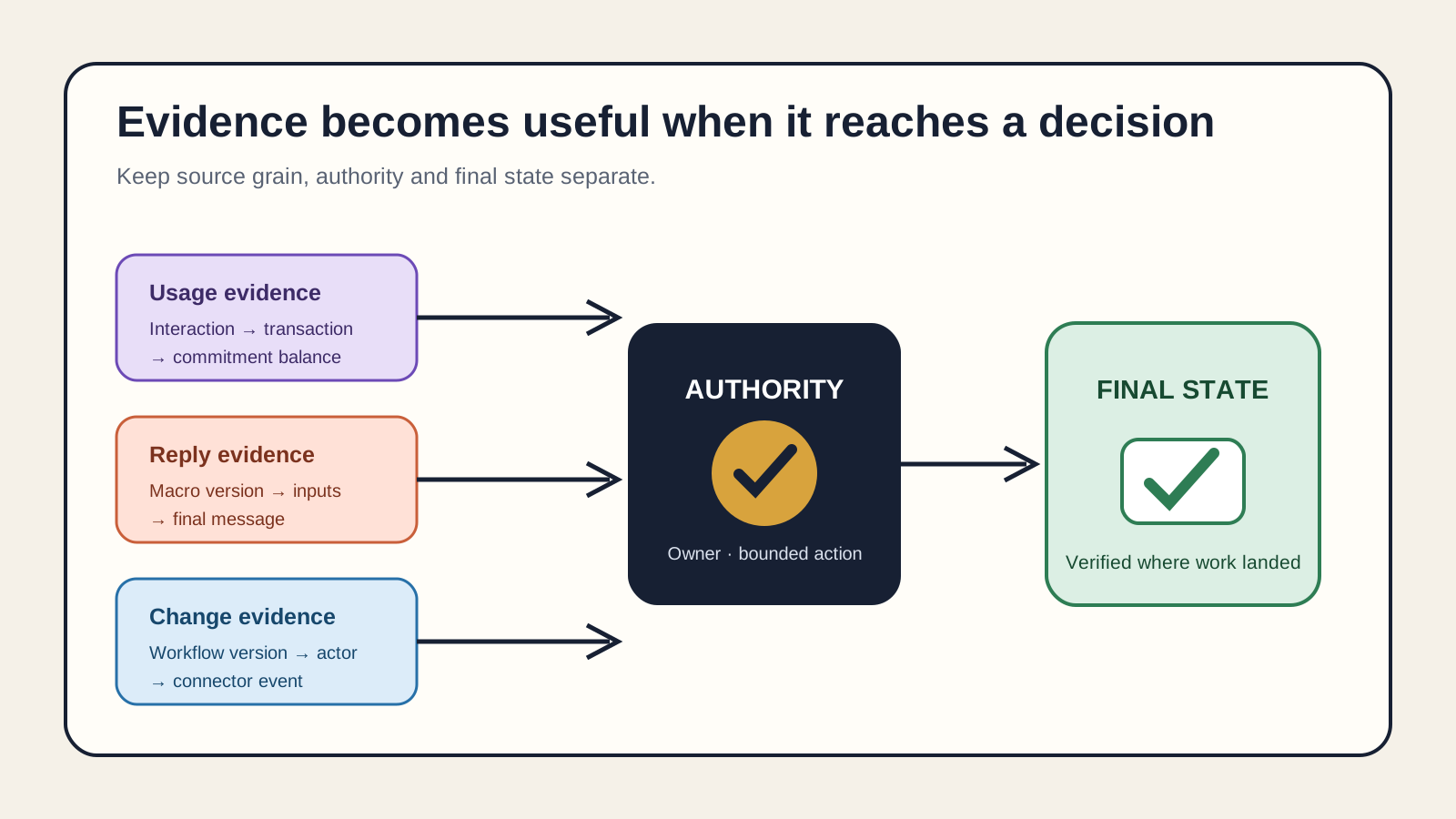
Three October product updates make a quiet change visible across the revenue stack. Talkdesk is adding Credit Commit ID and Credit Commit Balance to its Billing Usage Transactions Report. Intercom now lets a macro require teammate-entered fields before a completed reply reaches the composer. Method has enabled AI Build mode in its Action Editor by default and extended its audit trail to record QuickBooks and Xero disconnects or permission changes. One is about billing evidence, one about customer communication, and one about workflow construction. Together they show operational evidence moving closer to the action that creates risk or cost.
The common pattern is not artificial intelligence. It is the appearance of an inspectable intermediate record. A Talkdesk transaction can be tied to a credit commitment and remaining balance. An Intercom macro can distinguish a required input from the finished reply. A Method audit event can show that an accounting connection changed. RevOps can use those records to answer who changed what, which commercial pool paid for an action, and whether customer-specific context was supplied before execution.
Keep the grains separate
Talkdesk's own data dictionary says each row represents a transaction on a charge and that one interaction can have multiple transactions. It also warns that the report does not necessarily match the invoiced amount because the invoice incorporates credit commitments, recharges and a prior balance. That is an important boundary. A usage row is evidence about consumption, not the final commercial settlement. The correct reconciliation links interaction, transaction, commitment, billing period and invoice without forcing them into one row.
Intercom's fill-in fields operate at a different grain. They belong to one use of a macro in one conversation or ticket. The official guide documents text, long-text and choice inputs, required or optional settings, optional sections and a live preview. The completed reply remains editable and is not sent automatically. This is useful because a template definition, a teammate's inputs, the final composer content and the sent message are four different states. Preserving them separately makes review possible.
Method's release note adds a third grain: a workflow or integration change. Build mode can create or change Action Editor steps, while the audit enhancement records accounting disconnects and permission changes. An automation definition is not a run, and a connection event is not proof that downstream records were wrong. The change log should be joined to affected workflows, execution windows and reconciliation samples rather than treated as an incident conclusion by itself.
Evidence needs authority as well as detail
More detailed evidence does not decide who may act. A remaining credit balance can inform a spend review, but it does not authorize a pricing concession or contract change. A required macro field can prevent a blank order number, but it does not prove the order belongs to the customer in the conversation. An audit record can show that a connector lost permission, but it does not identify which accounting value is authoritative after the connection is restored.
For each evidence surface, name the decision owner. Finance or procurement may own commitment interpretation; Support Operations may own macro design; RevOps may own workflow and CRM field behavior; Accounting may own the ledger result. Give each owner a bounded action, escalation path and close condition. The goal is not one superuser who can see everything. It is a chain in which the responsible operator can reconstruct the decision from source records.
Build an evidence spine across systems
A practical evidence spine starts with stable identifiers and business time. For usage, preserve interaction ID, transaction ID, commitment ID, transaction time, billing period and currency. For a customer reply, preserve conversation or ticket ID, macro version, input values, teammate, final sent content and send time. For workflow change, preserve workflow version, change actor, connector or permission event, affected object scope, execution IDs and final-state checks.
Do not copy every field into the CRM. Store the small set needed for routing and customer work, then link to the authoritative report or audit record for detail. A CRM field such as commitment-risk review due can point to the Talkdesk evidence. A support exception can point to the macro and customer source. A workflow incident can point to the Method audit trail and the accounting reconciliation. Links should survive owner changes and make the source visible to the next reviewer.
Measure reconstructability, not dashboard completeness
The first useful metric is whether another operator can reconstruct a sampled action. Select transactions, macro-assisted replies and workflow changes from a named period. Ask the reviewer to identify the source record, version, actor, commercial or customer context, downstream effect and close evidence. Report the number eligible, number sampled and number fully reconstructable for each workflow. Do not combine the results into an industry benchmark or maturity score.
A failed sample should produce a specific queue: missing identifier, missing version, ambiguous customer match, unavailable source, unowned exception, unreconciled destination or expired evidence. Those categories are more actionable than a generic data-quality percentage. They tell the team whether to change instrumentation, permissions, retention, owner rules or the release process.
The operating opportunity
Talkdesk, Intercom and Method are not interchangeable products, and these releases do not prove better financial, support or revenue outcomes. Their usefulness is that important intermediate state becomes more explicit. RevOps can connect that state to the decisions already crossing support, finance, CRM and accounting, while keeping source meaning intact.
The mature design is a control surface, not another dashboard. It lets an operator move from a customer action or cost question back to the exact evidence, then forward to an authorized decision and verified outcome. That chain is what makes new automation safe to widen. Without it, more detailed product telemetry simply creates more places to look after the fact.
Source notes
These official sources support the workflow model and product concepts. They do not prove a specific retention outcome, benchmark, or vendor claim.
- Talkdesk Admin release notes, October 7, 2026: Official release note adding Credit Commit ID and Credit Commit Balance to the Billing Usage Transactions Report.
- Talkdesk Billing Usage Transactions data dictionary: Official field and grain documentation; one interaction can produce multiple transactions, and the report does not necessarily equal the final invoice.
- Intercom: Personalize macro replies with fill-in fields: Official documentation for text, long-text and choice fields, required inputs, optional sections, preview behavior and rollout limitations.
- Method release notes, October 5, 2026: Official release note enabling Method AI Action Editor Build mode by default and expanding audit coverage for QuickBooks and Xero disconnects or permission changes.
Last updated: 2026-10-07