Problem
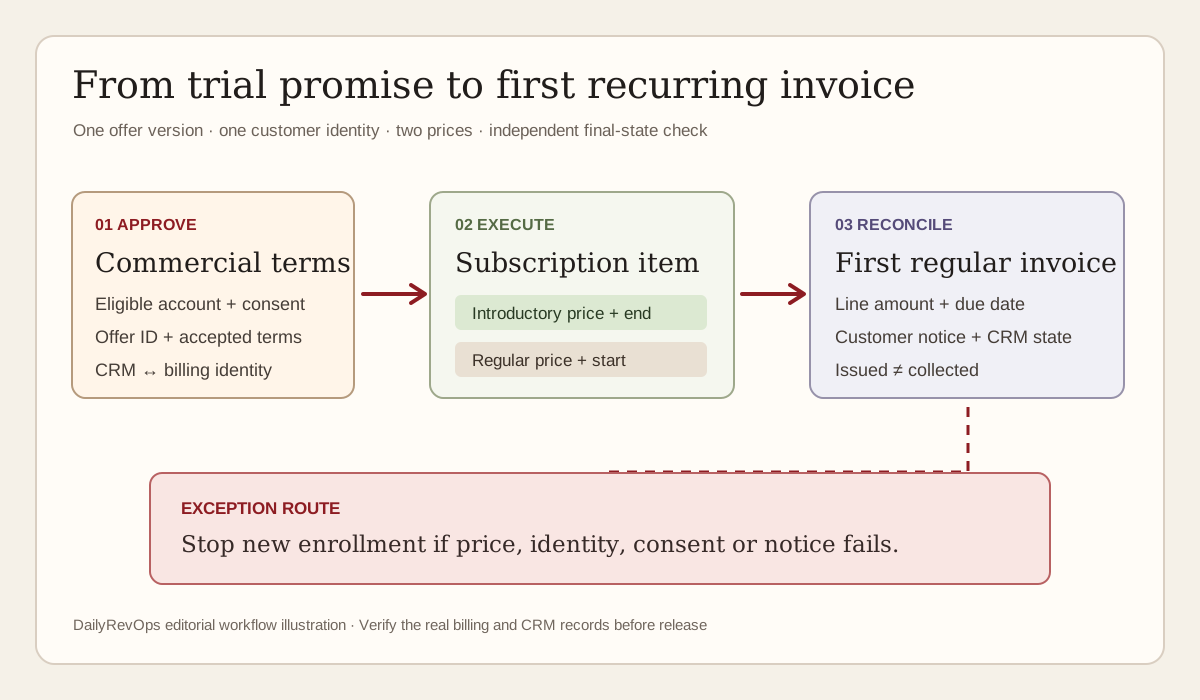
A trial offer can be configured correctly in a billing system and still create the wrong customer promise or reporting state. A free item, paid introductory period and discounted add-on are different contracts. The first invoice may be correct while the later regular-price invoice, CRM lifecycle field or cancellation message is wrong. RevOps needs a release gate that traces the offer from eligibility through the first recurring charge.
Why it matters
Stripe's September 30 Endive changelog makes trial offers generally available. Its documentation defines a trial price, duration and transition price for a recurring subscription item, with important integration and reporting limits. The control below uses those documented capabilities as one implementation example. It is a local operating method, not a claim that Stripe supplies every approval, identity or customer-consent check.
Trigger and accountable owner
Run this gate whenever a team introduces a new free or paid trial, changes an introductory price, moves an offer to another customer segment, adds a trial to an existing subscription item, or alters the post-trial handoff. Repeat it after changing the CRM sync, checkout path, pricing catalog or customer messaging even if the offer object itself has not changed. A trial is a commercial promise with a future action, so the trigger is the proposed change to that promise, not merely the API deployment.
Name a commercial owner for eligibility and approved terms, a billing engineer or administrator for configuration, a RevOps owner for CRM fields and lifecycle automation, a finance owner for invoice and revenue definitions, and a customer-experience owner for notices and cancellation language. One person may hold several roles, but the release record must show who approved each consequence. The person who creates a trial object should not be the sole verifier of the invoice and customer message.
Prerequisites and data contract
Capture the approved offer ID, product and recurring item, qualifying account segment, introductory Price, regular Price, currency, duration, transition behavior and channel where the customer accepts it. Keep the two recurring Price objects distinct. Record whether other items on the subscription bill normally during the offer. Store a stable CRM account or customer identifier, the Stripe customer and subscription IDs, the item ID, offer version, start time and expected end time. A generic trial=true field cannot reconstruct this state.
Before implementation, confirm the integration path. Stripe says trial offers require the 2026-09-30.endive API version or later and flexible billing mode. Its documentation excludes Checkout, Payment Links and Elements with Checkout Sessions from this trial-offer path, and prohibits combining the object with legacy trial_end. If the existing sales motion depends on one of those channels, choose a supported route or retain the documented legacy free-trial flow. Do not release copy that promises a feature the selected integration cannot deliver.
Create synthetic acceptance cases
Use synthetic customers first. Build cases for a free core item, a paid introductory price, an add-on under trial while the core item bills normally, an upgrade offer, and a cancellation before the transition. Add edge cases for two accounts sharing an email, a customer changing plan during the period, an unsupported purchase channel, a missing payment method and a timezone boundary. The expected result for each case should list the first invoice, the regular-price invoice, status shown to support, CRM lifecycle change and customer notice.
Keep the test fixture independent of the implementation. A spreadsheet or structured record should contain expected amounts and dates calculated from the approved terms, not copied from the billing response. The tester compares what Stripe returns to that fixture, then checks the CRM and messaging outputs. A passing API call is evidence of technical acceptance, not evidence that the human-readable promise or downstream entitlement is right.
Execute and verify the transition
Create and attach the offer only for a bounded test cohort. Check the subscription item carries the intended trial offer, introductory price and transition price. Reconcile the initial invoice and any other normally billed items. At the transition, compare the next invoice line by line to the expected regular price, tax treatment and dates. If a payment fails, record invoice state and collection action separately from whether the offer expired. Do not classify a failed collection as a successful paid conversion.
Check three clocks separately: commercial acceptance, trial start and trial end, and first regular-price invoice. A CRM field updated at offer start does not prove a paid state. Define exactly when a trial-to-paid metric increments and whether it requires invoice creation, successful collection, or another finance-approved event. Stripe documents that trial-offer items do not contribute to Billing Analytics MRR during the trial, while other subscription items can. Align internal reporting labels to that distinction.
QA, exceptions and recovery
The QA reviewer samples the complete journey from accepted terms to the first regular-price invoice. Verify that the account identity, offer version, price IDs, consent evidence, billing mode and API version match the release register. Check customer-facing copy for the amount and timing after the trial. Check the support view for an understandable explanation of current price and future change. Verify that a cancellation before the transition does not trigger an unapproved recurring charge.
Document the exception path before opening the cohort. Stripe says trial duration cannot be modified after subscription creation, and subscriptions with trial offers cannot be updated, paused or resumed in the customer portal. A support team must therefore know which changes require an authorized administrative procedure or a new offer, and what to tell the customer while the case is reviewed. Stop new enrollment if a price, eligibility or notice discrepancy is systemic; reconcile impacted subscriptions before restarting.
Rhythm and measurement
For the first week, review new enrollments daily and inspect every exception. After the first trial cohort reaches the transition, review failed invoices, unexpected price changes, cancellations, duplicate CRM records and support tickets together. Then move to a weekly cohort review with a named owner and an incident path for unusual volume. Do not close the launch simply because the initial subscription creation test passed; the highest-consequence step may be weeks later.
Measure accepted offers, starts, scheduled transitions, first regular-price invoices and collected regular-price invoices as separate counts. Track unmatched CRM-to-billing identities, incorrect notices, price corrections and the time from exception detection to owner decision. Publish local definitions and a collection window beside any rate. Compare one cohort to another only after accounting for audience, offer terms, acquisition channel and observation period. Those are internal acceptance measures, not an industry benchmark.
Step-by-step workflow
- Approve the commercial offer and freeze its versioned terms.
- Confirm API version, flexible billing mode and the supported acquisition channel.
- Create independent synthetic acceptance cases, including item-level and cancellation boundaries.
- Test first invoice, transition invoice, CRM state, customer copy and support visibility.
- Launch one bounded cohort with an exception owner and stop rule.
- Reconcile the first post-trial invoice and only then expand.
CRM fields and signals needed
- Offer and subscription item can be joined to one account and approved terms.
- The introductory and transition prices match the signed customer promise.
- The CRM trial state is distinct from paid invoice and collection state.
- The first regular-price invoice and customer notice match the approved fixture.
Operating quality check
Use this check before adding more tooling. The goal is to prove that the workflow is owned, current, and inspectable inside the system of action.
| Area | Healthy pattern | Risk pattern |
|---|---|---|
| Eligibility | Approved audience rule and accepted terms match the selected customer. | A generic campaign tag enrolls an ineligible or duplicate account. |
| Price transition | Trial Price and regular Price are explicit and independently checked. | The first invoice passes but the post-trial invoice surprises the customer. |
| Identity | Billing customer, subscription and CRM account reconcile. | A trial or payment is attributed to the wrong account. |
| Reporting | Trial, invoice and collection states have separate clocks. | A trial start is reported as collected recurring revenue. |
Common mistakes
- Using one trial flag for a multi-item subscription.
- Treating a successful API call as proof of customer consent.
- Assuming Checkout or Payment Links support the Trial Offer API path.
- Counting trial items as MRR during the trial contrary to Stripe's documented Billing Analytics behavior.
- Calling an uncollected first regular invoice a paid conversion.
Example operating rhythm
- Daily: review new enrollments and exceptions during the controlled pilot.
- At each transition: reconcile price, invoice and customer communication.
- Weekly: review cohort definitions, failed collections and unmatched identities.
- After any pricing or integration change: rerun the synthetic acceptance pack.
Tooling options
- Stripe is the example billing source for the trial object, subscription item and invoices.
- CRM holds commercial owner, account linkage, offer version and next action; decide its authority for each field.
- Finance or the warehouse defines booked, invoiced and collected revenue separately.
- Support needs a readable offer state and escalation path without direct billing write access.
Source notes
These sources support the workflow model and product concepts. They do not prove a specific business outcome, benchmark result, or vendor claim.
- Stripe Endive changelog, September 30, 2026: Official release index lists trial offers as generally available.
- Stripe trial-offer subscription documentation: Official behavior, prerequisites, use cases, integration and reporting limits.
Last updated: 2026-10-04
Decision frameworks to read next
FAQ
Can an item-level trial leave other items billing?
Yes. Stripe documents item-level trial offers; test the invoice and customer copy for every item on the subscription.
When is a trial-to-paid conversion counted?
Define the local metric explicitly. A transition to the regular price, an issued invoice and collected payment are different events.
Can the existing Checkout flow use trial offers?
Stripe's current documentation excludes Checkout from this trial-offer integration path. Validate a supported implementation or use the appropriate documented legacy trial mechanism.