RevOps tends to treat downtime as an incident and wrong meaning as cleanup. That priority is backwards whenever the quiet error changes money, customer treatment or a management decision. A failed export is obvious. An export that succeeds with the wrong currency is dangerous. A renewal job that crashes can be retried. A renewal job that succeeds after dropping part of the pricing model can flow into an invoice, forecast or customer conversation before anyone realizes the semantics changed.
Maxio's September 23 release notes are a useful reminder. The company documents a correction to recurring_price in subscription CSV exports and another correction to renewed hybrid price points. The prior behaviors could produce commercially wrong values without necessarily producing a transport error. That is more operationally serious than many visible integration failures because every ordinary health signal can remain green. The system did exactly what its software told it to do; the software represented the business rule incorrectly.
Green pipelines can be red business processes
Engineering observability often answers whether a request completed, a job ran, a queue drained or a service returned a valid response. RevOps needs another question: did the business state remain true? A sync can have zero failed records while mapping euros as dollars. A workflow can complete every enrollment while using an outdated owner. A report can calculate instantly while its denominator no longer matches the operating definition. Technical success is necessary, but it is not the final health signal.
The distinction is especially important as vendors expose more configurable reporting and AI-assisted operations. Intercom's new custom metrics let teams define filtered metrics and ratios across full history. That is useful precisely because organizations need local definitions. But once a locally defined metric becomes available across the workspace, a naming mistake or filter change can propagate just as effectively as a correct definition. The metric object deserves an owner and change history because it has become shared operational logic.
Treat silent corrections as a trigger for reconciliation
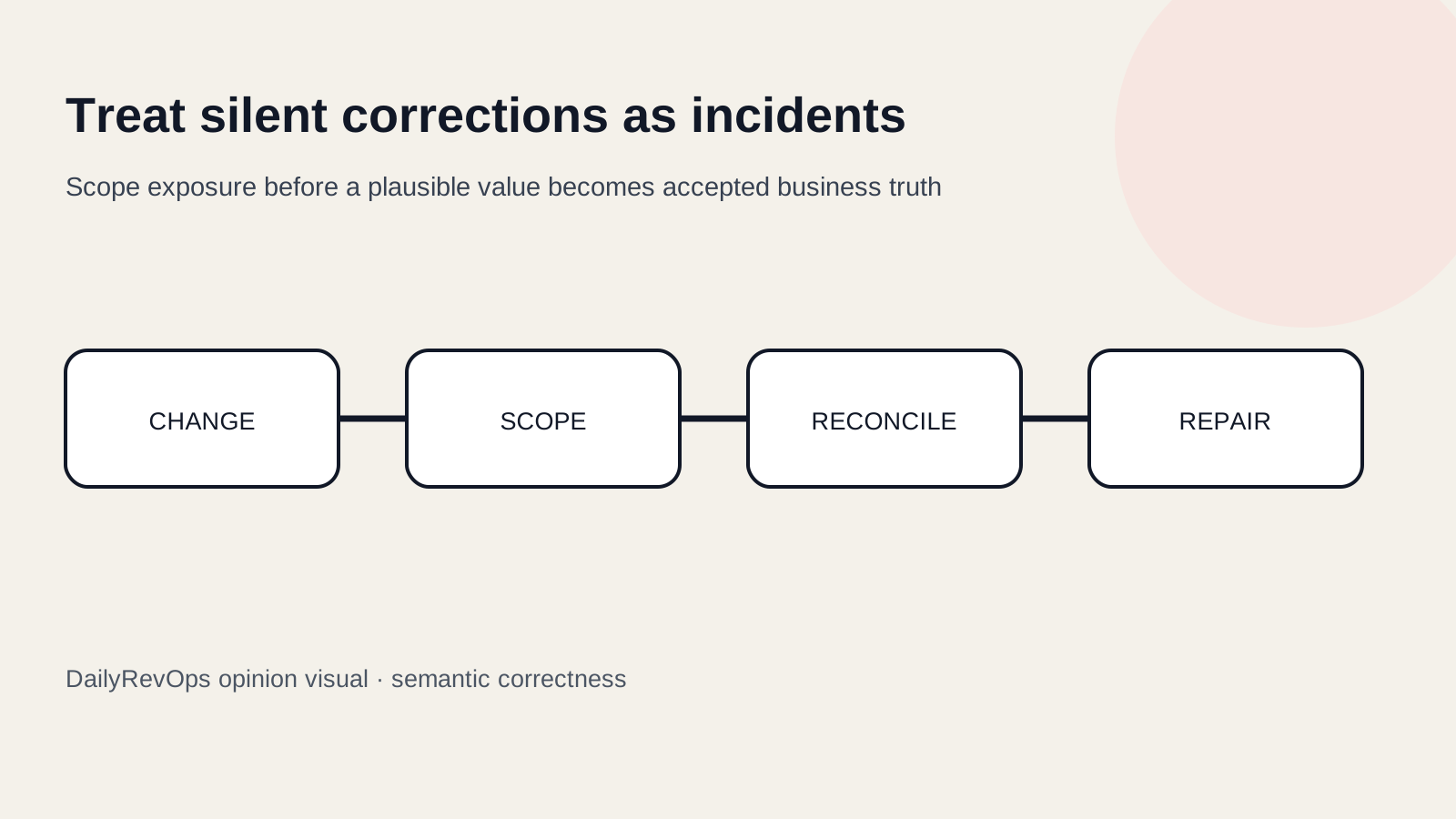
When a vendor release note says a field previously returned the wrong currency, a pricing model lost a secondary tier, a date could be incorrect or a status was misclassified, the first response should be scope discovery. Which records, periods, plans, currencies or workflows could have been affected? Which downstream systems copied the value? Which decisions or customer-facing artifacts used it? The answer may be none, but that should be established rather than assumed.
A lightweight incident record is enough for many cases. Capture the vendor statement, affected feature, earliest plausible exposure, internal dependencies, sample reconciliation, correction decision and owner. If the data was never consumed, close it. If a warehouse or report contains affected history, decide whether to backfill. If customer billing may have changed, route to the commercial owner. This is not an argument for panic every time a changelog mentions a bug. It is an argument for consequence-based triage.
Explicit failures are easier to govern
Apollo's move toward structured API errors shows the opposite pattern. A stable error code gives an integration something concrete to classify. Authentication can be handled differently from invalid input. The workflow can expose a repair path instead of translating every failure into a generic retry. A visible, typed failure may be inconvenient, but it creates a boundary that operators can test and route.
RevOps should prefer systems that fail clearly over systems that guess silently. If an account association is ambiguous, hold it. If a required source is stale, expose the stale state. If a pricing lookup has conflicting terms, route it for review. If a metric's denominator cannot be established, do not substitute the nearest available population. Human operators are capable of handling exceptions when the system admits that an exception exists; they cannot reliably correct errors that masquerade as normal data.
Data contracts should include meaning, not only shape
Many internal data contracts are too technical. They say a field is decimal, a timestamp is ISO-8601 or an ID is required. Those rules prevent malformed data, but they do not state whether recurring_price is denominated in the subscription currency, site currency or normalized reporting currency. They do not state whether renewal amount includes secondary usage pricing. They do not state whether a closure-rate denominator is conversations created, closed or eligible during the selected period.
For fields that cross operating boundaries, write one sentence of business semantics next to the technical type. Name the authoritative source and time basis. Add an invariant that can be sampled. For example: exported recurring price must match the active subscription's current recurring price in that subscription's currency. A good invariant is boring, testable and close to the decision the business actually makes.
Backfills are editorial decisions for data
Corrections create a historical question. If the source is fixed today, should yesterday's warehouse values change? There is no universal answer. Finance may need restatement. An audit trail may need the originally observed value plus a corrected value. An operational dashboard may simply need a clean backfill. The mistake is allowing the pipeline to decide by accident because a future full refresh overwrites some history while incremental tables preserve the rest.
Intercom's full-history custom metrics highlight a similar issue from the analytical side. A newly defined metric can be computed over old conversations. That historical calculation can be informative, but it does not mean the business used that metric at the time. Teams should distinguish event time, calculation time and policy-adoption time whenever the distinction matters for interpreting trends or evaluating a past decision.
Incident severity should follow consequence
A useful severity model for RevOps data starts with consequence rather than infrastructure. A wrong display label with no downstream use is low severity. A stale internal dashboard field that changes prioritization is higher. A silent amount, currency, consent, entitlement or customer-facing routing error can be severe even if no service was down. The model should also consider duration, affected population, reversibility and whether the original evidence still exists.
This framing prevents two bad extremes. Teams do not need to launch a war room for every vendor correction, and they should not dismiss every successful sync as harmless. Triage the business effect, run a representative reconciliation and escalate only when the evidence justifies it. The discipline is small but valuable because the most expensive RevOps failures often begin as plausible records that nobody thought to question.
Make correctness observable before adding more autonomy
Agentic systems will make this more important. An agent can read a plausible but semantically wrong value and act faster than a person would. It can also make a fluent explanation that hides which source field supplied the mistake. Before expanding automated authority, preserve the source value, definition, retrieval time and decision trace for facts that can alter customer or commercial state. A model cannot compensate for an upstream number whose meaning was already wrong.
The standard should be simple: if a correction could have changed a real business decision, investigate it like a production incident. Establish scope, reconcile samples, decide whether history needs repair and record the outcome. Visible failures already get our attention. The next maturity step for RevOps is learning to give the same attention to successful pipelines that quietly stopped telling the truth.
Source notes
These official sources support the workflow model and product concepts. They do not prove a specific retention outcome, benchmark, or vendor claim.
- Maxio: September 2026 Product Release: Official release notes documenting September 23 corrections to subscription export currency and renewed hybrid pricing behavior.
- Intercom custom metrics: Official September 23 release showing how local metric definitions can now become reusable workspace reporting objects.
- Apollo structured API errors: Official API changelog showing why explicit failure classification is operationally useful.
Last updated: 2026-09-24