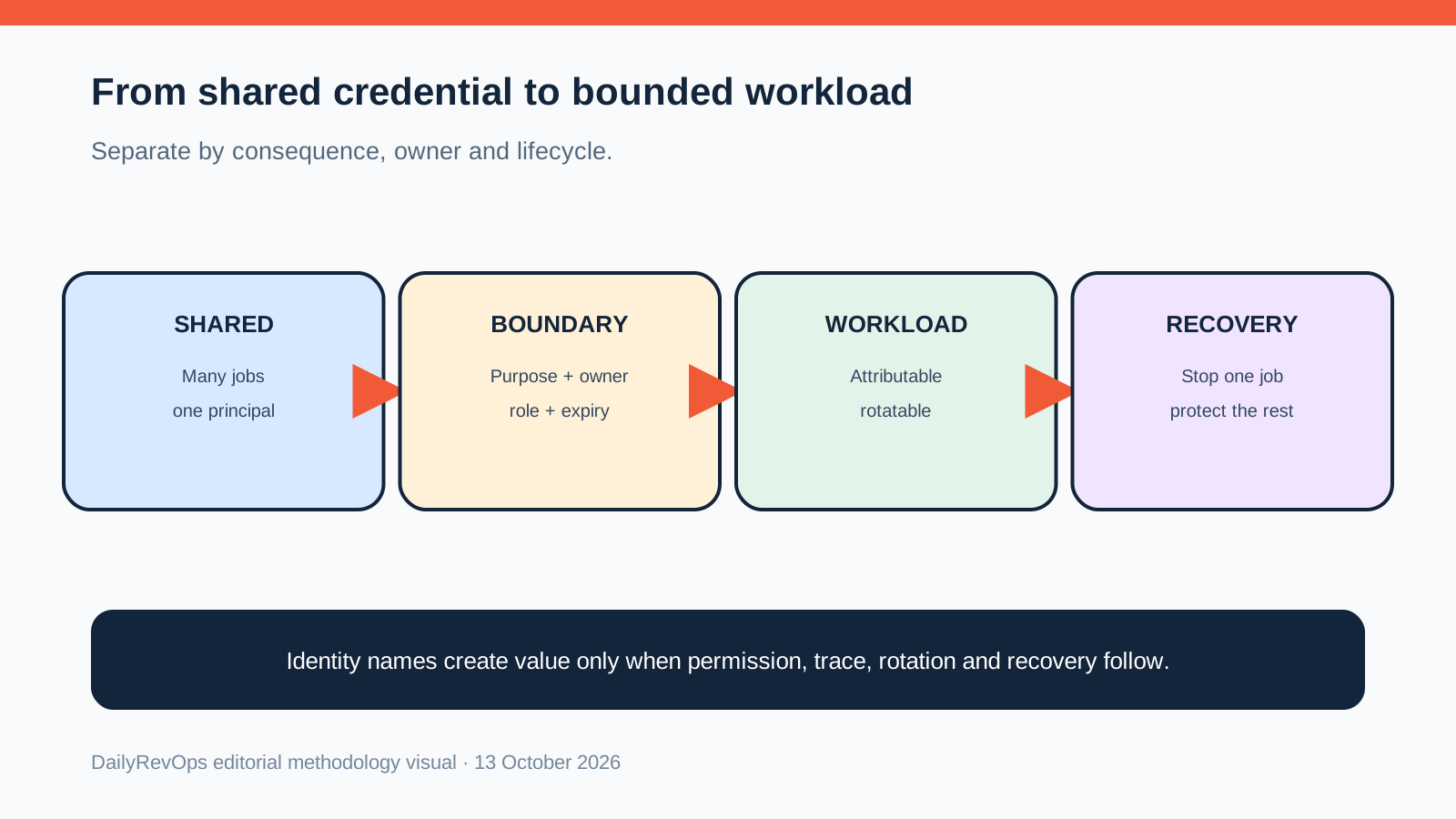
The shared service credential became normal for understandable reasons. One integration account was easier to create than a governed identity for every pipeline. A warehouse user could serve CRM replication, billing exports, dashboards and ad hoc scripts. When the stack was smaller and most changes were manual, the ambiguity felt manageable.
That bargain has expired. Revenue systems now execute customer communications, commercial calculations, knowledge releases and agent-initiated actions. When several workloads authenticate as the same undifferentiated user, the team cannot reliably answer which job acted, which owner should respond, which access can be rotated or which process must stop during an incident.
Snowflake's October 12 introduction of named workload identities for service users makes the issue concrete. It provides an additional mechanism to distinguish automated consumers. The product feature is not the entire argument, and it does not replace roles or logging. It shows that workload-level identity is becoming a practical unit of operations.
Convenience is becoming hidden coupling
A shared credential couples workloads that may have nothing else in common. Rotating it can interrupt a nightly revenue model and a customer export together. Expanding a role for one new use case may silently expand every other job. An investigation sees one principal even when several teams, codebases and schedules were active.
The resulting risk is operational before it is theoretical. A stale script can continue reading data because another team's credential is still valid. A failed connector can be hard to isolate because logs show the service account rather than the workload. A person may postpone rotation because the dependency list is incomplete.
RevOps should treat that coupling like an undocumented shared library in production: convenient until one change breaks unrelated systems. The correct response is not to create identities at random. It is to define workload boundaries deliberately.
Name the workload by consequence
A workload identity should correspond to a unit with a coherent owner, purpose, permission set, lifecycle and recovery plan. CRM opportunity replication may be one unit. A customer-level renewal export may be another. An experimental analysis agent should not inherit either simply because the same warehouse is convenient.
Environment matters. Production customer data and non-production testing should not hide behind one label. Consequence matters too. A read-only aggregate model has a different blast radius from a process that exports identifiable account records or feeds customer-facing answers.
Use a register with workload name, service user, named identity, provider, runtime, repository or configuration, owner, roles, data classes, schedule, downstream destination, rotation date and retirement condition. The register becomes the map for access review and incident response.
Identity and authorization must remain separate
Named identity does not equal least privilege. A perfectly named workload can still inherit a broad role. Keep authentication identity, authorization, network boundary, data classification and business approval as separate controls. Test them separately.
Run one positive and one negative case for every consequential workload. The positive test proves the intended path works. The negative test proves the boundary denies an object, role or action that should remain unavailable. Store the query or action, identity, expected result and observed result.
RevOps does not need to own warehouse security policy. It does need to explain the business purpose and consequence of the workload. Security and data-platform owners can translate that purpose into roles and controls, while the business owner accepts the workflow and recovery requirements.
Attribution must survive the whole path
A name in an identity registry is insufficient if downstream evidence drops it. Verify what appears in warehouse history, orchestration logs, integration events and destination records. Add a stable workload ID and run ID where the platform permits it.
The useful trace connects trigger, code or configuration version, identity, source reads, transformations, destination writes and final-state verification. For a billing export, an operator should be able to identify which run produced a file, which eligible records it included and which destination accepted it.
Do not rely on screenshots or a last-run green badge. Those are observations, not reconstructable evidence. Retain machine-readable identifiers and timestamps with the exception record.
Rotation should be a release, not a secret swap
Credential rotation often fails because teams change the secret first and discover dependencies afterward. Treat it as a bounded release. Register the replacement identity, configure one target workload, run permitted and denied tests, observe it, cut over, drain the old path and remove the old identity after the defined window.
Use overlap only for the migration. An indefinite pair of valid identities doubles ambiguity. Publish a rotation receipt with old and new identity, workload, owner, validation runs, errors, cutover and retirement evidence.
Snowflake states a default maximum of 10 named workload identities per service user. That is a product limit to confirm in the target account, not an architecture benchmark. If the design needs more defensible workload boundaries, revisit the service-user and role model rather than compressing unrelated jobs to fit a number.
Start where shared access has the largest blast radius
Inventory shared credentials across the revenue stack. Rank them by sensitive data, customer-facing consequence, financial consequence, number of dependent workloads and difficulty of recovery. Pick the highest-consequence credential whose dependencies can be mapped.
Separate one workload and run it for a full operating cycle. Confirm expected jobs, denied paths, audit visibility, alerts and owner response. Then rotate or revoke only that workload during a drill. The proof is the ability to contain one process without taking down or obscuring the others.
Use practical measures: percentage of consequential runs attributable to a workload, percentage of workloads with a named owner and retirement date, denied-test coverage, rotation completion time and orphaned identity count. Do not report identity-object volume as success.
The operator position
Shared service credentials were a shortcut for a simpler stack. They are now a source of hidden coupling across systems that make customer and commercial decisions. Workload-level identity is becoming an essential operating primitive, whether implemented through Snowflake's new capability or equivalent controls elsewhere.
RevOps should push for attributable workloads while resisting identity theater. Every name must connect to purpose, permission, owner, trace, rotation and recovery. The objective is precise control: one workload can be explained, changed and stopped without turning the rest of the revenue system into collateral damage.
Source notes
These official sources support the workflow model and product concepts. They do not prove a specific retention outcome, benchmark, or vendor claim.
- Intercom API 2.17 changelog: Official October 12, 2026 release for Data Connectors, article drafts, version history and other API changes.
- Maxio October 2026 product release: Official October 12 entry describing direct-ID prepayment lookup and non-retroactive recovery.
- Snowflake new features: Official October 12 feature update for named workload identities.
- NIST AI Risk Management Framework: General governance context, not product evidence or a vendor benchmark.
Last updated: 2026-10-13