Revenue automation usually fails in one of two ways. A system can stop visibly, or it can keep running while its interpretation of the data is wrong. The second class is harder. A report can calculate a plausible percentage from the wrong denominator. A subscription export can contain a believable price in the wrong currency. A renewal can preserve the primary pricing model while silently losing a secondary pricing scheme. An API integration can collapse several distinct failures into one generic error and retry them all the same way. Every one of those outcomes can look operationally healthy until a person reconciles the business meaning.
Three current product changes make that reliability problem unusually concrete. Intercom's September 23 release lets teams create custom metrics by filtering built-in metrics or dividing two metrics that can have different filters. Maxio's September 23 release notes document corrections to multi-currency subscription exports and hybrid pricing at renewal. Apollo's September 18 API update introduces structured error details with stable codes, suggestions and request context. These products solve different jobs, but the operating lesson is shared: the meaning of a number, a price and a failure must be inspectable if automation is going to depend on them.
A metric is a small program
Intercom says a custom metric can apply team-defined filters to an existing metric or divide one metric by another while each side uses different filters. That is useful because support and customer-operations teams rarely live inside the vendor's default reporting vocabulary. A team may need an email-only closure rate, a reopen rate for a particular tag, or a ratio that represents its own operating definition. Intercom also says those metrics calculate when a chart loads, apply across the workspace metric picker and cover the full available history.
The flexibility changes the control surface. A custom ratio is not just a label on a chart. It is a small program with a numerator, denominator, filters, population rules and evaluation time. Two metrics called reopen rate can disagree while both are mathematically correct because one excludes bots, one scopes to a queue, one uses conversations closed in the period and another uses conversations reopened in the period. RevOps should therefore version the definition that matters, not merely the resulting number.
For every custom operational metric that influences staffing, compensation, routing or customer action, keep the name, business question, numerator definition, denominator definition, filters, exclusions, time basis and owner. Add a change date when the definition changes. If historical results recalculate under the current definition, say so explicitly. A chart that spans full history can be useful for comparability, but it can also make a newly created definition look as though the organization has always governed the number that way.
Correct data can still carry the wrong commercial meaning
Maxio's September release notes illustrate a more consequential version of semantic drift. The company says the Subscription CSV export's recurring_price field now reports the subscription's own currency. Before the September 23 correction, custom-priced subscriptions outside the site's primary currency could export 0.00, and catalog-priced subscriptions could export the site's primary-currency price instead of the subscription's actual currency. On zero-decimal primary currencies, Maxio also says amounts could be scaled incorrectly. A downstream spreadsheet or warehouse could ingest every row successfully while the commercial meaning was wrong.
The same page documents a September 23 fix for renewed hybrid price points. Maxio says a renewed hybrid-priced component now preserves its secondary pricing scheme and brackets for both auto-renewal and scheduled renewal. Before the fix, usage above the primary model's threshold could fall back to the top primary-tier rate without an error or warning. Renewal previews could also apply uplift at the wrong level. This is exactly the kind of failure that conventional integration monitoring misses: the request succeeds, the record exists, the number looks plausible, but the business rule has changed in transit.
RevOps cannot prevent every vendor defect, but it can decide which fields deserve semantic reconciliation. Contract value, recurring price, renewal price, currency, entitlement and invoice totals should not be accepted merely because an API or export returned a valid type. For high-consequence data, preserve source currency, pricing model, effective period and source record ID alongside the value. Compare sampled outputs with authoritative records after vendor upgrades and after internal mapping changes. When a field feeds a forecast, commission, renewal queue or finance process, semantic tests belong in release management.
Structured errors turn failure into routable data
Apollo's API update approaches reliability from the other side: visible failure. Apollo says errors using its new format include an error_details object with a stable machine-readable code, a concise message, actionable suggestions and safe request-specific context. The documented invalid-key example uses a code such as AUTH.AUTHENTICATION.API_KEY_INVALID. That structure gives an automation a better chance of distinguishing a credential problem from invalid input, a permission issue, a rate condition or another class of failure.
That distinction matters because retries are not neutral. Retrying malformed input wastes capacity and may create noise. Retrying a credential failure indefinitely can hide an expired integration. Retrying after an uncertain write can create duplicates if the destination committed before the client lost the response. A generic catch block that waits and retries everything converts several operational states into one loop. Stable error classes let the workflow route each state deliberately: retry, repair input, refresh credentials, hold for review or stop.
A useful error contract records the provider, endpoint or job, stable error code, request or execution ID, whether the operation was a read or write, retry safety, attempt count, next action and final disposition. Human-readable error text still matters for diagnosis, but automation should not parse prose when the provider exposes a documented machine-readable identifier. Treat those identifiers as interface contracts and alert when an unknown code appears rather than silently mapping it to a generic failure bucket.
Reliability needs three layers of evidence
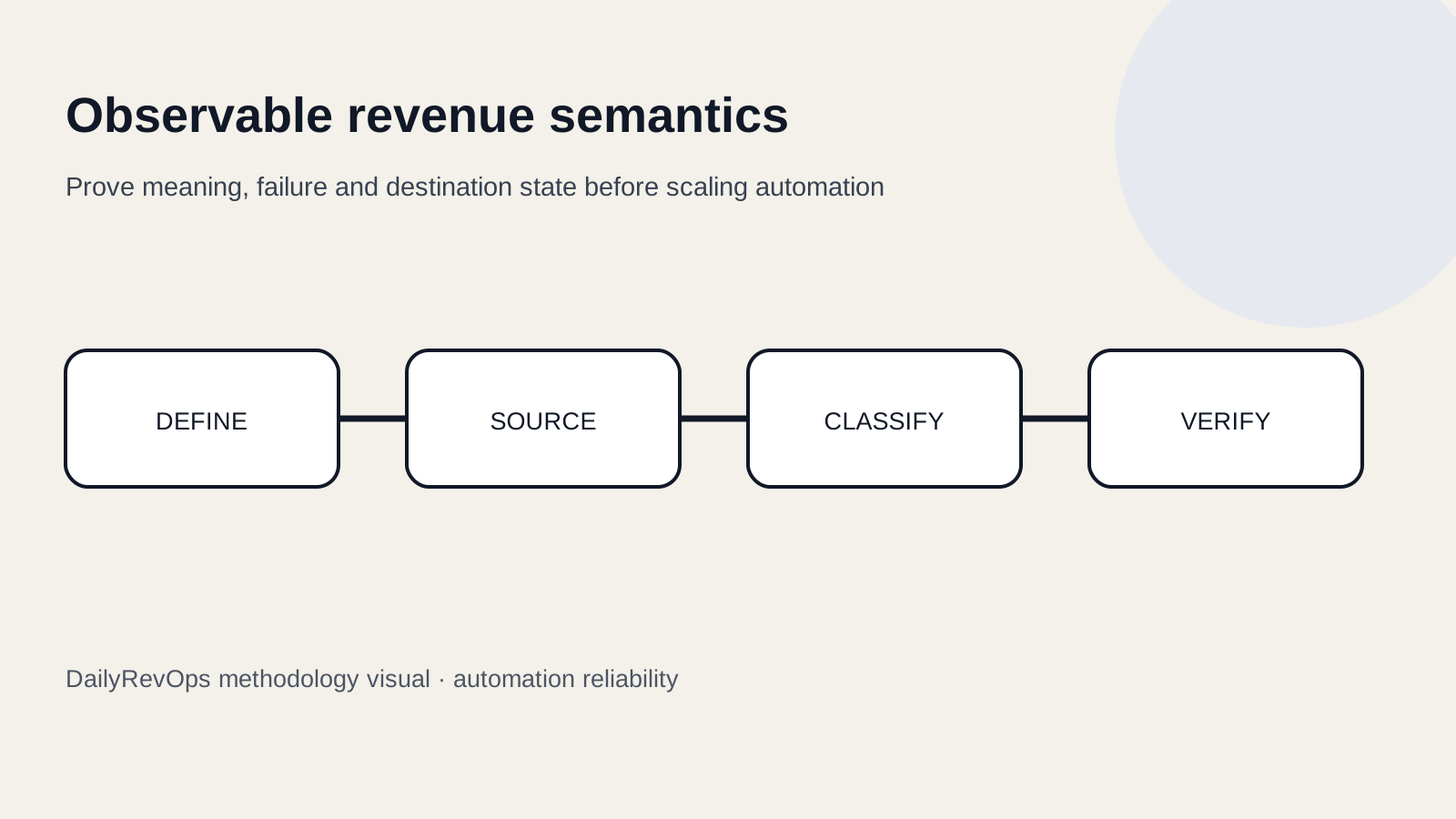
A mature revenue workflow needs evidence at three layers. First is business semantics: what does the metric, price, status or date mean? Second is transport and execution: did the source return successfully, and if it failed, what class of failure occurred? Third is destination state: what actually exists after the operation? Monitoring only one layer leaves blind spots. An HTTP 200 does not prove the price is commercially correct, and a correct formula does not prove the destination write happened once.
This suggests a practical release record for critical RevOps automation. Name the business object and stable ID, source fields and semantic definitions, transformation version, target fields, expected invariants, error classes, idempotency strategy, reconciliation query and owner. Before expanding a workflow, run representative records that include different currencies, pricing shapes, empty values, ambiguous identities, permission failures and retries. The purpose is not to create a large test framework for every Zap or workflow. It is to concentrate controls where a silent error can change money, customer treatment, ownership or reporting decisions.
Full-history reporting increases the value of definition governance
Intercom's statement that a custom metric created today can cover full history is operationally useful, but it also separates definition time from observation time. A team can evaluate historical conversations with a metric that did not exist when those conversations happened. That is legitimate analysis as long as the interface and downstream users do not mistake retrospective calculation for a historically governed KPI. Store the definition-created date and, when relevant, the date from which the metric was formally adopted for operating decisions.
The same principle applies to corrected commercial exports. If Maxio fixes recurring_price today, a fresh export may accurately represent current source records, but a warehouse may still contain older rows loaded under previous behavior. A correction needs a backfill decision: leave historical data as observed, restate it from the corrected source, or store both with a revision marker. The right choice depends on the use case, but the choice should be explicit. Silent partial correction creates two semantic regimes under one column name.
What RevOps should do this week
Pick one metric, one commercial field and one API integration that currently drive an operating decision. For the metric, write the numerator, denominator, filters, time basis and owner. For the commercial field, identify source currency, pricing or date authority and one reconciliation query. For the API integration, list the error classes you currently collapse into generic failure and decide which are retryable. Then force one failure and one changed-state case in a controlled environment and verify that the resulting evidence survives outside the transient workflow log.
The larger pattern is not that every team needs more monitoring. It is that automation becomes trustworthy when its meaning is observable. A metric definition should be reconstructable, a commercial value should retain its source semantics, an error should be classifiable and a write should be verifiable. Revenue systems will continue to add flexible reporting, richer pricing models and more agentic interfaces. Those capabilities increase leverage only when operators can explain what the system believed, what it did and why the resulting state should be trusted.
Source notes
These official sources support the workflow model and product concepts. They do not prove a specific retention outcome, benchmark, or vendor claim.
- Intercom: Build the metric you need, across your full history: Official September 23, 2026 changelog describing custom metrics built from filtered built-in metrics or ratios with separately filtered numerator and denominator.
- Maxio: September 2026 Product Release: Official release page updated September 23, including fixes to recurring-price exports and renewed hybrid price points.
- Apollo: API errors now include structured details: Official September 18, 2026 API changelog describing stable machine-readable error codes, suggestions and safe request context.
Last updated: 2026-09-24