Zendesk's September integrations roundup includes a Refundid app that brings return details into the support ticket sidebar. That is a useful placement. A support agent answering a customer can see return context without switching between systems. The interface can reduce the time spent locating the relevant case. It also creates a tempting shortcut: when information is visible in the same workspace as the reply, it can feel as though the workspace has decided what the company owes. Visibility and authority are different things.
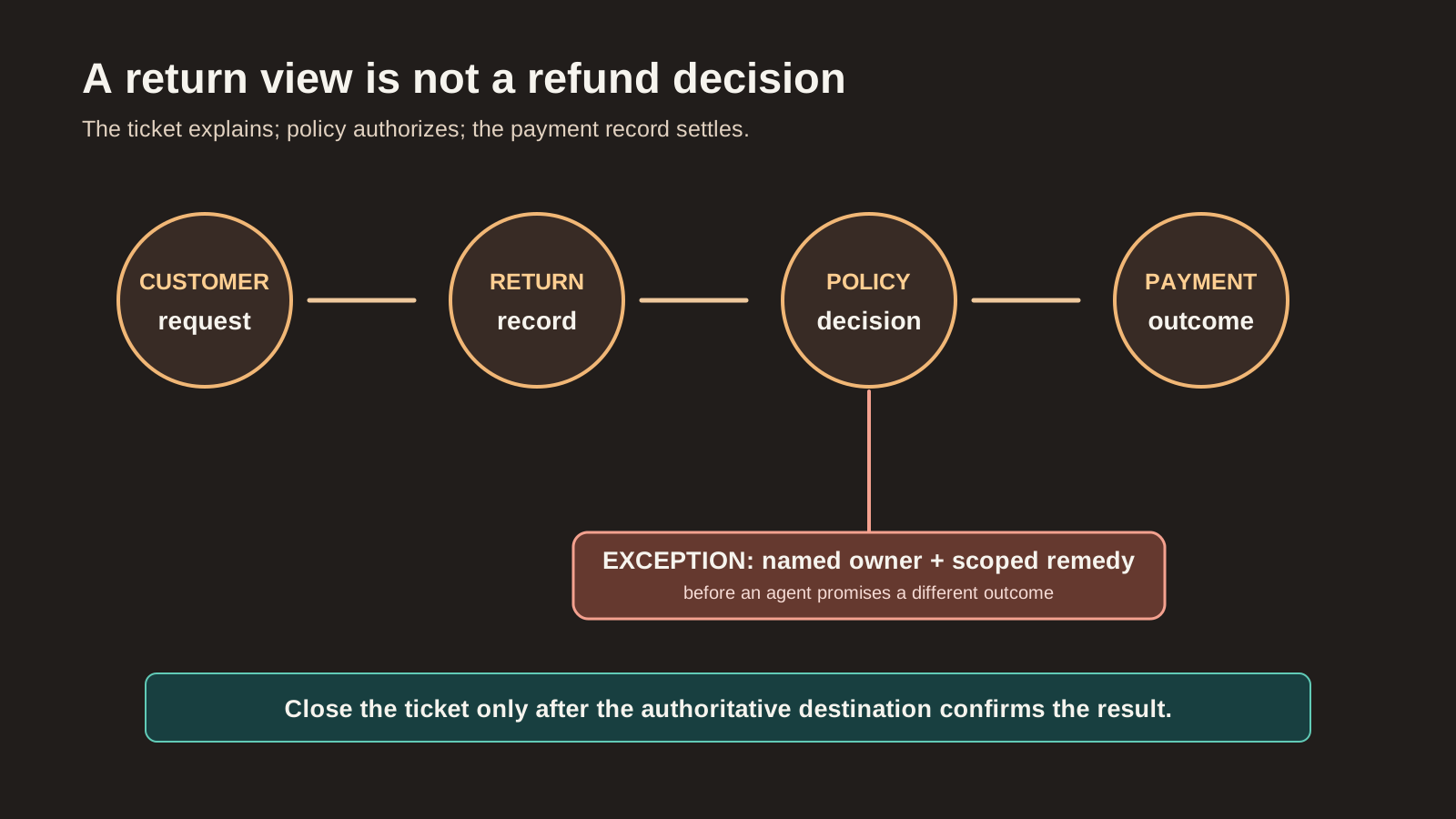
A return request commonly spans at least four states. There is the customer's reported problem, the merchant's order and return record, the policy or exception decision, and the money movement or replacement outcome. The support ticket is where the conversation occurs; it is rarely the ledger of every state. The return app may show a status, but RevOps should ask what source produced it, when it was refreshed and whether it represents a request, an accepted return, a refund instruction or a settled refund. Those are different promises to make to a customer.
The view should therefore display provenance, not just a reassuring badge. An agent needs an order ID, return case ID, customer match, relevant item, timestamp, source system and exception reason. If one customer has several orders, a partial return or a split shipment, the interface must not imply that a single status covers all items. The official Zendesk listing describes an integration surface and data access, but it cannot establish the merchant's own policy, matching logic or final financial state. Each implementation has to verify those locally.
A responsible reply says what is known at the current stage. If the return has been requested, say it has been requested. If it has been approved, identify what approval means and what still has to happen. If payment processing has been initiated, do not silently convert that into a claim that funds have arrived. Avoid training agents to paste an automated sentence that overspecifies the state. This is not a request for slower service; it is a request for fewer corrections and less avoidable customer confusion.
The exception queue is where design quality becomes visible. Consider a customer who used a different email at checkout, a gift recipient, two matching orders, a returned item that fails inspection, or a refund issued to a replaced card. A sidebar can display useful facts for all these cases, but it should not force a match or infer the commercial outcome. Give the agent a way to mark the association as uncertain, request evidence and route the case to an owner who can decide. A fast answer built on the wrong order is worse than a clearly explained investigation.
Security deserves the same attention as speed. The marketplace listing discloses the data categories and permissions requested by the integration. Before enabling it broadly, a team should compare those permissions to the agents' actual duties, retention policy and customer-data access rules. Does every support agent need every return field? Are there separate permissions for viewing return evidence and initiating a change? Can access be revoked when a worker changes role? The app's presence in a marketplace is a distribution fact, not a substitute for local access review.
The downstream accounting question is easily missed because the interface is conversational. If a goodwill exception or replacement is granted, which system records the decision and its cost? If the agent promises a refund outside the normal policy, who authorizes it and how is the authorization tied to the order and customer? If the return is cancelled, what happens to an already queued refund? A support transcript alone cannot reconcile a payment processor, a merchant ledger and a customer-visible notification.
The right operating contract can be compact. Let the sidebar bring source-linked return context into the ticket. Let the support agent verify the customer and the case, explain the current stage and collect missing information. Let a named policy owner approve exceptions, with amount and reason where relevant. Let the order or payment system execute and record the commercial state. Then let support read the final result before sending a closing promise. This preserves the speed benefit while giving each step an accountable owner.
Measure the result from the customer's perspective and the reconciliation record. Sample return tickets and count cases with a correct order match, an explicit stage, a source timestamp and a truthful final reply. Track repeated contacts caused by ambiguous status, corrections to the order match, policy escalations without a decision owner and refunds whose ledger state does not match the ticket. These are proposed local measures, not public Refundid or Zendesk performance claims. A baseline should be established from the merchant's own data before a target is set.
A team should also test what happens when the app is unavailable. A ticket must not become unanswerable simply because the sidebar did not load. The agent needs a documented path to the authoritative return record, a way to identify stale display data and a reason code for pausing the reply. Where a queued action exists, a retry needs an idempotency check. Otherwise, an interface outage can produce duplicate adjustments or conflicting messages when the system recovers.
My position is that support tools should make commercial truth easier to inspect while making it harder to overclaim. Zendesk's placement of Refundid return context may be valuable for exactly that reason. The implementation succeeds when the sidebar shortens evidence gathering and still makes unresolved stages unmistakable. It fails when a convenient view becomes an unofficial refund policy or when an agent's reply outruns the payment record. The distinction is an operating design choice that the merchant, not the integration, must own.
RevOps should treat this as part of revenue continuity, not a narrow support enhancement. Return handling changes customer trust, margin, retention conversations and the accuracy of commercial records. A clean ticket contains enough identifiers to follow the case into the authoritative order and settlement systems; a clean closing message describes the verified outcome. That is the standard by which a new sidebar should be judged. Related reading: Customer success · Revenue operations.
Source notes
These official sources support the workflow model and product concepts. They do not prove a specific retention outcome, benchmark, or vendor claim.
- Zendesk September integrations roundup: Official Zendesk roundup last updated September 30, 2026; describes the Refundid ticket sidebar.
- Refundid for Zendesk listing: Official Zendesk Marketplace listing describing the Refundid integration and its disclosed data access; confirm tenant configuration directly.
Last updated: 2026-10-02