A renewal queue can look reassuring for the wrong reason. Every account has an owner. The CRM shows recent activity. Several tasks are marked complete. Yet nobody can point to what the customer has agreed to do next. The problem is a mismatch between the evidence being collected and the decision the team thinks it supports. Activity is an event. A renewal plan is a set of commitments with timing, ownership and unresolved questions.
This distinction matters even when the underlying CRM is well configured. A platform can faithfully record a message that never received a reply. It can show a meeting that concerned a support problem rather than the contract. It can associate an internal task with the right company without establishing that a customer has accepted the proposed next step. Data accuracy and commercial sufficiency are different checks.
Define the decision before choosing the signal
Start with the exact question the queue must answer. For example: which accounts inside the agreed renewal window lack an accepted next step? That question is narrower than which accounts are unhealthy, and it is different from which contracts expire soon. The scope determines which facts matter. A support incident may affect the relationship without changing the contract date. A future meeting may cover renewal preparation without proving purchase intent.
Write down the unit of work. A company with one subscription may need one account-level follow-up. A company with several independent contracts may need several commercial decisions even if the team maintains one coordinated customer conversation. Decide how those cases appear before treating a single company-level date as sufficient. Preserve the underlying contract or subscription references so an operator can inspect what the queue represents.
Separate four levels of evidence
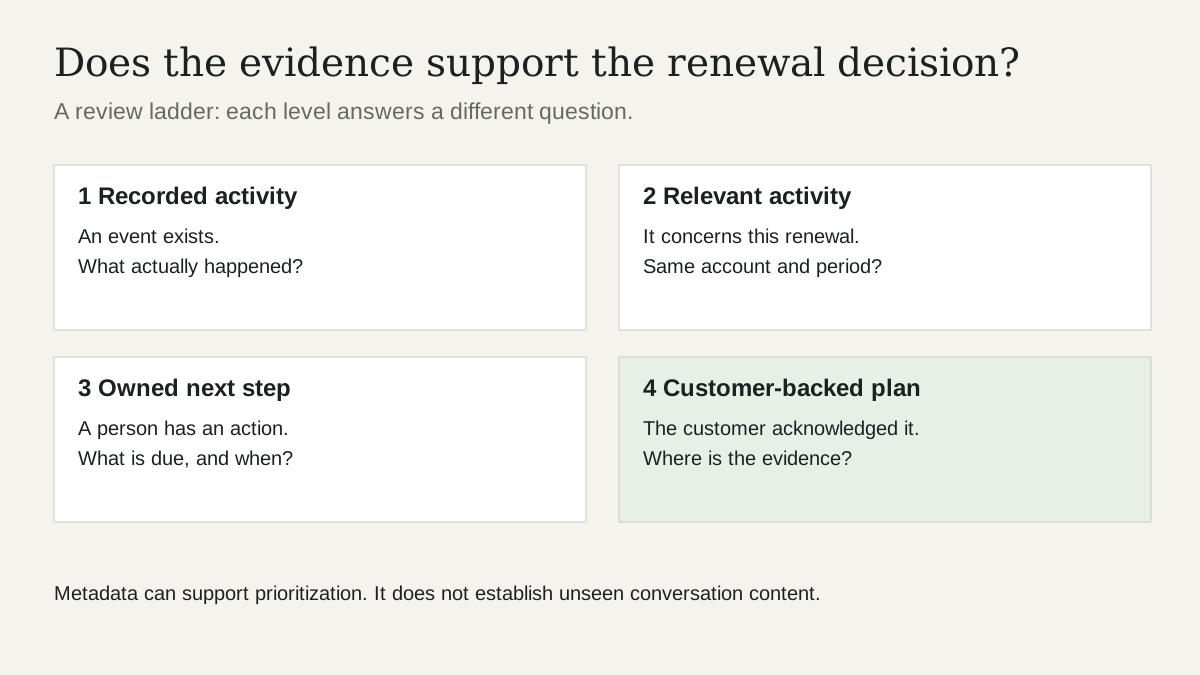
The first level is recorded activity: a call, email, task or meeting exists. The second is relevant activity: its purpose plausibly concerns the current renewal decision. The third is an owned next step: a named person has a specific action and due date. The fourth is customer-backed progress: the customer has acknowledged a next step or supplied the evidence required for the decision. These levels describe a proposed review method, not a universal scoring model.
An automated system may only have reliable access to the first level and parts of the third. That limitation should remain visible. Metadata can help prioritize a queue, but a timestamp cannot establish the substance of a conversation that the system never read. Do not silently relabel a metadata signal as customer confirmation. Give the reviewer a way to record the stronger evidence after checking the account.
Run the false-reassurance test
Choose one account that the current rules suppress because recent activity exists. Open the associated records and ask what action actually happened. Was it an outbound message, an inbound reply, an internal note, a completed task, a cancelled meeting or a meeting that is still scheduled? Does the evidence refer to the same customer entity and the same commercial period? What would justify keeping the account out of the queue tomorrow?
Now choose an account that remains flagged. The flag may be correct, but it may also miss an accepted plan recorded in another place. Document why the discrepancy occurred before changing the rule. Otherwise the team will patch a false positive by accepting weaker evidence everywhere, or patch a missed account by creating alerts for every ordinary activity gap. Both reactions can make the queue less useful.
Give the owner a small set of outcomes
A reviewer should be able to choose a concrete outcome: plan confirmed, outreach required, timing unresolved, wrong association, owner missing or commercial decision pending. Each outcome should have its own next action. Timing unresolved belongs with the person who can establish date authority. Owner missing belongs with the manager who can assign responsibility. Outreach required belongs with the customer-facing owner. Sending every exception to the same inbox hides these distinctions.
Require enough detail to support the decision without turning the queue into a second CRM. Record the evidence link, reviewer, next action and review date. If a plan is confirmed, say when it should be checked again. If the next step depends on a customer response, retain the condition that will reopen the item. A dismissed alert should not become a permanent blind spot because somebody clicked a button once.
Inspect the quiet accounts deliberately
Teams naturally inspect the loudest records: urgent support cases, escalations and large opportunities. A renewal review should also deliberately sample accounts that have no visible drama. Quiet can mean satisfied, disengaged, inactive, incorrectly associated or simply poorly logged. The queue should express uncertainty rather than choose the most comforting interpretation. Missing evidence is a reason to investigate, not a diagnosis that the customer will leave.
Use a small manual sample from both flagged and unflagged accounts. Record how often the automated classification disagrees with the reviewer and why. Keep those findings separate from revenue outcomes. A corrected association improves the queue. It does not demonstrate that revenue was saved. A confirmed plan improves visibility. It does not guarantee renewal. Clear measurement protects the team from claiming a commercial result that the evidence cannot support.
Keep HubSpot as the operating home
HubSpot's customer-success offering provides account context and tools for prioritizing post-sales work. That makes it a suitable place to retain the evidence and ownership behind renewal decisions. Native views and workflows may cover the requirement; a focused application may help when timing is dispersed or follow-up rules are hard to maintain. The selection should follow the observed operating gap rather than the appeal of another interface.
Whichever implementation is chosen, review where the signal comes from and what the resulting action can change. Avoid duplicate task writers. Preserve an exception for uncertain timing. Keep a clear owner for the underlying data rule and another for the customer action when those responsibilities differ. The standard is simple enough to ask in a revenue meeting: show the record, explain the gap and name the next step.
A useful queue earns the right to be trusted
The strongest evidence that a renewal queue works is mundane. Operators understand why an account appears. They can verify the source. They know what action is expected. The item stops demanding attention when the relevant work is genuinely covered, and returns when the conditions change. Trust grows from this repeatable behavior, not from a reassuring health label or a large total at the top of the page.
Source notes
These official sources support the workflow model and product concepts. They do not prove a specific retention outcome, benchmark, or vendor claim.
- HubSpot: Customer Success Management: Native product context for post-sales work.
- Renewal Radar product scope: Vendor description of timing and follow-up detection. The evaluation method here is DailyRevOps analysis.
Last updated: 2026-09-08