Problem
A single unsupported invoice or product type can block the records behind it. When the connector starts moving again, the latest success can hide a historical gap, duplicate recovery, wrong product-family mapping or changed recurring-revenue classification.
Why it matters
Maxio's October 7 release says Wallet Product invoices now sync into Maxio Core as recurring Usage-revenue Items in a new family and no longer stall everything queued behind them. That makes the recovery pattern concrete: resuming transport is necessary, but Finance Ops still has to prove completeness and classification before close.
Declare the incident boundary
Record the source and destination systems, affected site, suspected product type, first failed source event, last confirmed destination event and first confirmed post-recovery event. Keep source timestamps and processing timestamps separate.
Name an incident owner, billing owner, reporting owner and finance approver. State which close outputs could be affected and which actions are temporarily frozen.
Freeze the eligible population
Enumerate every source invoice, transaction, subscription and Wallet Product event in the interval. Do not build the denominator from successful destination records because that excludes the missing population by design.
Publish exclusions such as test records, deleted records or sites without Wallet Products. Preserve unknown identity instead of replacing it with zero or dropping the row.
Capture destination state before recovery
Query the destination for each stable source identifier and store the existing Item, transaction, product family, component kind, period and status. This snapshot is the duplicate-prevention baseline.
Do not use customer name, amount and date as the only key. Legitimate invoices can share those values, while retries can slightly change display fields.
Choose the supported recovery path
Confirm whether the corrected connector resumes automatically, needs vendor-supported reprocessing or requires a controlled import. Document the exact path, identity, expected mutation and stop condition.
Test one non-production or lowest-risk eligible record where possible. Verify that the destination is created or updated once, not merely that the job reports success.
Validate the new classification
For a representative set, compare source Wallet Product, destination recurring Usage-revenue Item, Wallet Products family, component kind, subscription relationship, usage period and currency. Store the exact observed fields.
Separate vendor application classification from internal management reporting and accounting policy. Finance owns the final policy decision; RevOps owns the traceable mapping and exception route.
Reconcile downstream consumers
Identify every report, export, warehouse model, CRM workflow and forecast that consumes the recovered records. Recompute only the bounded affected window and retain before-and-after results.
Check paid state, invoice state, revenue schedule and recurring metrics separately. A corrected Item can still be joined to the wrong account or included in the wrong observation window downstream.
Close with exceptions, not assumptions
Classify each eligible source record as verified, missing, duplicate, wrong classification, wrong identity or unresolved. Give every non-verified result an owner, due date, containment and next evidence.
The close approver should see the eligible count, verified count, unresolved population, metric impact and recovery evidence. Do not close because the connector dashboard is green.
Turn the incident into a durable control
Monitor the oldest unresolved eligible source record, not only the latest successful sync. Alert on missing and duplicate destinations, unexpected families and classification changes.
Review the invariant by product type and consequence. Retest it after connector, schema, mapping, billing-policy or product-family changes and keep the recovery runbook linked to the alert.
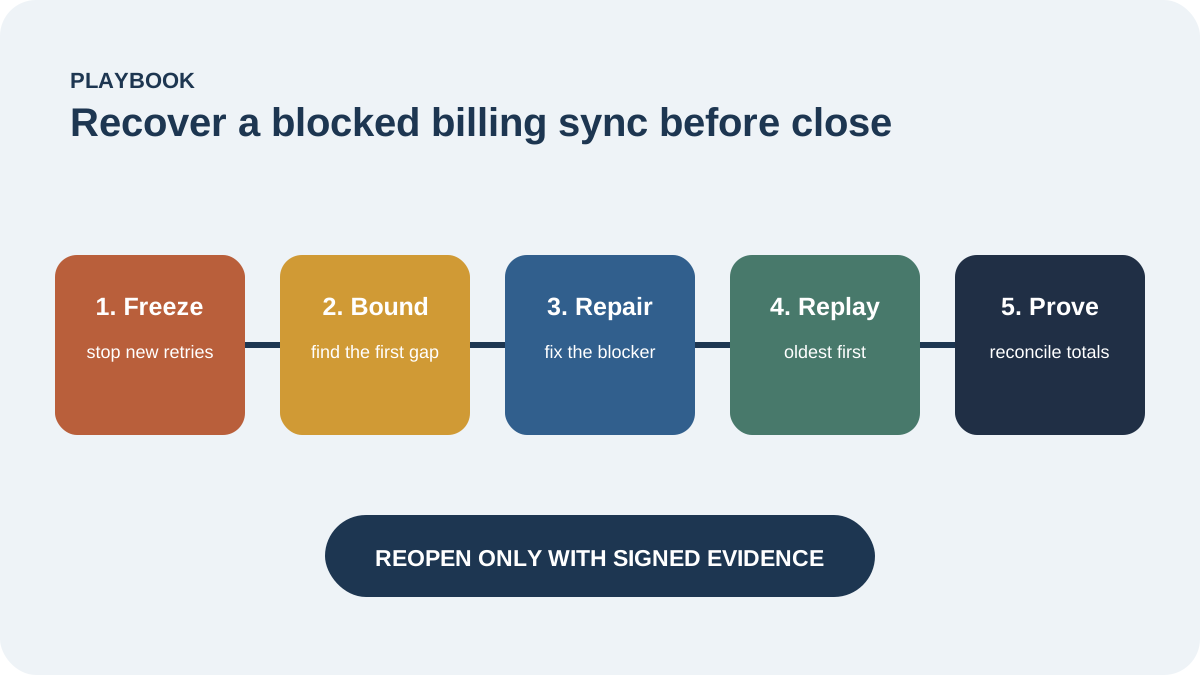
Step-by-step workflow
- Finance Ops declares the affected site, interval, outputs and incident owners.
- Data Operations enumerates the complete source population and published exclusions.
- The platform owner snapshots destination state by stable source identifier.
- The team confirms and tests the supported recovery path on one bounded case.
- Billing Operations reprocesses the frozen interval with duplicate-safe behavior.
- RevOps validates classification, customer identity and downstream joins.
- Finance approves the close packet or explicitly carries owned exceptions.
- The platform owner deploys a product-specific completeness invariant and recovery drill.
CRM fields and signals needed
- Earliest unresolved source event
- Complete eligible source population
- Stable source-to-destination identifier
- One expected destination per source record
- Verified product family and component kind
- Explicit recurring-metric treatment
- Owned unresolved exceptions
- Tested recovery route
Operating quality check
Use this check before adding more tooling. The goal is to prove that the workflow is owned, current, and inspectable inside the system of action.
| Area | Healthy pattern | Risk pattern |
|---|---|---|
| Scope | Frozen source interval and complete denominator | Latest-success window only |
| Identity | Stable invoice, transaction and subscription keys | Name, date and amount matching |
| Recovery | Supported path with query-before-write behavior | Blind retry or manual copy |
| Classification | Observed destination fields plus finance policy | Vendor label treated as final policy |
| Downstream | Bounded reports and joins reconciled | Connector success treated as reporting completeness |
| Close | Verified population and owned exceptions | Green dashboard without a close receipt |
Common mistakes
- Using the latest green sync as proof of history
- Building the denominator from destination records
- Retrying without a pre-recovery snapshot
- Deduplicating on amount and date
- Treating vendor classification as accounting policy
- Recomputing every historical period unnecessarily
- Hiding unresolved items from the close owner
Blocked billing-sync reconciliation
- Affected site
- First failed source event
- Last confirmed destination event
- Eligible record list
- Existing destination snapshot
- Recovery method
- Source and destination identifiers
- Product family and component kind
- Metric and period treatment
- Downstream reports
- Exception owner
- Finance approval
- Durable control
Example operating rhythm
- Per incident: freeze scope, snapshot, recover, reconcile and approve.
- Daily until close: review the oldest unresolved item and material exceptions.
- Weekly: inspect product-specific completeness, duplicates and classification drift.
- Monthly close: retain the eligible population, results and approved carryovers.
- After connector or mapping changes: rerun a representative recovery drill.
Tooling options
- Source billing export
- Destination reconciliation query
- Stable identifier registry
- Duplicate detector
- Product-family mapping contract
- Warehouse lineage map
- Exception queue
- Close approval packet
Source notes
These sources support the workflow model and product concepts. They do not prove a specific business outcome, benchmark result, or vendor claim.
- Maxio October 2026 product release: Official release page; the Wallet Product sync entry is dated October 7, 2026.
- Maxio official site: Official product context; verify current account configuration and commercial terms directly.
- NIST data integrity guidance: General integrity definition used as control context, not evidence about Maxio.
Last updated: 2026-10-12
Decision frameworks to read next
FAQ
Is the incident closed when the next sync succeeds?
No. Reconcile every eligible source record in the blocked interval and validate destination classification and downstream reports.
Should all records be reprocessed?
Only through the supported path and after querying destination state. Mixed partial state makes blind batch retry unsafe.
Does recurring Usage revenue automatically determine accounting treatment?
No. Treat it as vendor application classification; Finance owns accounting policy and final close treatment.
Which metric should alert first?
The age of the oldest unresolved eligible source record. Latest success can hide an old gap.
What belongs in the close packet?
Scope, eligible population, verified results, classifications, downstream impact, unresolved exceptions, owners and recovery evidence.