Three September product changes illuminate different parts of a lifecycle-automation run. Attio now shows workflow history step by step and adds an agent log for tool calls, changed records and credits. Customer.io's stable iOS SDK 4.9.0 supports polygon geofences so entry and exit events can follow a drawn venue shape. Braze announced journey building through Operator alongside available threshold alerts and a Messaging Observability Dashboard that explains why messages were sent, held or dropped. Each platform exposes useful evidence, but no single log proves the whole customer outcome.
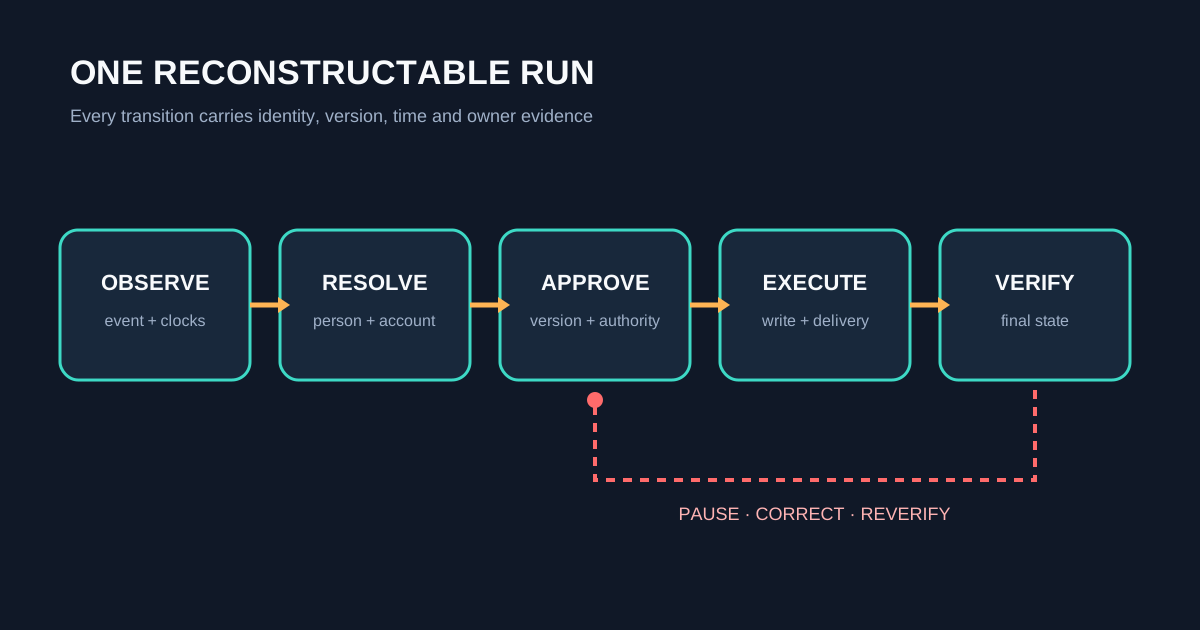
RevOps should define a run as more than an automation execution. A reconstructable run begins with the source observation, identifies the person or account, records the rule or model decision, shows every write and delivery attempt, and ends with the state the customer and operator actually experienced. That chain crosses systems. A clean workflow log can coexist with a wrong geofence event, and a delivered message can still be commercially inappropriate because the subscription or owner changed after eligibility was calculated.
Attio's update improves the execution layer. A step history that shows what changed and the result helps an operator answer where a workflow diverged. The agent log adds the tools an agent called, records it changed and credits it used. Those facts are stronger than a single success badge. They still need a stable run identifier, the version of the workflow, the initiating record and the business evidence that authorized the change. Otherwise a readable trace remains difficult to connect to a customer consequence.
Customer.io's polygon geofences improve the observation layer. A circle around an irregular campus, venue or service area can generate entry and exit events outside the intended physical boundary. A polygon can follow the relevant footprint more closely. Precision of shape, however, is not precision of meaning. Location permission, device state, cached definitions, coordinate quality, boundary jitter and the business definition of an eligible visit still affect whether an event should start a lifecycle action.
The geofence therefore needs its own versioned contract. Store the geofence ID, shape version, coordinate reference, deployment time, SDK version, device event ID, observed time and processing time. Keep entry and exit as separate events rather than overwriting one current state. When the boundary changes, preserve which version evaluated each event. A later operator should be able to explain whether a message followed the old or new venue geometry without recreating the map from memory.
Braze covers decision, orchestration and delivery. Its September 28 announcement says Operator can build end-to-end customer journeys in Canvas from plain-language instructions. The same announcement describes Content Optimizer as an available Canvas step that tests combinations and shifts volume, and lists Canvas Threshold Alerts and a Messaging Observability Dashboard as available. This combination shortens production work and increases the importance of a formal approval packet. Faster construction should not silently expand who can approve audience, timing, content or customer contact.
The control plane should separate proposal from authority. An operator or agent can propose an audience, branch, delay and message. A named business owner approves the purpose and material customer consequence. A platform administrator approves data use, channel and limits. The runtime executes only the approved version. Any later edit creates a new version and a new release record. This design lets teams gain speed from assisted construction without treating generated configuration as self-authorizing.
Threshold and delivery observability answer different questions. A volume threshold can reveal that fewer people are progressing through a journey than normal. A send, hold or drop explanation can show what the messaging system did with a particular communication. Neither automatically establishes why the customer entered the journey or whether a connected CRM, billing or consent record changed in the interval. Join platform evidence by stable run, profile, campaign and source-event identifiers rather than by email address or a copied timestamp alone.
A useful event envelope contains event ID, subject ID, account ID where relevant, event type, observed-at time, received-at time, source system, schema version, consent or eligibility reference and correlation ID. Every downstream decision adds its rule or model version, decision time and reason. Every action adds destination, attempted-at time, result and vendor execution ID. The final verification records current destination state and any customer-facing outcome. This is intentionally more specific than a general audit log because it supports operational reconstruction.
Cross-system clocks need special care. A location event can be observed on a device, queued offline, received later, evaluated against a campaign and delivered after another system changes customer state. Sorting only by ingestion time can create a false narrative. Preserve observed, received, evaluated, attempted and confirmed times. Define which clock controls eligibility. For an expiring offer, observed time may matter; for a current consent check, decision time should usually use the latest authoritative preference.
Reconstruction is also the foundation for recovery. If an incorrect polygon version created excess entries, the team can identify affected event IDs, pause the linked journey, suppress unprocessed actions and decide whether a correction is appropriate. If an Attio workflow changed the wrong records, the agent log can locate tool calls and writes, but recovery still needs the previous values and an owner who can approve reversal. If Braze held or dropped messages, the observability reason guides whether retrying is safe.
Measure the chain by evidence completeness rather than execution volume. Sample runs and ask whether the reviewer can locate the initiating observation, identity resolution, versioned decision, writes, delivery result, current business state and recovery owner. Track unlinked events, ambiguous identities, version gaps, destination mismatches, unexplained holds and corrections. These are local operating measures, not vendor benchmarks. Their value comes from repeated sampling with the same definitions.
The operational lesson is that observability cannot stop at a product boundary. Attio makes workflow and agent execution more visible. Customer.io can make location entry and exit more faithful to a drawn venue. Braze exposes journey construction and messaging diagnostics. RevOps should connect those surfaces into a single evidence model that follows the customer from trigger through action, names the authority at every transition and preserves enough state to contain a bad run without guesswork.
Related reading: Revenue Operations · Marketing Operations · Data Quality · Braze
Source notes
These official sources support the workflow model and product concepts. They do not prove a specific retention outcome, benchmark, or vendor claim.
- Attio: Workflow history and agent log: Official changelog dated September 23, 2026; describes step-level workflow history and agent logs covering tool calls, record changes and credits.
- Customer.io: iOS SDK 4.9.0 polygon geofences: Official stable iOS SDK changelog dated September 25, 2026; states that polygon geofences follow the drawn venue shape while existing circular geofences continue to work.
- Braze: Forge 2026 product announcements: Official product announcement published and last edited September 28, 2026; describes journey building, Content Optimizer, threshold alerts, messaging observability, data ingestion and account objects.
Last updated: 2026-09-30