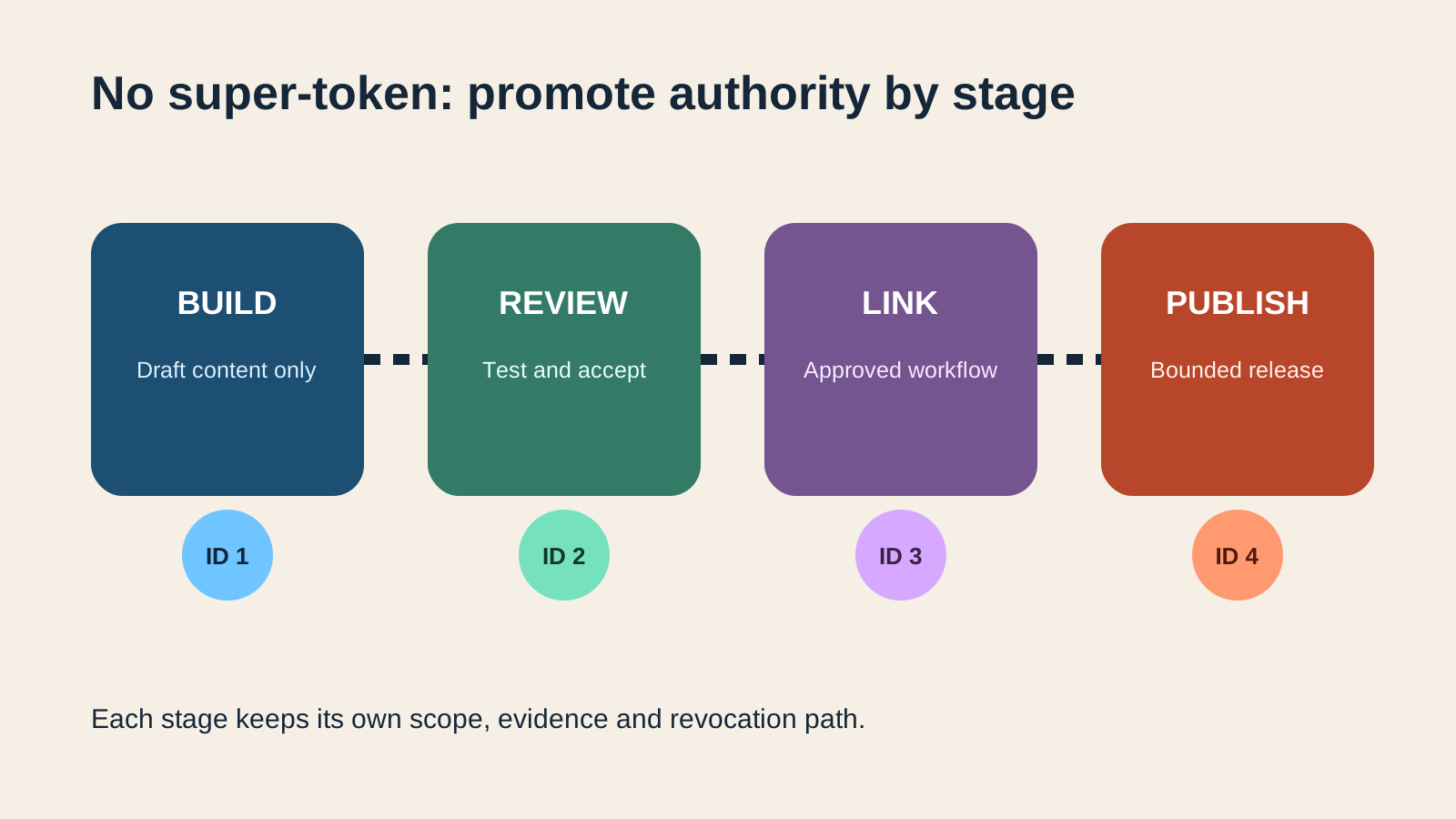
Customer.io's October 6 release is a useful expansion: its Design Studio API can manage email content from supplied HTML through review and testing, connect it to a workflow and publish later changes. The feature creates a credible path for teams that produce lifecycle content in a source-controlled system but execute customer journeys in Customer.io.
It also illustrates why lifecycle automation should reject the super-token pattern. A credential that can create content, attach it to live workflow logic and publish a customer-facing change combines authoring, release and execution authority. Even if the platform permits that arrangement, RevOps should prefer separately scoped identities and explicit promotion between stages.
Creation is not publication
Creating a content object is usually recoverable. The object can remain unpublished, be inspected and be deleted or superseded. Publication is different because a live or scheduled workflow may use the result. The customer impact can extend beyond the moment of the API call and beyond the person who approved the underlying HTML.
The credential model should reflect that difference. A build identity can create and update draft content in a designated workspace. A test identity can request approved render or delivery checks. A release identity can publish only an approved object to an approved workflow. The final action should require a release receipt and, for higher-risk journeys, a human approval or constrained deployment window.
Workflow attachment is its own privilege
Teams often treat attaching content to a workflow as configuration. In practice, it decides which audience, timing and branching logic can invoke the content. A perfectly reviewed email linked to the wrong step is an operational failure. The ability to change that association should not arrive automatically with HTML authoring access.
Maintain an allowlist of target workspaces and workflow IDs for automated releases. Require the change request to name the exact step, current content version and intended replacement. Read the association after writing it. If a title or display label is the only identifier in a release script, the process is too weak for safe retry and investigation.
Review cannot be a ceremonial endpoint
An API may expose review or test operations, but an organization supplies the acceptance criteria. Decide which results block release: invalid sender, missing legal language, failed link checks, absent personalization fallback, inconsistent consent, unexpected segment population, inaccessible content, unsupported locale or failed rendering in a critical client.
Keep the evidence. A green response without the inspected artifact, test target and time does not let a second operator reconstruct the decision. The review record should point to the source revision, rendered version, workflow context and exceptions accepted by named owners. Expire approvals when the content or surrounding workflow changes materially.
Consent must remain outside the convenience credential
Customer.io's October 1 consent-record release is a useful companion signal. The vendor says it can retain when a person opted in or out, what the choice applied to and where the change came from. That history should constrain delivery eligibility; a content-publishing credential should not be able to override or reinterpret it.
Treat consent, suppression and contact policy as protected authorities. The release process can test them but should not modify them as a side effect of publication. Where the workflow needs a lawful or contractual eligibility rule, encode it in a governed policy layer and include negative tests. A publish approval is not customer permission.
Separate credentials improve incident response
When one token performs every step, revoking it can stop build, test and recovery at once. Separate identities make containment more precise. A team can disable publication while preserving read access for investigation, or stop workflow attachment while allowing a corrected draft to be prepared. Logs also become easier to interpret because identity expresses intended function.
Rotation becomes safer as well. Test each replacement credential against designed allow and deny cases before promoting it. Record the previous token's last use and revoke it deliberately. Never place long-lived publication credentials in developer laptops, general chat systems or broadly readable continuous-integration logs.
A practical minimum role model
Use at least four roles when the platform and architecture allow it: content builder, reviewer or test runner, workflow linker and publisher. Add a read-only auditor for reconciliation. Smaller teams can combine roles at the human level while still using different service identities, explicit approvals and logs. The goal is not bureaucracy; it is limiting the blast radius of a mistaken or compromised action.
For every role, document permitted environments, object types, fields, actions, volume, hours, approval requirement and expiry. Test a safe denial. A permission model is unproven until the system refuses an action that should be refused and records enough evidence to explain why.
Automation should promote, not mutate in place
A reliable release path promotes a known artifact through stages. It does not repeatedly mutate an unnamed live object until it seems correct. Freeze the approved source revision, create or update the draft, run tests, verify workflow association, approve publication and read back the final state. If a later change is needed, start a new version and retain the prior recovery target.
Idempotency and reconciliation are part of permission design. Before retrying a create or publish operation, query the destination. A token with narrow authority can still duplicate work if the script assumes a timeout means nothing happened. Every consequential request needs a stable idempotency key or equivalent recovery method.
The objection: too many roles slow teams down
Poorly designed access can slow work, but one super-token only hides the cost until an incident. The answer is a small, documented promotion path with automatic checks and fast approval, not unrestricted authority. Most releases should become routine because evidence is generated consistently and the exceptions are visible.
Customer.io's API expansion deserves a positive reading: it gives teams more control over how lifecycle content is produced and released. RevOps should use that flexibility to make authority clearer. A fast programmatic path is strongest when creation, review, workflow attachment and publication remain distinct acts with distinct evidence.
Source notes
These official sources support the workflow model and product concepts. They do not prove a specific retention outcome, benchmark, or vendor claim.
- Customer.io release notes: Official October 6, 2026 release note for managing the Design Studio content lifecycle by API.
- Zendesk: What's new in October 2026: Official page edited October 7, 2026; it documents automated-resolution usage notifications and eligible allowance increases.
- Customer.io: consent records: Official October 1, 2026 release note for retaining consent changes, their scope and origin.
- NIST AI Risk Management Framework: Cross-sector framework used only as general risk-management context; it is not evidence about the vendors.
Last updated: 2026-10-11