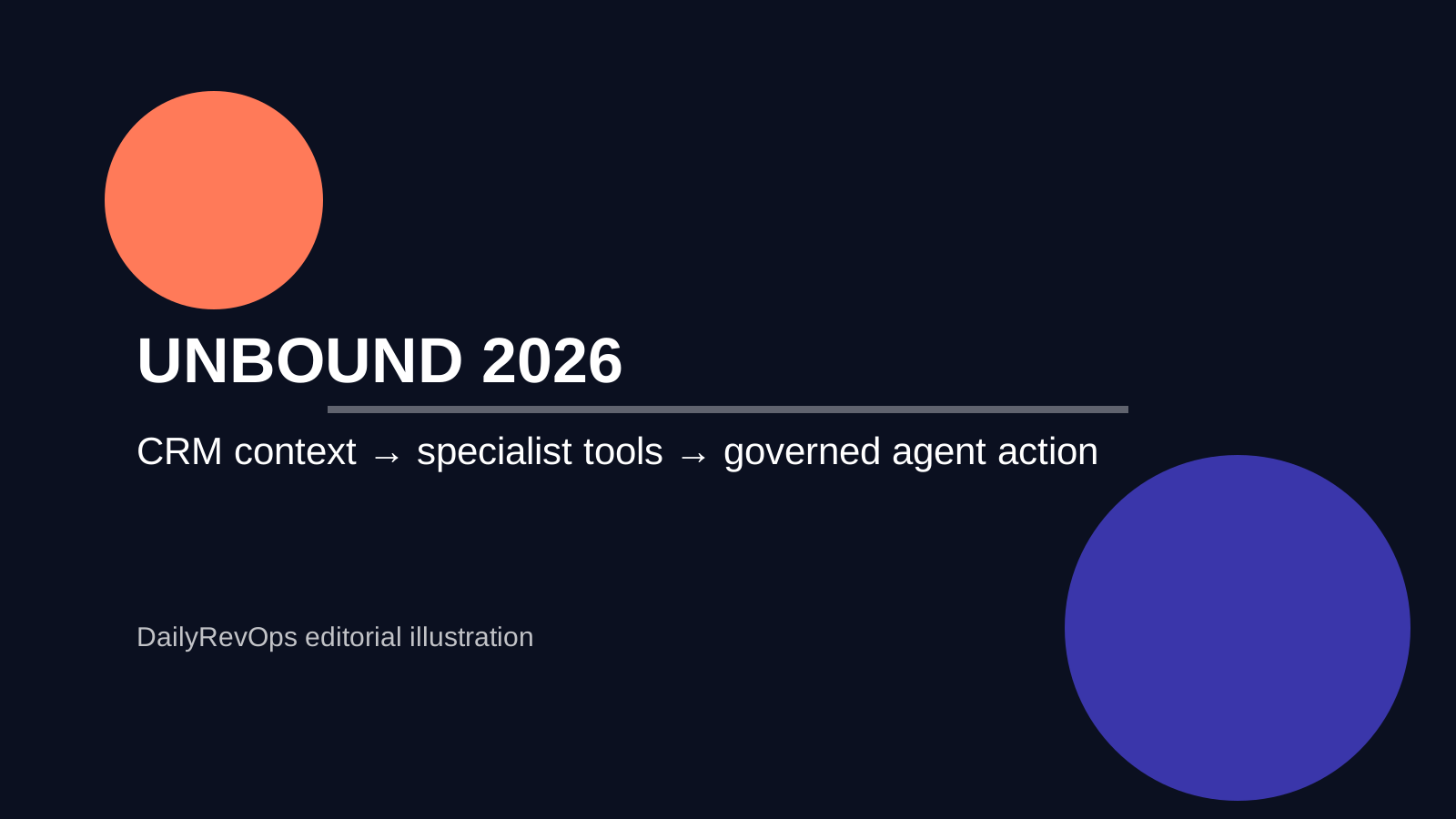
HubSpot’s first UNBOUND arrives with a product direction that is already larger than an event rename. Agent Hub, Agent Builder, Breeze Studio and Agent Tools are moving agents closer to the operating layer of the CRM. The practical shift for RevOps is not simply that HubSpot has more AI features. It is that software inside the HubSpot ecosystem can increasingly be consumed by agents instead of only by people clicking through an interface.
That distinction matters because the first generation of CRM AI mostly assisted a human. It drafted an email, summarized a record, researched an account or suggested a next step. An agentic model goes further: an agent can receive an objective, inspect CRM context, call specialized tools and execute bounded work. The human moves toward defining goals, authority and exceptions rather than performing every individual step.
For RevOps teams, this creates a new architecture question. Access to CRM data is not the same as a reliable business decision. An agent can read a company record and inspect activity, but it still needs rules for deciding whether the evidence is sufficient, which source is authoritative, whether another process already owns the work and whether an action is allowed. The more execution moves into agents, the more important that decision layer becomes.
Renewals make the problem concrete. A renewal agent might be able to read deals, contracts, activities and tasks. Before acting, however, it still needs to establish whether a renewal is actually approaching, which date is trustworthy, whether follow-up already exists and what evidence supports attention. Asking the model to reinterpret scattered CRM records from scratch on every run creates unnecessary variance. A reusable tool can instead resolve that business logic before the agent acts.
Sighub’s Renewal Radar is one example of this emerging pattern. Its HubSpot Agent Tools expose structured renewal decisions and supporting evidence to agents. The interesting part is not the individual product. It is the architecture: HubSpot supplies CRM context, a specialist tool supplies a bounded decision or capability, and the agent orchestrates the next step. That model can extend far beyond renewals.
A traditional RevOps stack is usually described as a collection of applications. An agentic RevOps stack may increasingly look like a collection of callable capabilities. One tool can resolve renewal timing. Another can retrieve conversation intelligence. Another can enrich a company, evaluate usage, check entitlement or validate an action. The agent coordinates those capabilities around an objective while policy and human controls define how far execution can go.
This changes what developers in the HubSpot ecosystem may optimize for. Historically, an integration often needed its own destination, dashboard and workflow. In an agentic CRM, the interface can become secondary to the quality of the capability exposed to an agent. Structured inputs, deterministic outputs, visible evidence, permission boundaries and predictable failure states become product features in their own right.
It also changes what RevOps should evaluate. Teams should ask whether an agent-facing tool has a clear contract: what question it answers, which systems it reads, how freshness is handled, what evidence comes back, which actions are permitted and what happens when the answer is uncertain. A natural-language interface should not erase those boundaries. If anything, agentic execution makes them more important because fewer manual clicks stand between interpretation and action.
UNBOUND is therefore worth watching less as a list of isolated AI announcements and more as a signal about HubSpot’s platform model. If Agent Hub becomes a place where agents discover and use specialist capabilities, the HubSpot ecosystem starts to resemble an execution environment rather than only a marketplace of apps for human operators.
That shift also changes release management. An agent can be affected by a prompt edit, a tool version, a permission change, a workflow update, a CRM schema change or a different source-system mapping. RevOps needs a release record that names the agent version, callable tools, effective identity, source fields, allowed actions and rollback path. Without that record, a team can observe that an agent behaved differently without being able to reconstruct which dependency changed.
The safest rollout pattern is deliberately narrow. Start with one agent job and one defined population of records. Verify identity and source freshness in read-only mode, then allow a reversible internal action, such as creating a tagged task. Change a source record between proposal and execution to prove material state is rechecked. Retry the same request to prove duplicate prevention. Only widen authority after those failure cases produce explicit, inspectable outcomes.
Human review also needs a clearer definition than simply keeping a person in the loop. A useful approval surface shows the target record, current state, proposed action, source evidence and consequence before a person approves. If an approver sees only a polished sentence from the model, the human is validating prose rather than the underlying decision. Agentic CRM makes review design part of the operating model, not an optional interface detail.
The question for RevOps teams coming out of UNBOUND is not only which new AI features to enable. It is which parts of the existing stack should become callable by agents, which decisions must remain deterministic, where humans need to retain authority and what evidence must survive after an agent acts. That operating model will matter more than the label attached to any single agent.
Source notes
These official sources support the workflow model and product concepts. They do not prove a specific retention outcome, benchmark, or vendor claim.
- HubSpot UNBOUND: Official HubSpot event site for UNBOUND 2026.
- HubSpot: INBOUND is now UNBOUND: HubSpot's explanation of the event transition and its AI-era positioning.
- Sighub: HubSpot Agent Tools: Third-party product example of a capability designed to be called by HubSpot agents.
Last updated: 2026-09-16