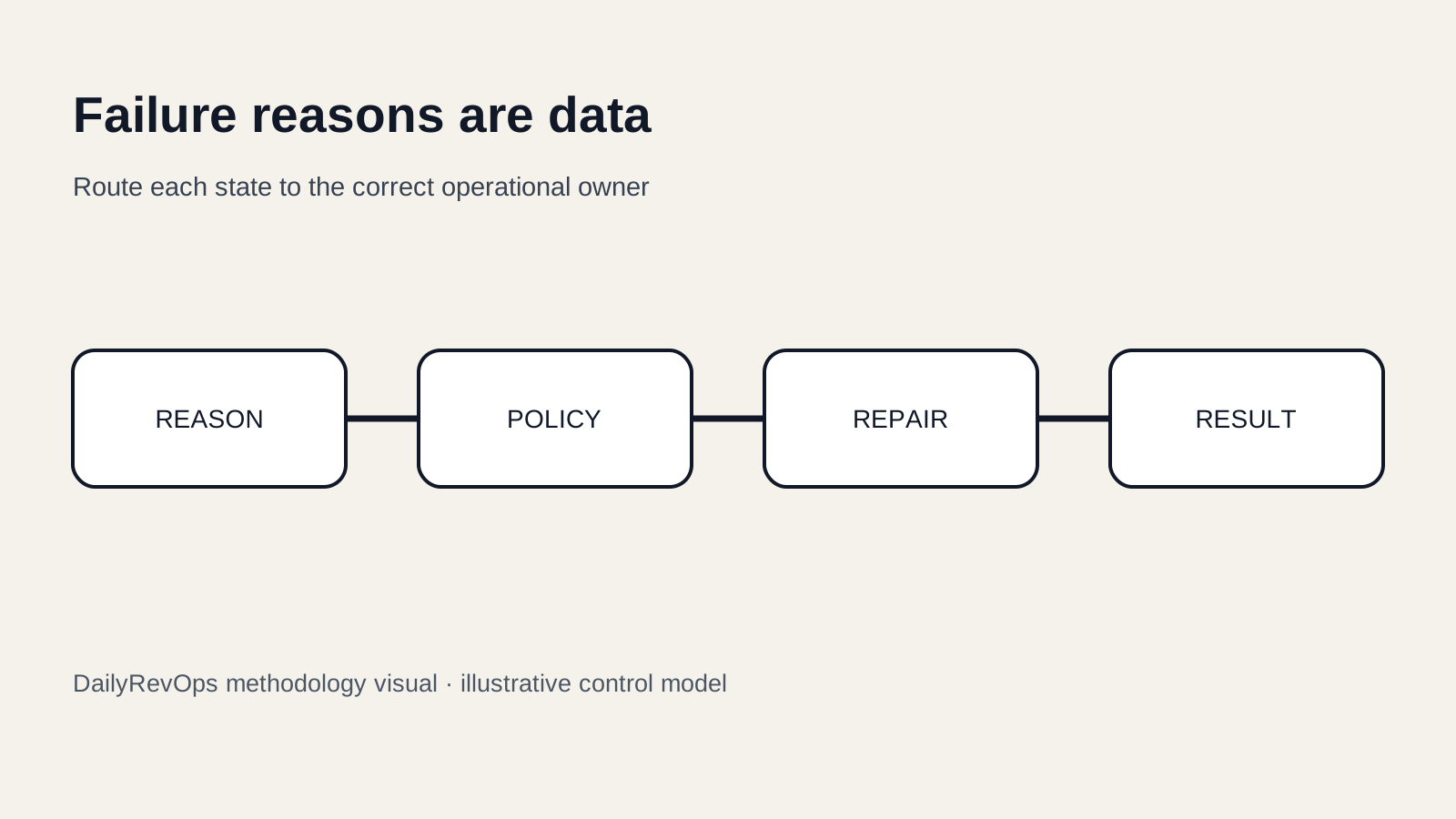
When a revenue system replaces 'call failed' with a specific reason, that is not a cosmetic improvement. It creates operational data. Intercom's September 21 update distinguishes invalid number, busy line, recipient decline, carrier block and region restriction for outbound calls. Outreach's September release similarly calls out clearer Sequential Dialing status messages. Those distinctions change what the next workflow should do and what RevOps can measure.
Generic failures force every downstream system to guess. A seller sees an unsuccessful call and decides manually whether to retry, fix data or abandon the attempt. Reporting groups different problems together. Automation either retries too aggressively or gives up too early. A reason code turns a dead end into a branchable state, but only if the organization preserves the meaning instead of collapsing it back into one failed bucket in CRM.
Reason codes need a contract
For each failure reason, document the source system, machine value, human label, expected permanence, retry eligibility, retry delay, maximum attempts, owner and destination field. 'Busy' is normally transient. 'Invalid number' is primarily a data-quality issue. 'Blocked by carrier' may require compliance, deliverability or routing investigation. 'Region not permitted' is an entitlement or policy state. Treating them as equivalents creates bad automation even when the UI looks clearer.
The contract also needs an unknown state. Providers change taxonomies, integrations drop detail and APIs can return values a downstream workflow has not seen before. Unknown should route to review or a safe default, not silently map to the closest familiar category. Reason normalization is useful only when the source value remains available for later reconciliation.
CRM should keep the evidence, not just the disposition
A CRM activity can store a business disposition such as no connection, but RevOps should preserve the provider reason separately when that reason drives automation or reporting. The business disposition supports a common operating view across channels. The raw provider reason supports debugging and rule changes when the taxonomy evolves. One field should not have to serve both purposes.
For phone data, keep the attempted number in normalized form, provider or product source, attempt time, user or automation identity, raw failure code, normalized category and final action taken. If the number is later corrected, preserve the old attempt rather than rewriting history. The team should be able to distinguish a data-quality repair from a successful retry on the same original number.
Retry policy should follow failure semantics
Automatic retry is useful for transient conditions and dangerous for permanent or policy failures. A busy line may justify another attempt inside configured calling windows. An invalid number should generally create a data-quality task before any retry. A recipient decline should respect the workflow's contact policy rather than immediately redialing. A carrier block or prohibited region may require a different number, channel or compliance decision instead of another identical attempt.
Put those rules in one place. If each sequence, workflow or rep decides independently, the organization cannot explain why two similar failures produced different treatment. Centralized failure policy also makes it possible to change behavior when provider guidance or regulatory constraints change without editing dozens of seller workflows.
Failure data belongs in capacity and quality reporting
Call-connect rates are easy to misread when failure mix changes. A team can appear to perform worse because it entered a market with more carrier restrictions, because a data source delivered lower-quality phone numbers or because a calling provider started exposing a failure category that was previously hidden. Reporting should separate human conversion performance from infrastructure and data-quality failure where possible.
That does not mean every dashboard needs twenty reason codes. Start with operational groups such as invalid destination, temporary unavailable, recipient action, provider or carrier restriction, regional or policy restriction, system error and unknown. Preserve the raw code underneath. The grouped view helps managers see patterns while the raw evidence lets RevOps investigate without guessing.
A specific failure can trigger upstream repair
Invalid-number failures should feed enrichment and data-quality work. Repeated carrier blocks should feed telephony configuration or provider review. Region restrictions should be compared with account segmentation and seller assignment. A generic failure rarely points upstream because it does not identify which system owns the fix. Better reason data lets the workflow route work to the team capable of correcting the root condition.
This is especially valuable when AI or automation is involved. An agent can summarize a call result fluently, but the workflow should not infer a retry strategy from free text when the platform already provides a deterministic reason. Use the code for policy and let the model add context where interpretation is actually needed.
Do not turn reason codes into fake causality
A reason label describes what the platform observed at a specific stage, not necessarily the ultimate real-world cause. A carrier-blocked status may not explain why the carrier blocked the call. An invalid-number result can arise from formatting or routing issues as well as genuinely bad data. Keep the distinction between observed failure class and investigated root cause.
This matters in analytics. Do not claim a data vendor caused lost meetings simply because more invalid-number failures appeared after a source change without controlling for routing, geography, formatting and provider behavior. Reason codes improve diagnosis; they do not eliminate the need for investigation.
The best workflow ends with a closed loop
A mature failure workflow does four things: captures a specific state, applies a bounded next action, records the result of that action and updates the policy when repeated cases reveal a better rule. If a phone number is repaired, the system should show whether the next attempt connected. If a region restriction is intentional, the record should stop re-entering the same calling path. If a retry budget is exhausted, another channel or human decision should take ownership.
Intercom and Outreach are making the first step easier by exposing more specific calling state. RevOps should finish the job by treating those states as governed data. The value is not that the seller sees a nicer message. The value is that the organization can make consistent, measurable decisions about what happens after failure.
Related reading: Revenue data quality · Revenue intelligence · GTM operations
Source notes
These official sources support the workflow model and product concepts. They do not prove a specific retention outcome, benchmark, or vendor claim.
- Intercom outbound call failure reasons: Official September 21, 2026 product update.
- Outreach September 2026 release notes: Official release notes including clearer Sequential Dialing status messages in the September rollout.
Last updated: 2026-09-22